

Most politically engaged readers already know that misinformation exists. What’s harder to accept is that your current reading habits might be making you more vulnerable to it, not less. When you read a single article and move on, you’re doing exactly what bad actors count on. Learning to cross reference news stories consistently is the single most powerful upgrade you can make to your political analysis toolkit. This guide gives you the exact method, the tools, and the judgment to do it well.
Table of Contents
- What you need to cross reference news stories effectively
- Step-by-step process to cross reference news stories
- Common pitfalls and how to avoid them when cross referencing news
- Expected outcomes and how to interpret cross-referenced news insights
- Why traditional news consumption habits undermine political understanding
- Enhance your news analysis skills with Whitebunnywabbit resources
- Frequently asked questions
Key Takeaways
| Point | Details |
|---|---|
| Adopt lateral reading | Verify news by checking multiple independent sources rather than trusting a single site. |
| Use the Rule of Three | Confirm facts with at least three credible and unrelated sources to ensure accuracy. |
| Beware professional fakery | Misinformation can masquerade as credible news through polished websites and About pages. |
| Cross-check images carefully | Use reverse image search plus provenance and metadata analysis to verify news images. |
| Continuous practice matters | Regularly applying these techniques strengthens political news understanding and resilience to misinformation. |
What you need to cross reference news stories effectively
Before you can compare news articles with any real accuracy, you need the right mindset and a basic set of tools. The mindset comes first. Approach every news story with a working hypothesis: this might be incomplete, biased, or wrong. That’s not cynicism. That’s the baseline posture of anyone doing serious news story analysis.
On the technical side, you need very little to get started:
- Multiple browser tabs open simultaneously (this is non-negotiable for lateral reading)
- A reliable search engine you can use to investigate sources, not just consume them
- Access to authoritative primary sources: government databases, court records, academic journals, official press releases
- Familiarity with at least one credible fact-checking platform
The most important skill you can develop is lateral reading. Instead of scrolling deeper into a single article, you leave it immediately and search for what other independent sources say about the same outlet or claim. The SIFT method is a proven framework for lateral reading that improves news verification skills. SIFT stands for Stop, Investigate the source, Find better coverage, and Trace claims. It’s the same method professional fact-checkers use, and it works because it treats the internet as a network of corroboration rather than a series of isolated pages.
Here’s a quick reference for the tools and their purposes:
| Tool | Primary use | Limitation |
|---|---|---|
| Search engine (lateral) | Investigate source reputation | Results can be gamed by SEO |
| Reverse image search | Trace image origin and circulation | Does not confirm authenticity alone |
| Fact-checking platforms | Cross-check specific claims | Coverage is not exhaustive |
| Primary source databases | Verify original documents | Requires knowing where to look |
| Lateral reading in media | Deepen source evaluation | Requires practice to do quickly |
Pro Tip: Bookmark three or four authoritative primary source portals right now. Congressional records, official government data releases, and verified court document repositories are the anchors of any serious news credibility check. When a claim traces back to one of these, your confidence level rises significantly.
Step-by-step process to cross reference news stories
Now that you know what you need, here is the concrete procedure. Follow these steps every time a story feels important or surprising.
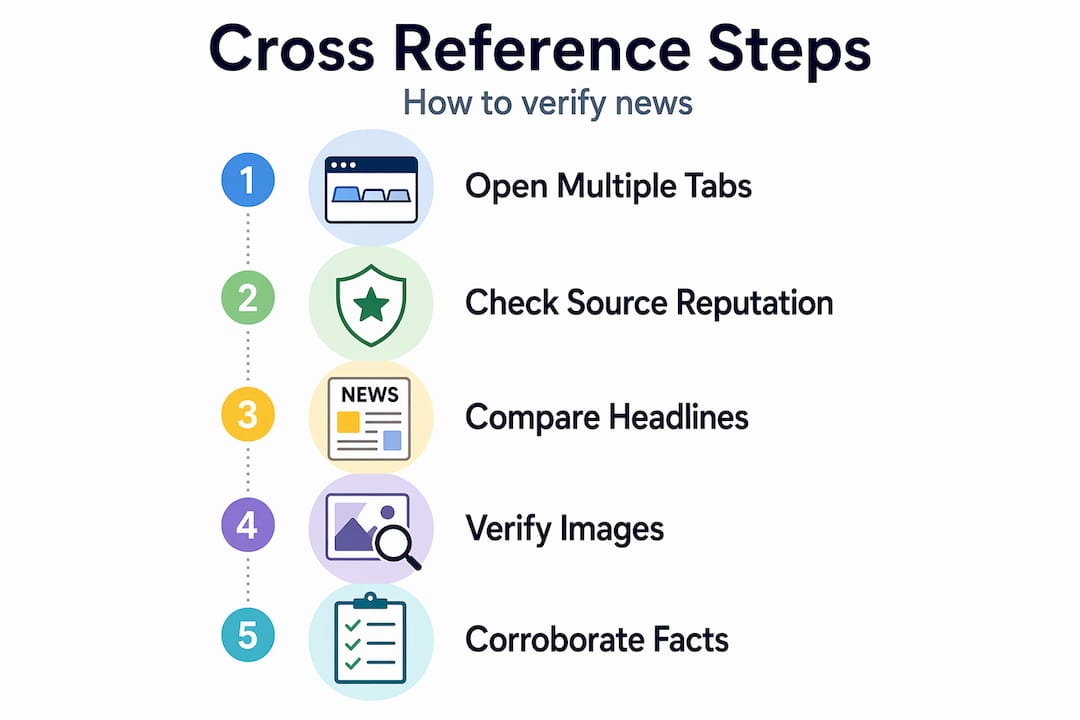
- Stop before you react. Emotionally charged headlines are designed to trigger a share or a strong reaction before you think. Pause. Open three to five new tabs before you do anything else.
- Investigate the source. Search the outlet’s name plus words like “bias,” “credibility,” or “ownership.” Search the author’s name independently. You’re looking for what others say about them, not what they say about themselves.
- Find better coverage. Search the core claim of the story. Look for independent reporting from outlets with different editorial perspectives. If only one outlet is covering a major claim, that absence is itself a signal.
- Trace claims to their origin. Follow every statistic, quote, or data point back to its primary source. A study, a court filing, an official statement. If the article doesn’t link to one, find it yourself or treat the claim with skepticism.
- Apply the Rule of Three. Finding three independent confirmations is a core verification principle before you trust any significant news claim. Three outlets that independently reported the same facts, without citing each other, is a strong signal of accuracy.
- Use reverse image search as a starting point, not a conclusion. It tells you where an image has appeared before. It does not tell you whether the image is authentic or accurately captioned.
Professional fact-checkers open multiple tabs within 60 seconds to quickly triangulate the credibility of news claims. Speed matters here. The goal is to build a fast reflex, not a slow research project.
Here’s how different types of sources compare when you’re analyzing media reports:
| Source type | Credibility signal | Red flag |
|---|---|---|
| Wire services (AP, Reuters) | Broad independent corroboration | Rare, but not immune to errors |
| Partisan outlets | Strong framing, sometimes accurate facts | Selective omission of context |
| Anonymous blogs | No institutional accountability | No external editorial oversight |
| Official government releases | Primary source status | Can be self-serving or incomplete |
| Academic/peer-reviewed | Rigorous methodology | Can be misrepresented in summaries |

Pro Tip: When you’re checking news verification practices, pay attention to which sources a story cites, not just how many. Five citations that all trace back to the same original blog post are not five independent sources. They’re one source with five aliases.
The habit of cross-referencing media reports this way shifts your analysis from passive consumption to active verification. It takes about five extra minutes per story. For political analysis, those five minutes are the difference between informed opinion and confident misinformation.
Common pitfalls and how to avoid them when cross referencing news
Understanding the steps is crucial, but recognizing and avoiding these common pitfalls will make your cross-referencing successful.
The most dangerous mistake is judging a source by how it looks. A polished website with a credible-sounding name, a detailed About page, and well-written prose is not evidence of accuracy. Sophisticated misinformation is designed to fool vertical reading by mimicking credible site features. This is exactly why lateral reading exists. You’re not evaluating the site. You’re evaluating what the rest of the internet says about the site.
Watch out for these specific traps:
- Circular citations: Site A cites Site B, which cites Site A. Neither is an independent confirmation.
- Isolated blog coverage: A claim that appears only on small, unverified blogs with no mainstream or primary source coverage is a major warning sign.
- AI-generated content: Synthetic articles can be grammatically flawless and factually hollow. Look for bylines, author history, and institutional affiliation.
- Outdated primary sources: A real study cited out of context or from a decade ago can be used to support claims it was never meant to support.
- Misleading image use: A photo that’s real but from a different event, country, or year can completely distort a story’s meaning.
“Reverse image searches are discovery tools rather than definitive proofs and must be supplemented by metadata checks.” — a principle emphasized by image provenance experts
When you run a reverse image search and find the image appeared in a 2019 article about a completely different event, that’s useful. But it doesn’t tell you whether the current article is using it honestly or accidentally. You still need to check the image’s metadata and trace its full provenance before drawing any conclusions.
Pro Tip: When handling authentic and user-generated news, always ask: who benefits if this story spreads? That question won’t tell you whether something is false, but it will tell you where to look for the motive behind any distortion.
Expected outcomes and how to interpret cross-referenced news insights
After mastering techniques and avoiding pitfalls, here is what effective cross-referencing can reveal for you.
When a story is well-sourced and accurate, cross-referencing confirms it quickly. Multiple independent outlets report the same core facts. Primary documents exist and are accessible. Authors are identifiable and have verifiable track records. The absence of coverage across independent outlets often signals fabricated stories. That’s one of the most useful signals in news accuracy assessment: silence from credible outlets is not neutrality. It’s a red flag.
Cross-referencing also reveals something that isolated reading never can: the shape of a narrative. When you compare how five different outlets cover the same event, you start to see which facts are universally reported, which are selectively emphasized, and which are absent from certain editorial perspectives. That pattern is where political analysis gets genuinely interesting.
Here’s what different cross-referencing outcomes typically mean:
| Outcome | What it signals | Recommended action |
|---|---|---|
| Strong corroboration across outlets | High likelihood of accuracy | Proceed with confidence |
| Partial corroboration with gaps | Possible framing differences | Dig into the gaps |
| Single-source claim, no corroboration | Possible fabrication or early reporting | Wait for confirmation |
| Contradictory coverage | Genuine dispute or active misinformation | Trace to primary sources |
| Circular citations only | Manufactured consensus | Treat as unverified |
The deeper benefit of this practice is cumulative. Over time, you build a mental map of which outlets reliably cover which topics, which ones have documented biases, and which primary sources to trust. That map is what separates a politically informed reader from someone who simply reads a lot of news.
Key outcomes you can expect from consistent cross-referencing:
- Faster detection of narratives that lack independent support
- Clearer understanding of where genuine disagreement exists versus manufactured controversy
- A stronger foundation for political arguments grounded in lateral reading and deeper news understanding
- Reduced susceptibility to emotional manipulation through one-sided framing
Why traditional news consumption habits undermine political understanding
Here’s the uncomfortable truth most media literacy guides won’t say directly: the way most people read news is not just inefficient. It’s actively exploited.
Vertical reading, which means scrolling through a single article and judging it on its own terms, made sense in the print era. A newspaper had editors, institutional reputation, and legal accountability. Those guardrails don’t apply to the modern web. Any actor with $50 and a WordPress account can publish a site that looks indistinguishable from a legitimate news outlet. Traditional vertical reading fails because misinformation leverages polished websites to trick readers. The investment required to fake credibility has dropped to nearly zero.
What’s changed is not just the volume of misinformation. It’s the sophistication. Modern disinformation campaigns study what credible news looks like and replicate it deliberately. They hire writers. They build citation networks. They create author profiles with fake credentials. Judging a source by its appearance is now essentially useless.
Lateral reading flips this dynamic. Instead of asking “does this site look credible?” you ask “what does the rest of the internet say about this site?” That question is much harder to fake at scale. You can’t manufacture a decade of independent editorial coverage from diverse outlets. The limitations of vertical reading become obvious the moment you try lateral reading on a story you already know is false. The contrast is stark.
For political analysts specifically, this matters beyond personal accuracy. The narratives you accept and repeat shape discourse. When analysts cite poorly verified sources, those sources gain legitimacy through association. Cross-referencing is not just a personal defense. It’s a civic responsibility. The readers and communities you influence deserve analysis grounded in verified, layered evidence rather than the most emotionally compelling headline you encountered that morning.
Enhance your news analysis skills with Whitebunnywabbit resources
If this guide has shifted how you think about reading political news, the next step is building these habits into your regular practice. Whitebunnywabbit offers a space designed specifically for politically engaged readers who want more than surface-level news consumption.
Explore news cross-referencing education to deepen your understanding of lateral reading and verification methods. Stay current with latest news verification practices through Whitebunnywabbit’s curated news section, where political stories are covered with the kind of sourcing awareness this guide describes. Whether you’re building a personal library of trusted sources or looking for a community of readers who take media literacy seriously, the Whitebunnywabbit homepage is a practical starting point for politically engaged analysis that goes beyond the headline.
Frequently asked questions
What is lateral reading and why is it important?
Lateral reading is the practice of verifying information by leaving the original source and searching for corroboration across multiple independent sites. Lateral reading produces more accurate evaluations by comparing multiple sources instead of relying on a single site, making it essential for detecting misinformation.
How can I verify if an image in a news story is authentic?
Use reverse image search to find the image’s circulation history, then verify its metadata and provenance. Reverse image searches are discovery tools rather than definitive proofs and must be supplemented by metadata checks before you draw any conclusions.
What does the Rule of Three mean in news verification?
The Rule of Three means finding at least three independent and credible sources confirming the same fact before trusting a news claim. Finding three independent credible confirmations is a core verification principle to guard against misinformation.
Why can’t I just trust the About page on a news website?
Because sophisticated misinformation sites create professional-looking About pages to appear credible, independent confirmation from multiple sources is necessary. Misinformation exploits polished About pages and plausible author profiles, making traditional vertical reading an unreliable credibility test.
How often should I cross reference news stories to stay accurately informed?
Cross-referencing should be a consistent habit, especially for important or surprising political news, to build a well-rounded and verified perspective over time. The more regularly you practice it, the faster and more instinctive the process becomes.
Leave a Reply