

The exact same set of facts can produce wildly different public opinions. That is not a glitch in human reasoning. It is the news framing effect at work, and it operates on everyone, regardless of education or political awareness. Framing is a cognitive bias where the way information is presented changes how people interpret and respond to it, even when the underlying facts are identical. Understanding how news framing works gives you a real advantage in decoding media influence on politics, public policy, and your own beliefs.
Table of Contents
- What is the news framing effect and how does it work?
- How news framing shapes public opinion on political and social issues
- Narrative framing: organizing news stories into compelling political messages
- Types and categories of framing effects in the news
- How to recognize and critically assess framing effects in media
- Why understanding news framing is essential for informed citizenship
- Explore education resources to master media framing and communication
- Frequently asked questions
Key Takeaways
| Point | Details |
|---|---|
| Framing changes perception | How information is presented can alter decisions and opinions even when facts are identical. |
| Framing shapes public opinion | Media framing affects political views by emphasizing certain aspects and eliciting emotions. |
| Narrative framing organizes meaning | News stories use frames to create coherent interpretations that guide how people feel and respond. |
| Recognize framing to think critically | Being aware of framing helps you evaluate news more independently and spot biases. |
| Framing is a cognitive necessity | Frames are fundamental to how our brains process reality, not just manipulative tricks. |
What is the news framing effect and how does it work?
The framing effect is a cognitive bias where the presentation of identical information leads people to different decisions or judgments. It is not about lying or distortion. It is about emphasis, language, and context, and it is baked into how the human brain processes information.
The most famous demonstration comes from psychologists Amos Tversky and Daniel Kahneman. In their 1981 Asian disease experiment, participants were told 600 people would die from an outbreak. One group was offered a program that would “save 200 lives.” Another group was offered one where “400 people would die.” Same outcome. Completely different responses. The “save 200” frame produced far more support because it emphasized gain. The “400 will die” frame triggered loss aversion, a core feature of what Kahneman later formalized as Prospect Theory.
Prospect Theory explains why losses feel roughly twice as painful as equivalent gains feel good. When news frames a policy as preventing harm, people respond differently than when the same policy is framed as accepting risk. This is not irrationality. It is a fundamental feature of how human cognition works.
“The framing effect reveals that people do not evaluate outcomes in absolute terms but relative to how they are presented, making context inseparable from meaning.”
Here is what makes framing so significant in news media:
- The same unemployment figure can be framed as “only 5% out of work” or “millions of Americans without jobs”
- A tax policy can be a “relief for working families” or a “giveaway to the wealthy”
- A military operation can be “precision strikes” or “civilian casualties”
- Crime statistics can signal “falling crime rates” or “persistent danger in communities”
None of these pairs are lies. All of them shape perception in measurably different directions.
How news framing shapes public opinion on political and social issues
The impact of news framing on political opinion is not subtle. It is large, measurable, and consistent across studies. Framing effects cause significant shifts in public support for policies based on nothing more than wording changes.

One of the most cited examples involves welfare policy. When Americans are asked whether they support “welfare,” support drops considerably. When asked whether they support “assistance to the poor,” support climbs. The policy being described is the same. The label does the political work.
| Framing used | Typical public support |
|---|---|
| “Welfare spending” | Lower support |
| “Assistance to the poor” | Higher support |
| “Estate tax” | Lower support |
| “Death tax” | Even lower support |
| “Climate change” | Moderate concern |
| “Global warming” | Higher urgency response |
Emotional framing adds another layer. Research published in Nature Human Behaviour found that emotional frames increase boycott intentions and drive greater political polarization in news audiences. When news stories use emotionally charged language, blame attribution, and vivid imagery, readers become more reactive and less analytical. That is not an accident.
Blame frames are particularly powerful. When news coverage assigns clear responsibility for a problem to a specific group, political party, or institution, it does not just inform. It activates. Readers feel stronger emotions, form harder opinions, and become more resistant to alternative interpretations.
Pro Tip: When you notice a news headline that triggers a strong emotional reaction, that is exactly the moment to slow down. Emotional intensity in framing is often a signal that nuance has been traded for engagement.
Media algorithms compound this problem. Platforms reward content that generates clicks, shares, and comments. Emotional frames perform better by those metrics than measured, thematic reporting. So the media ecosystem increasingly selects for the kind of framing most likely to provoke, not inform.
Narrative framing: organizing news stories into compelling political messages
Simple frames are powerful on their own. Narrative framing takes it further by organizing news into a full story structure with characters, causes, conflict, and resolution. This is how news framing theory explained in academic literature differs from everyday framing: narrative framing does not just label a fact, it builds a world around it.
A narrative frame answers four questions simultaneously:
- What is the problem? (Defines the issue and its severity)
- Who caused it? (Assigns agency and blame)
- What values are at stake? (Appeals to morality, fairness, or safety)
- What should be done? (Points toward a preferred solution)
When a news outlet covers immigration by centering the story on a single family’s journey, it activates empathy and humanizes a policy debate. When it covers the same issue by leading with crime statistics and border security costs, it activates fear and fiscal concern. Both are “true.” Both are narrative frames that guide the audience toward very different emotional and political responses.
“Narrative framing organizes political reality into a coherent story that shapes not just what people think about an issue, but how legitimate they consider different responses to be.” Source: The Role of Narrative Framing in Political Communication
This is why crisis communication is so contested. During a public health emergency, government officials and media outlets compete to establish the dominant narrative frame. Is this a failure of leadership? A natural disaster beyond anyone’s control? A community resilience story? Each frame produces different emotional responses and different demands on policymakers. Understanding narrative framing is not optional for anyone who wants to interpret political news with any independence.
Types and categories of framing effects in the news
News framing theory explained across decades of research identifies three primary categories of framing effects. Each operates differently and targets a different part of decision-making.
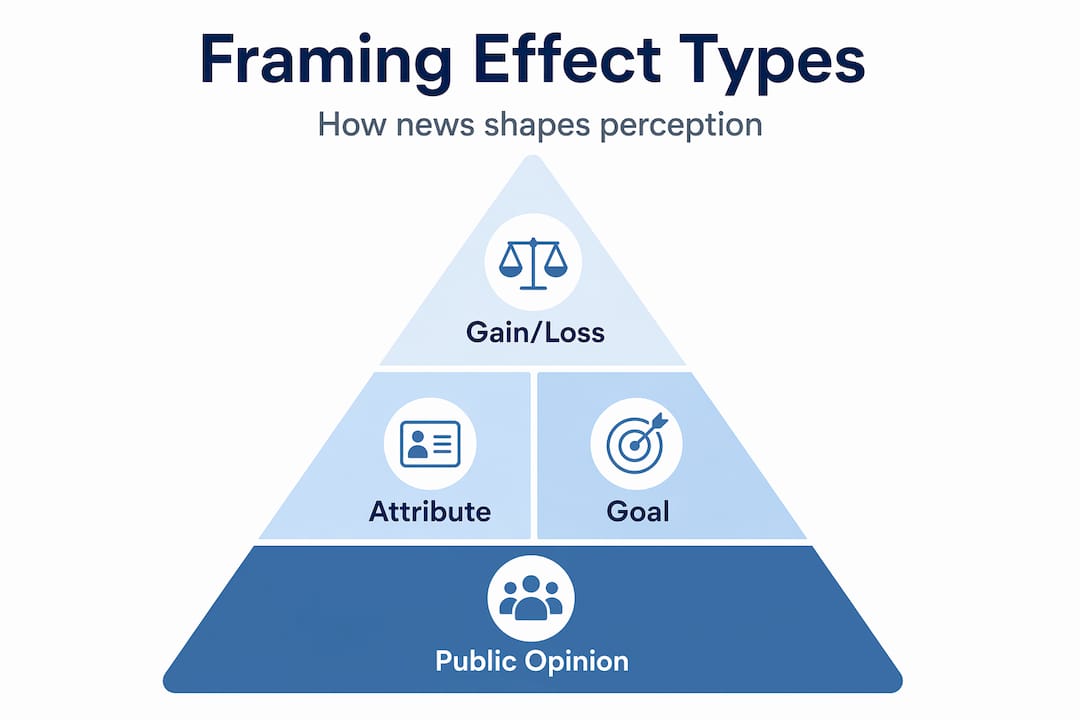
Gain/loss framing shapes risk choices, attribute framing affects how we evaluate objects or people, and goal framing influences whether we take action. Here is how each plays out in practice:
Gain/loss framing: A medical treatment described as having “a 90% survival rate” is received more favorably than one described as having “a 10% mortality rate.” Identical odds. Different emotional weight. Politicians use this constantly: “protecting jobs” versus “preventing layoffs” frames the same policy as proactive rather than defensive.
Attribute framing: Ground beef labeled “75% lean” is rated as higher quality than the same product labeled “25% fat.” In news, this shows up in how sources are labeled. A political activist becomes a “community organizer” or an “agitator” depending on the outlet. A foreign government becomes an “ally” or a “regime.”
Goal framing: This frame motivates behavior by emphasizing consequences. “Wearing sunscreen prevents skin cancer” and “not wearing sunscreen increases your cancer risk” are logically equivalent. The loss-focused version tends to be more motivating. In political news, goal framing appears in calls to action: “Vote or lose your voice” outperforms “Voting gives you a say.”
| Frame type | Mechanism | News example |
|---|---|---|
| Gain/loss | Emphasizes positive or negative outcomes | “Saves 200 lives” vs. “400 will die” |
| Attribute | Changes evaluation through labeling | “Regime” vs. “government” |
| Goal | Motivates action through consequence | “Protect democracy” vs. “prevent authoritarianism” |
Pro Tip: Before accepting a news story’s implicit recommendation, ask yourself: is this framed as a gain or a loss? Switching the frame mentally often reveals whether your reaction is to the facts or to the presentation.
How to recognize and critically assess framing effects in media
Recognizing framing in real time is a learnable skill. Media scholar Dietrich Scheufele identified five areas where framing impacts perception: what counts as important, who has agency, who is identified as a victim, how labels shape understanding, and how specific incidents get generalized into patterns.
Use these five areas as a checklist when reading news:
- Importance: What is being treated as the central issue, and what is buried in paragraph seven?
- Agency: Who is shown as having power to act, and who is portrayed as helpless?
- Victim identification: Whose suffering is made visible, and whose is absent?
- Labels: What words are being used to describe people, places, and policies? Who chose those words?
- Generalization: Is this story presented as a one-time incident or as evidence of a larger pattern?
Beyond Scheufele’s framework, ask these questions every time you read a politically charged story:
- What emotion does this headline trigger, and is that emotion earned by the facts?
- What alternative frame could explain the same events?
- Which sources are quoted, and which voices are missing?
- Is the story episodic (focused on a single event) or thematic (placing events in broader context)?
Seeking multiple sources is not just about fact-checking. It is about exposing yourself to competing frames so no single narrative monopolizes your interpretation. Reading coverage of the same event from outlets with different editorial orientations is one of the fastest ways to see framing in action.
Pro Tip: The most effective way to spot framing is to find a story you feel strongly about and read it in an outlet you distrust. Your discomfort with their framing will make your own preferred frame visible to you.
Why understanding news framing is essential for informed citizenship
Here is what most media literacy discussions get wrong: they treat framing as something done to passive audiences by manipulative media. That framing of framing is itself misleading.
Framing is not deception. It is a core cognitive process that shapes how all humans construct meaning. We cannot perceive reality without frames. Every sentence you read, every story you tell yourself about your own life, operates through a frame. The question is never whether you are being framed. It is whether you are aware of it.
Even experts are susceptible. Economists, scientists, and policy analysts show measurable framing effects in their judgments. Intelligence does not protect you from framing. Awareness does, partially, and only when actively applied.
The current media ecosystem makes this harder. Algorithms built to maximize engagement systematically favor emotional, conflict-driven, blame-heavy frames over measured, contextual reporting. The result is a public discourse where the most provocative version of every story gets the widest reach. That is not a neutral technological fact. It is a structural force reshaping what democratic deliberation looks like.
The consequence is civic polarization that is not primarily driven by people having different values. It is driven by people consuming different frames of the same reality until they can no longer recognize each other’s version of events as legitimate. That is a genuine threat to the kind of shared factual ground that democratic decision-making requires.
Media literacy education matters more now than at any point in the history of broadcast journalism. Not because people are dumber, but because the system is more sophisticated. Understanding how news framing works is not a niche academic interest. It is a basic requirement for participating in public life with any independence of thought.
Explore education resources to master media framing and communication
If this article has shifted how you think about the news you read every day, that is exactly the starting point. Whitebunnywabbit goes deeper on political communication, media effects, and the mechanics of public opinion through ongoing commentary and analysis built for readers who want more than headlines.
The media framing education resources available on the site connect the theory covered here to real current events, giving you a living case study in framing every time a major story breaks. Whether you are building your critical thinking practice or just trying to read political news without getting played, the Whitebunnywabbit homepage is a good place to keep returning to. Understanding framing is a skill that sharpens with practice, and consistent exposure to quality analysis is how that practice happens.
Frequently asked questions
What is the news framing effect in simple terms?
The news framing effect happens when the way information is presented in the media changes how people interpret or respond to it, even if the facts stay the same. As framing effect research consistently shows, presentation alters interpretation without altering the underlying information.
How does framing influence political opinions?
Framing can shift political opinions significantly by changing labels or the emotional tone of news stories, guiding people toward different conclusions without introducing new facts. Studies show wording changes alone produce large swings in public support for identical policies.
Can recognizing framing help me consume news more critically?
Yes, understanding framing helps you spot when information is presented with bias or selective emphasis, enabling you to think more independently about news stories. Applying Scheufele’s framing framework gives you a practical checklist for evaluating any news story.
Are framing effects a sign that people are irrational?
No, framing effects are a natural part of human cognition and not due to lack of intelligence. Our brains rely on frames to make sense of complex information, making framing a fundamental cognitive feature rather than a flaw.
Why do media outlets often use emotional framing?
Media and platforms use emotional framing because it attracts more attention and engagement. Research confirms that algorithms favor emotional frames for reach and virality, though this increases polarization and reduces nuanced public understanding.
Leave a Reply