

Most people assume they consume news and opinions with a fair degree of objectivity. The reality is far less comfortable. Common echo chamber behaviours are so deeply woven into daily media habits that most people never notice them operating. You follow accounts that think like you, platforms serve you more of the same, and over time your sense of what is “normal” quietly narrows. The consequences stretch from social media polarisation to genuine shifts in how you interpret facts. This article maps the specific behaviours to watch for and gives you practical tools to push back.
Table of Contents
- Key takeaways
- 1. Common echo chamber behaviours: selective exposure and homophily
- 2. Confirmation bias and groupthink: reinforcing agreement
- 3. Algorithmic feedback loops and filter bubbles
- 4. Social dynamics offline: belonging and peer pressure
- 5. Amplifying emotionally charged content
- 6. Information silos and narrow content loops
- 7. Social isolation from diverse opinions
- 8. How to recognise and counteract echo chamber behaviours
- My honest take on echo chambers
- Explore further with Whitebunnywabbit
- FAQ
Key takeaways
| Point | Details |
|---|---|
| Algorithms amplify your biases | Social media platforms actively serve content that matches your prior behaviour, deepening existing beliefs. |
| Peer pressure works offline too | Real-world social belonging reinforces echo chambers just as powerfully as any algorithm. |
| Confirmation bias distorts interpretation | You are not just choosing what to read. You are unconsciously reshaping what it means. |
| Behaviour patterns are identifiable | Knowing the specific signs of echo chamber exposure makes it far easier to catch yourself in one. |
| Small habits break the cycle | Deliberate, incremental changes to your media diet produce meaningful shifts in perspective over time. |
1. Common echo chamber behaviours: selective exposure and homophily
The most foundational of all common echo chamber behaviours is simply choosing to spend time with people and content that already agree with you. Psychologists call this homophily, the preference for associating with those who share your values, beliefs, and worldview. It feels natural because it is natural. But when it operates unchecked across your entire media diet, it becomes a problem.
Selective exposure means you are not just avoiding content you dislike. You are actively constructing an information environment that confirms what you already believe. Every article you click, every account you follow, and every group you join sends a signal to the platform about what to show you next. The result is a feed that increasingly reflects a single ideological colour.
The psychological driver here is the discomfort of cognitive dissonance. When information challenges a deeply held belief, the brain registers genuine stress. Seeking like-minded content is partly a stress-avoidance strategy. It feels good to be agreed with.
- You follow accounts that share your political or cultural views almost exclusively
- You share articles without reading past the headline if the headline confirms your position
- You feel irritated rather than curious when you encounter a contradictory perspective
- You interpret neutral information through the lens of your existing beliefs
Pro Tip: Audit your social media follows once a month. If every account you follow holds the same broad worldview, that is not balance. It is a curated echo chamber you built yourself.
2. Confirmation bias and groupthink: reinforcing agreement
Confirmation bias is not just about what you choose to read. It is about how you process what you read. You unconsciously weight evidence that supports your existing views as more credible, and dismiss contradictory evidence as flawed, biased, or irrelevant. This is one of the most well-documented confirmation bias examples in behavioural science.
Groupthink behaviours compound this further. Inside tightly knit online communities, whether subreddits, private Facebook groups, or encrypted messaging apps, ideological homogeneity becomes the norm. Dissenting voices are not just ignored. They are often ridiculed or removed. The community develops a shared sense of certainty that feels like truth simply because everyone around you agrees.
“People overestimate the extremity and animosity of opposing views, which makes conversations far more acrimonious than they need to be.” Harvard Gazette, 2026
This distortion matters because it makes genuine dialogue feel impossible before it even starts. If you believe the other side is extreme and hostile, you will never test that assumption by actually talking to them. The echo chamber sustains itself through imagined conflict as much as real disagreement.
- Comment sections fill with agreement and pile-ons rather than genuine debate
- Moderators in private groups remove posts that challenge the consensus
- Members who express doubt are labelled traitors or plants
- The group develops its own vocabulary that outsiders find alienating
3. Algorithmic feedback loops and filter bubbles
Technology does not create echo chambers on its own, but it accelerates them with extraordinary efficiency. Every major platform uses recommendation algorithms designed to maximise engagement. Engagement, it turns out, is highest when content matches your existing preferences. The result is a filter bubble: a personalised information environment so tailored to your prior behaviour that genuinely alternative perspectives rarely appear.

The data on this is striking. During the 2024 US election cycle, TikTok accounts aligned with Republican content received 11.5% more partisan recommendations than other users, across a 27-week audit of 323 controlled accounts. The platform was not neutral. It was amplifying ideological alignment.
| Factor | With algorithmic filtering | Without algorithmic filtering |
|---|---|---|
| Content variety | Low. Feed reflects prior choices | Potentially higher, but chaotic |
| Partisan reinforcement | High. Algorithms amplify alignment | Lower, but user behaviour still drives selection |
| User engagement | Higher short-term | Often lower without familiar content |
| Polarisation risk | Elevated | Reduced but not eliminated |
Removing algorithms entirely is not the solution either. Research cautions that in mixed communities, algorithmic filtering can actually stabilise exposure by reducing the extreme disagreement that causes users to leave and realign entirely. The problem is not algorithms per se. It is algorithms optimised purely for engagement rather than for informational breadth.
Pro Tip: Deliberately search for topics using incognito mode or a secondary browser profile. Without your browsing history attached, you will see what the algorithm hides from your usual feed.
4. Social dynamics offline: belonging and peer pressure
Here is what most discussions of echo chambers miss entirely. The most powerful reinforcement of belief rigidity does not happen on your phone. It happens in person. Peer group dynamics, particularly among adolescents, are stronger drivers of echo chamber formation than online algorithms.
The need to belong is one of the most fundamental human motivations. When your social group holds a particular set of beliefs, expressing doubt about those beliefs carries a real social cost. You risk exclusion, mockery, or being labelled disloyal. So you conform. You repeat the group’s talking points not because you have independently verified them, but because doing so keeps you safe and included.
This dynamic plays out in schools, workplaces, and local communities just as readily as it does online. A workplace where everyone shares the same political outlook will subtly penalise dissent through tone, body language, and social exclusion, even without anyone making an explicit rule. The echo chamber becomes the culture.
| Setting | Echo chamber mechanism | Consequence |
|---|---|---|
| School peer groups | Social pressure to conform | Belief rigidity in adolescence |
| Workplace teams | Implicit cultural norms | Suppression of alternative views |
| Local communities | Shared identity and belonging | Resistance to outside perspectives |
| Family units | Emotional loyalty | Difficulty questioning inherited beliefs |
5. Amplifying emotionally charged content
One of the most recognisable common echo chamber behaviours is the tendency to share, like, and engage with content that produces a strong emotional reaction, particularly outrage, fear, or moral indignation. This is not accidental. Emotionally charged content spreads faster and further than neutral, nuanced analysis.
Platforms know this. Outrage drives clicks, and clicks drive revenue. The consequence is that your feed gradually fills with the most extreme, emotionally provocative version of any story. Moderate voices get drowned out not because they are wrong, but because they generate less engagement. Over time, you begin to perceive the most extreme version of opposing views as representative, which feeds directly into the overestimation of hostility described by Harvard researchers.
Echo chambers can push harmful content including misogyny, conspiracy theories, and radical political views through a combination of algorithmic amplification and social pressure. The shift is gradual. Nobody wakes up one morning having been radicalised overnight. It happens through incremental exposure to content that is slightly more extreme than the last thing you saw.
6. Information silos and narrow content loops
Information silos form when your media consumption becomes so repetitive and narrow that you are essentially cycling through the same themes, sources, and framings on a loop. This is distinct from simply having preferences. A silo means you have lost access to the broader information environment without realising it.
The practical signs are specific. You find yourself hearing the same stories from multiple sources but never encountering a genuinely new angle. You assume that if something important had happened, you would have heard about it through your usual channels. You feel surprised or sceptical when someone from outside your information environment references events or perspectives you have never encountered.
Filter bubble dynamics make this worse because the silo feels complete. Your feed looks full. There is always something new to read. The absence of diverse perspectives is invisible precisely because the algorithm fills the gap with more of what you already know.
7. Social isolation from diverse opinions
A subtler but significant echo chamber behaviour is the gradual social distancing from people who hold different views. This is not always conscious. You simply spend less time with people who challenge you, and more time with those who affirm you. Over months and years, your social network contracts around a narrower band of perspectives.
Individuals with depression are particularly vulnerable to this pattern, as they are more susceptible to becoming trapped in loops of negative, emotionally reinforcing content that deepens both their isolation and their belief rigidity. But the dynamic applies more broadly. Comfort and familiarity pull everyone toward homogeneous social environments if left unchecked.
The result is that you lose the informal exposure to alternative views that used to come naturally through diverse friendships, workplaces, and communities. Breaking out then requires deliberate effort rather than simply living your life.
8. How to recognise and counteract echo chamber behaviours
Recognising that you are in an echo chamber is genuinely difficult because the experience feels like clarity, not distortion. Here is what actually works.
The H.E.A.R. framework, developed through Harvard’s communication research, offers a structured approach: Hear the other person fully before responding, Empathise with their underlying concern, Acknowledge what is valid in their position, and Respond with your own view only after completing the first three steps. It sounds simple. Most people skip straight to the response.
- Actively seek out one credible source per week that holds a different political or cultural perspective to your usual diet
- Mute or unfollow accounts that consistently produce outrage without analysis
- Notice your emotional response when reading news. Strong certainty is often a signal to slow down, not speed up
- Ask yourself whether you could accurately summarise the opposing view before dismissing it
- Introducing randomness into your content feed, through deliberate searches or varied sources, demonstrably reduces belief rigidity over time
Pro Tip: Before sharing any article, ask yourself: “Would I share this if it said the same thing about my own side?” If the answer is no, that is confirmation bias in action.
My honest take on echo chambers
I have watched people I respect become progressively more certain and progressively less curious over the years I have spent following political media. That trajectory is the real cost of echo chambers. Not that people hold wrong views, but that they stop questioning their own.
What I have found is that the discomfort of engaging with opposing views is almost always less than anticipated. People overestimate how hostile the other side is, and that overestimation is itself an echo chamber product. The moment you actually read a thoughtful piece from a perspective you usually dismiss, the cartoon version of that viewpoint tends to collapse.
I do not think the answer is aggressive, confrontational media diet overhauls. Incremental changes stick. One different source. One conversation with someone who disagrees. One moment of genuine curiosity instead of reflexive certainty. Those small shifts accumulate. What I have learned is that complexity is not a threat to good thinking. It is the evidence of it. The political content you consume shapes your sense of reality more than most people are willing to admit, and that is worth sitting with.
— John
Explore further with Whitebunnywabbit
If this article has prompted you to think more carefully about your media habits, Whitebunnywabbit has resources that go deeper.
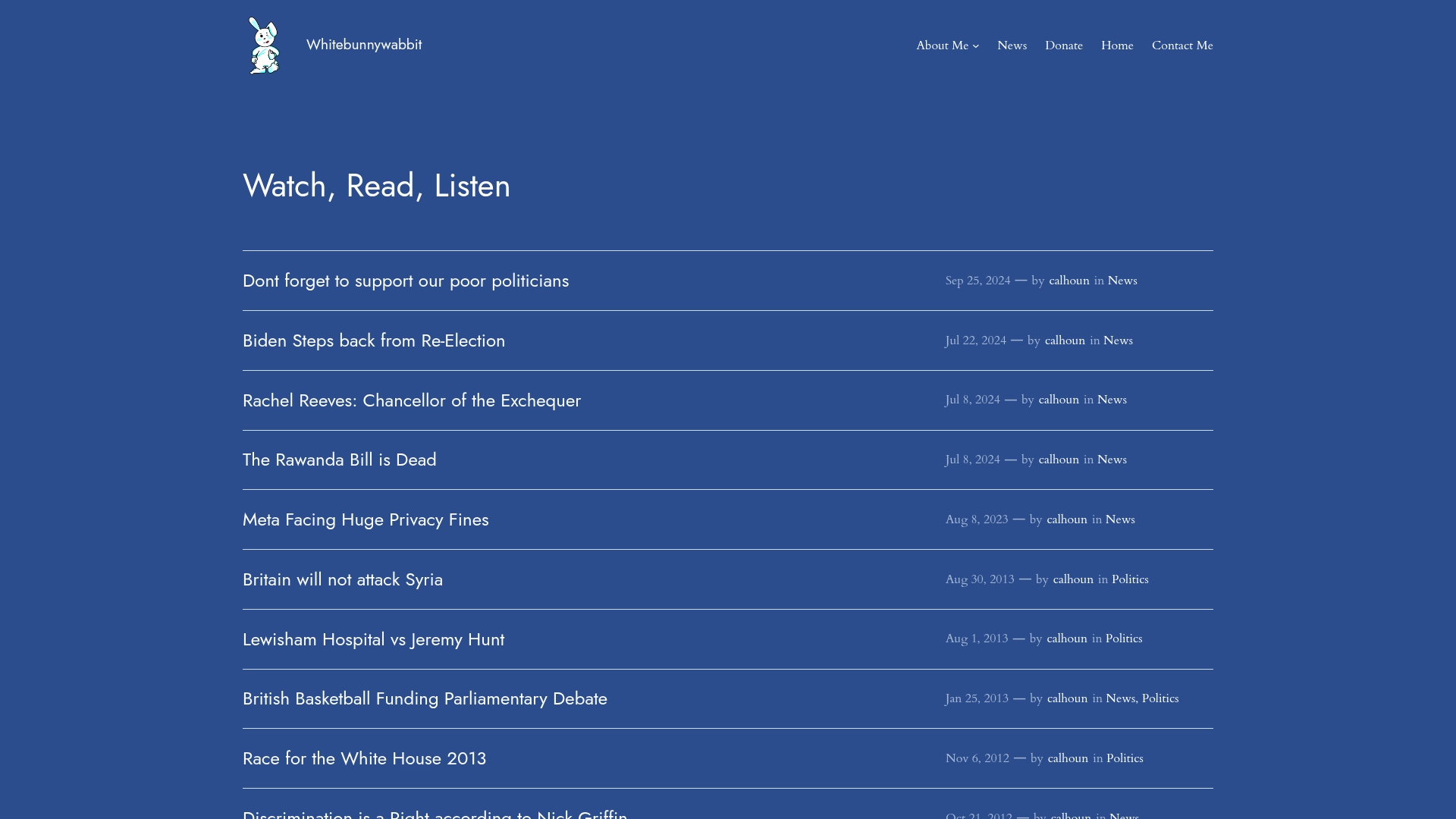
The education section at Whitebunnywabbit offers material specifically aimed at building media literacy and understanding how echo chamber effects shape political interpretation. Whether you are just beginning to question your information diet or looking to sharpen your critical thinking further, the resources there are worth your time. Awareness is the first step. Building the habit of seeking out diverse, well-sourced perspectives is where the real change happens.
FAQ
What are the most common echo chamber behaviours?
The most common include selective exposure to like-minded content, sharing emotionally charged material without scrutiny, dismissing opposing views without engaging them, and gradually reducing social contact with people who hold different perspectives.
How do algorithms contribute to echo chamber effects?
Recommendation algorithms prioritise content that matches your prior behaviour, creating filter bubbles that limit exposure to alternative viewpoints. TikTok’s 2024 election audit found partisan accounts received 11.5% more ideologically aligned content than other users.
Can echo chambers form offline as well as online?
Yes. Peer group dynamics in schools, workplaces, and communities reinforce beliefs through social pressure and the need for belonging, often more powerfully than online algorithms.
How can I break out of an echo chamber?
Seek one credible opposing source weekly, use the H.E.A.R. framework in conversations, and introduce deliberate randomness into your media consumption. Controlled research shows that randomised content exposure measurably reduces belief rigidity.
Are echo chambers harmful to mental health?
They can be. Studies show that individuals with depression are particularly vulnerable to negative content loops online, which can deepen both emotional distress and ideological isolation.
Leave a Reply