

Political satire is often dismissed as entertainment for the already-converted. That framing misses the point entirely. Why satire matters politically goes far beyond the laugh track. It is a mechanism for accountability, a tool for civic engagement, and in some corners of the world, an act of genuine courage. When a comedian skewers a politician’s hypocrisy more effectively than a newspaper editorial, that is not a failure of journalism. It is proof that humour carries its own form of truth.
Table of Contents
- Key takeaways
- Why satire matters politically: a brief history
- How satire shapes public opinion
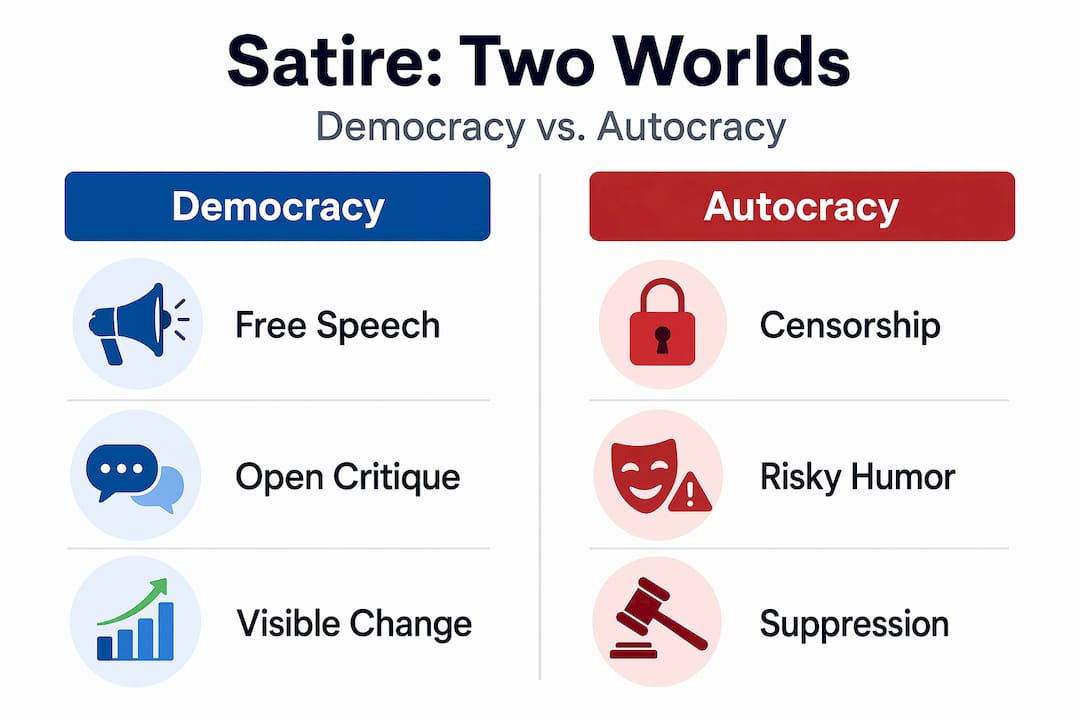
- Satire in democracies versus autocracies
- The real limitations of political satire
- Using satire as a political tool
- My take on satire’s staying power
- Explore more at Whitebunnywabbit
- FAQ
Key takeaways
| Point | Details |
|---|---|
| Satire drives civic engagement | Viewers of political satire are more likely to seek out traditional news and participate in civic life. |
| Satire functions differently by regime | In democracies it holds power to account; in autocracies it becomes underground resistance with serious personal risk. |
| Humour makes politics accessible | Satire frames complex political issues in relatable ways, lowering the barrier to political understanding. |
| Satire carries real limitations | It can deepen partisan divides and, in low media literacy contexts, be mistaken for factual reporting. |
| Scepticism beats cynicism | The best satire promotes critical thinking and demands accountability rather than simply breeding disillusionment. |
Why satire matters politically: a brief history
Political satire did not begin with late-night television. It stretches back to ancient Greece, where playwrights like Aristophanes used comedy to mock Athenian politicians and military leaders. In colonial America, Benjamin Franklin and others used satirical pamphlets to challenge British authority. The form has always served the same core purpose: speaking uncomfortable truths to people who hold power, using humour as both shield and weapon.
The modern era transformed satire’s reach dramatically. Television gave it a mass audience, and digital platforms gave it permanence and shareability. Programmes like The Daily Show and Have I Got News For You did not merely entertain. They built politically literate audiences who expected their news to be interrogated, not just reported.
Key shifts in satire’s evolution include:
- Ancient and early modern roots: Aristophanes, Jonathan Swift’s A Modest Proposal, and colonial-era pamphlets established satire as a legitimate form of political critique.
- Broadcast television: Shows like Spitting Image in Britain and Saturday Night Live in the United States brought political mockery into living rooms weekly.
- Digital and social media: Memes, satirical Twitter accounts, and short-form video have made satire instantaneous and globally distributed.
- Youth engagement: Satire acts as a gateway to civic engagement, particularly for younger audiences who might otherwise tune out traditional political coverage entirely.
Pro Tip: If you want to understand a political moment, look at what the satirists are targeting. They tend to identify the absurdities that straight reporting normalises.
Jon Stewart’s tenure on The Daily Show is the most studied example of satire’s contemporary influence. His approach was not simply mockery. Stewart blended humour, scepticism, and emotional transparency in a way that demanded accountability from politicians and media alike. He made audiences feel the weight of political failures, not just laugh at them.
How satire shapes public opinion
The impact of satire on politics operates through several distinct mechanisms. Understanding them helps explain why satire is not a trivial sideshow to serious political discourse.
-
Breaking down complexity. Political issues are often deliberately obscured by jargon, bureaucratic language, and sheer volume of information. Satire frames politics in relatable ways, stripping away the noise and making the core contradiction or failure visible. When a satirist replays a politician’s contradictory statements back to back, the argument is made without a single original word.
-
Exposing hypocrisy. Satire’s greatest political function is holding power to account by naming the gap between what politicians say and what they do. This is not the same as cynicism. It is a demand for consistency and honesty.
-
Encouraging participation. Research shows that satire reinvigorates democratic debate and helps overcome political apathy and information overload. Viewers who engage with political satire are more likely to vote, discuss politics, and seek out further information.
-
Making politics emotionally accessible. Anger at political failures is real, but it can be paralysing. Humour provides a release valve. It allows people to process frustration without shutting down, which is why satire’s role in democracy extends well beyond entertainment.
“Satire is often misunderstood as cynicism, but it actually promotes scepticism and demands truth and accountability.” — The Law Legal Pad
The distinction between scepticism and cynicism is worth holding onto. A cynic believes nothing can change and disengages. A sceptic questions, investigates, and stays in the fight. The best political satire produces sceptics, not cynics. That is precisely why the importance of political satire is so often underestimated by those who see it as mere mockery.
Satire in democracies versus autocracies
The freedom to satirise power is not universal. Where you live determines whether political satire is a protected art form or a criminal act. This contrast reveals something fundamental about satire’s role in democracy and its importance to political freedom more broadly.
| Aspect | Democracies | Autocracies |
|---|---|---|
| Legal protection | Generally protected under free speech | Frequently criminalised or censored |
| Public visibility | Broadcast, published, widely shared | Circulated underground or anonymously |
| Risk to satirist | Reputational criticism, occasional legal challenge | Imprisonment, exile, or physical harm |
| Political function | Accountability and public debate | Resistance and subversion |
| Audience reach | Mass audiences via mainstream media | Small, clandestine networks |
In democracies, satire is a critical voice that operates openly. It challenges governments, ridicules pomposity, and keeps citizens engaged. The protection afforded by free speech laws means satirists can push hard without fearing imprisonment. That freedom is not incidental. It is the condition that makes satire as a political tool most effective.

The picture is starkly different under authoritarian rule. In Russia, China, and North Korea, satirists face severe repercussions including imprisonment and exile. Yet satire persists. It moves underground, circulates through encrypted channels, and survives because the human impulse to mock power does not disappear simply because power forbids it. That persistence is itself a form of political resistance.
Pro Tip: When a government moves to silence satirists, pay attention. Suppressing political humour is almost always a signal that those in power fear scrutiny more than they fear opposition.
The contrast between these two contexts shows that satire is not a luxury of liberal democracies. It is a pressure valve in any society where power is concentrated and accountability is weak.
The real limitations of political satire
Acknowledging the benefits of satire in politics does not mean ignoring its genuine problems. Satire can do real damage when it operates without care, and those who value it most should be clearest about its risks.
- Partisan amplification. An analysis of nearly 8,000 jokes found that conservative political figures are mocked disproportionately on late-night television. This imbalance does not just reflect existing political divides. It can deepen them by giving audiences a steady diet of one-sided ridicule rather than genuine critique.
- Cynicism over scepticism. When satire focuses relentlessly on failure without ever acknowledging complexity or the possibility of change, it risks breeding the very disengagement it is supposed to combat. Audiences can come away feeling that all politicians are equally corrupt and that participation is pointless.
- Misinformation risk. In contexts where media literacy is low, satire can be mistaken for factual reporting. A satirical headline shared without context becomes misinformation within minutes on social media. This is not a hypothetical risk. It happens regularly.
- Institutional erosion. The American Psychological Association has found that satire’s focus on humiliation risks eroding democratic trust in institutions over time. When every politician is a punchline, the institution of democratic governance itself begins to look absurd.
These are not arguments against satire. They are arguments for satire that is thoughtful, targeted, and honest about its own limitations.
Using satire as a political tool
Understanding why satire matters politically is one thing. Knowing how to engage with it productively is another. Whether you are a citizen, a commentator, or simply someone trying to make sense of current events, satire can be a genuinely useful lens if you approach it with the right habits.
-
Use satire as an entry point, not an endpoint. When a satirical clip makes you laugh or makes you angry, treat that as a signal to go deeper. Find the original speech, the policy document, or the news report that the satire is responding to. Satire is best understood as a pointer, not a destination.
-
Distinguish the target from the institution. Good satire mocks individuals and specific decisions, not entire systems of governance. When you consume satire, ask whether it is critiquing a person’s behaviour or undermining the legitimacy of democratic processes altogether.
-
Notice what is not being satirised. The gaps in satirical coverage are as revealing as the coverage itself. If certain figures or parties are never subjected to the same scrutiny, that asymmetry tells you something about the satirist’s assumptions and your own.
-
Value emotional honesty. The satirists who have had the most lasting political impact, from Swift to Stewart, combined humour with genuine moral seriousness. They were angry about real things. That emotional transparency is what separates satire that changes minds from satire that merely confirms existing ones.
Pro Tip: The question to ask of any political satire is not “Is this funny?” but “Is this true?” If the humour lands because it captures something real, the satire is doing its job.
The benefits of satire in politics are most fully realised when audiences treat it as a catalyst for engagement rather than a substitute for it. Satire opens the door. Walking through it is still your responsibility.
My take on satire’s staying power
I have been watching political satire closely for years, and the thing that strikes me most is how consistently it gets underestimated by the people it targets. Politicians dismiss it as entertainment. Media critics treat it as a lesser form of journalism. Neither framing holds up.
What I have seen, again and again, is that satire does something straight reporting often cannot. It names the absurdity of a situation in a way that makes the absurdity undeniable. When a satirist plays a politician’s words back with a straight face and the audience laughs, that laughter is recognition. It is the sound of people realising they have been told something ridiculous.
The digital age has complicated this. Satire spreads faster than ever, but it also gets stripped of context faster than ever. A clip that was clearly satirical in its original setting becomes ambiguous when it is a ten-second video shared without attribution. That is a real problem, and I think satirists and their audiences both need to be more careful about it than they currently are.
But the core function of satire remains intact. In turbulent political times, it holds anger and hope together in the same sentence. That is not a small thing. It is, frankly, one of the more politically useful things anyone is doing right now.
— John
Explore more at Whitebunnywabbit
If this piece has sharpened your thinking about political satire and its role in public life, there is plenty more to explore. Whitebunnywabbit covers political commentary, current affairs analysis, and opinion pieces that take the same approach: direct, evidence-informed, and unwilling to treat serious questions as settled.

For readers who want to go further into the relationship between critical thinking and political engagement, the education resources on the site offer a grounding in how to read political media, including satire, with more precision and less noise. Political humour is worth taking seriously. Whitebunnywabbit does exactly that.
FAQ
What makes political satire different from regular comedy?
Political satire targets real figures, policies, and institutions with the specific intent of critique and accountability. Unlike general comedy, it carries a political argument beneath the humour.
Can satire change political views?
Research suggests satire can shift attitudes, particularly among younger audiences, by making political issues more emotionally accessible and prompting viewers to seek out further information.
Is political satire protected by law?
In most democracies, political satire is protected under free speech provisions. In authoritarian states, it is frequently criminalised, with satirists facing imprisonment or exile.
Does satire make political polarisation worse?
It can. An analysis of thousands of late-night jokes found that satirical coverage disproportionately targets one side of the political spectrum, which can reinforce existing divides rather than challenge them.
Why is satire important in authoritarian regimes?
In regimes where direct political opposition is suppressed, satire functions as underground resistance. It allows citizens to express dissent and critique power through channels that are harder to censor than open protest.
Leave a Reply