

You have almost certainly heard it happen in a political debate. Someone raises a serious criticism, and instead of addressing it, the other person fires back with “Well, what about when you did something similar?” That deflection has a name: whataboutism. Understanding whataboutism explained properly is not just a matter of learning a new word. It genuinely sharpens how you think, how you argue, and how you spot when someone is trying to avoid accountability rather than engage honestly.
Table of Contents
- Key takeaways
- What is whataboutism explained properly
- Valid comparisons vs fallacious whataboutism
- Why whataboutism poisons debates
- How to respond to whataboutism
- Whataboutism examples in real life
- My honest take on this
- Go deeper on critical thinking
- FAQ
Key takeaways
| Point | Details |
|---|---|
| Whataboutism is a deflection tactic | It redirects an accusation by pointing to a different wrongdoing rather than addressing the original point. |
| It is related to two known fallacies | Whataboutism connects to tu quoque and red herring fallacies, both designed to shift the conversation. |
| Not all comparisons are whataboutism | A comparison that answers the original question is valid; one that replaces it is fallacious. |
| It creates circular, unresolvable debates | Whataboutism traps discussions in endless accusation chains, making accountability nearly impossible. |
| You can respond constructively | Naming the tactic calmly and redirecting to the original question breaks the deflection cycle. |
What is whataboutism explained properly
The simplest definition comes from Merriam-Webster, which describes whataboutism as responding to an accusation by claiming that another’s offence is as bad or worse. You are not defending yourself. You are pointing somewhere else entirely, hoping everyone follows your finger.
Cambridge Dictionary marks the term as “disapproving”, which tells you something immediately. This is not neutral rhetoric. It carries a negative connotation because it is widely recognised as a way to dodge rather than discuss.
The word itself is relatively modern, though the technique is ancient. It gained particular traction as a label for Soviet-era diplomatic responses to Western criticism, where Soviet officials would reply to human rights accusations by pointing to racial segregation or poverty in the United States. The tactic has since migrated from Cold War diplomacy into everyday political discourse, social media arguments, and even dinner table conversations.
Here is what whataboutism looks like in practice:
- A politician is asked about corruption in their party. They reply, “What about the corruption scandal in the opposition three years ago?”
- Someone criticises a company’s environmental record. The response: “What about the emissions from that country over there?”
- A person is accused of being rude in a meeting. Their answer: “What about the time you interrupted me last month?”
In every case, the original accusation goes unanswered. Whataboutism replaces the question rather than responding to it, which is precisely what makes it a logical fallacy rather than a legitimate rebuttal.
Valid comparisons vs fallacious whataboutism

Here is where understanding whataboutism requires careful thought, because not every comparison in an argument is a deflection. Some comparisons are genuinely useful. The distinction matters, and getting it wrong means dismissing fair points as whataboutism when they are actually legitimate.
The key question is this: does the comparison answer the original accusation, or does it replace it? If someone points to a comparable case to demonstrate inconsistency in how a rule is being applied, that is a legitimate argument. If they raise a different case entirely to avoid engaging with the original one, that is whataboutism.
| Legitimate comparison | Whataboutism |
|---|---|
| “You criticised my policy on X, but you supported the same policy under the previous government, which suggests the criticism is partisan rather than principled.” | “You criticised my policy on X, but what about your policy on Y?” |
| “Both incidents share the same legal standard, so applying different penalties is inconsistent.” | “Yes, we did that, but they did something worse first.” |
| “If this principle applies here, it must also apply to the similar case last year.” | “Why focus on us when there are bigger problems elsewhere?” |
The philosopher J. Aaron Simmons captures this nuance well. He notes that some uses of whataboutism do represent a selective commitment to moral consistency, meaning the person genuinely wants criticism applied even-handedly. That is not inherently wrong. The problem is that this demand for symmetry is almost always deployed without consistent application. The person calling for even-handed critique rarely applies it to themselves.
Pro Tip: When you encounter a comparison in an argument, ask whether it would still be relevant if the original question were answered first. If yes, it may be legitimate. If the comparison only makes sense as a way to avoid answering, it is whataboutism.
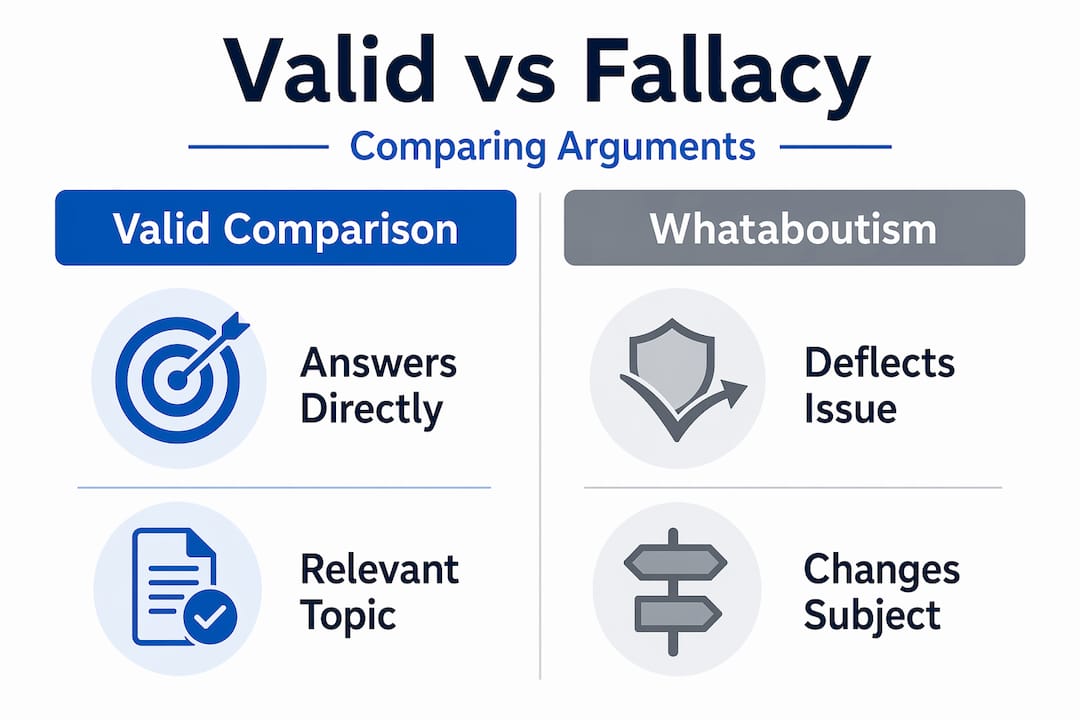
Simmons also suggests that some whataboutisms can function as invitations to broader epistemic reflection, a prompt to question whether criticism is being applied fairly. But even that charitable reading does not excuse avoiding the original question. The two things can coexist: acknowledge the broader point and still answer what was actually asked.
Why whataboutism poisons debates
The damage whataboutism does to a conversation goes beyond mere annoyance. It fundamentally breaks the conditions needed for honest debate.
“Whataboutism changes the question of a discussion from accuracy or justification to comparative wrongdoing, making accountability cycles nearly impossible.” — TeachThought
When a discussion shifts from “Did you do this wrong?” to “Who has done worse?”, accountability becomes structurally impossible. There is always someone worse, somewhere, in some context. The original wrong never gets examined.
The other consequence is what makes whataboutism particularly frustrating in political debates and on social media. It is sticky. Once one whataboutism enters a conversation, it invites another, which invites another, until both sides are lobbing accusations backwards through history rather than addressing anything in the present. You end up in an infinite chain of “but what about…” with no resolution in sight.
This pattern produces several predictable problems:
- Accountability disappears. The person being criticised never has to justify their actions because the conversation is always about someone else.
- Trust erodes. When audiences watch a politician deflect with whataboutism, they may not consciously identify the fallacy, but they register the evasion. Over time, it breeds cynicism about political discourse generally.
- Moral reasoning collapses. Whataboutism avoids evidence and responsibility, replacing careful moral judgement with a race to find worse examples.
- Social media amplifies everything. Platforms reward outrage and quick responses. Whataboutism thrives in that environment because it is faster and louder than careful engagement.
Understanding these effects is part of why the definition of whataboutism matters beyond academic interest. This is a tool being used on you, regularly, by people who want to avoid scrutiny.
How to respond to whataboutism
Knowing how to respond to whataboutism is where this knowledge becomes genuinely useful. The good news: there are straightforward strategies that work without requiring you to become aggressive or lecture anyone.
- Name it calmly, not accusingly. You might say, “That’s an interesting point about X, but I’d like to stay with the original question for a moment.” You are not calling them a liar. You are simply keeping the conversation on track.
- Separate the threads. Acknowledge that the counter-example they raised may be worth discussing separately, but insist that it does not answer the original question. “We can certainly talk about that case too, but it doesn’t address what I asked.”
- Ask whether the comparison answers the question. This works well in written debates or social media. “Does pointing to this other situation mean you’re saying what happened in this situation was fine?” That forces a direct answer.
- Avoid matching whataboutism with whataboutism. The temptation to respond in kind is real, but it accelerates the spiral. You are better served by staying anchored to the original point.
- Disengage when necessary. Some conversations are not worth continuing. If someone is committed to deflecting indefinitely, withdrawing your participation is not a loss. It is a recognition that the discussion was never going to be productive.
Pro Tip: In written arguments, copy and paste the original question back into your reply. It is a simple, neutral way to remind both parties what was actually being discussed without escalating the tone.
Understanding whataboutism in debates means knowing that winning the argument is less important than maintaining the quality of the argument. If you get drawn into a whataboutism spiral, even if you “win” on points, the conversation itself has been degraded.
Whataboutism examples in real life
Seeing whataboutism examples across different contexts helps cement recognition. Here are several cases worth analysing.
- Political press conferences. A leader is asked about domestic surveillance overreach. They respond by pointing to another country’s surveillance state. The comparison tells the audience nothing about whether the original policy was justified.
- Social media pile-ons. A celebrity is criticised for an offensive comment. Their supporters respond by cataloguing offensive statements by other celebrities. Whether those other statements were also wrong is irrelevant to whether this one was.
- International diplomacy. Country A accuses Country B of human rights violations. Country B immediately cites Country A’s own record. Both records may deserve scrutiny, but the deflection allows Country B to avoid engaging with the specific accusation.
- Workplace disputes. An employee is pulled up for a process violation. They respond by listing occasions when their manager made similar errors. The manager’s behaviour may indeed be worth raising, but it does not address the original concern.
What each of these has in common is the same structural move: shift the focus, avoid the question, make the conversation about comparison rather than accountability. Once you can spot that pattern, whataboutism in debates becomes visible almost immediately.
My honest take on this
I have spent years reading political commentary and following public debates, and I will be direct: whataboutism is one of the most corrosive habits in modern political discourse because it exploits something genuinely reasonable. The impulse to demand consistency in criticism is not stupid or dishonest. It is a legitimate principle. What I have found, though, is that the tactic almost never gets deployed in good faith.
When I encounter it in political discussions, I notice that the person using it rarely follows through. They never actually return to the original question after raising their counter-accusation. That asymmetry is the tell. If your genuine goal were moral consistency, you would demand it of yourself too.
What genuinely troubles me is how effective it remains despite being so widely recognised. People know what whataboutism is, they can name it, and they still get drawn into the spiral. I think that happens because the tactic triggers an emotional response before the analytical one kicks in. You feel the unfairness of an accusation and you want to defend by comparison. Slowing that instinct down is the real skill.
The more I have engaged with these debates, the more I believe that understanding this kind of rhetorical deflection is not just useful for argument. It is part of participating responsibly in a democratic society.
— John
Go deeper on critical thinking
If you found this breakdown useful, there is a lot more worth exploring. Whataboutism is just one of many rhetorical tools that distort public debate, and recognising it is only the starting point.

Whitebunnywabbit has been covering political discourse, logical fallacies, and the mechanics of public argument for years. The education resources go well beyond single-concept explainers, offering broader context on how arguments are constructed, distorted, and used. If you want to engage with political commentary from a more informed position, the Whitebunnywabbit site is worth exploring at your own pace. The goal is not to tell you what to think. It is to give you better tools for thinking for yourself.
FAQ
What is the definition of whataboutism?
Whataboutism is a rhetorical tactic in which someone responds to an accusation or criticism by pointing to a separate wrongdoing, rather than addressing the original point. Merriam-Webster defines it as a defensive move that claims another’s offence is comparable or worse.
Is whataboutism always a fallacy?
Not every comparison is fallacious. A comparison becomes whataboutism when it replaces the original question rather than answering it. If the comparison genuinely addresses whether a principle is being applied consistently, it may have legitimate argumentative value.
How can I spot whataboutism in a debate?
Look for responses that introduce a different subject entirely rather than engaging with the original accusation. If someone replies to “why did you do X?” with “what about when they did Y?”, and never returns to answer X, that is whataboutism.
Why is whataboutism so common in politics?
It is fast, emotionally satisfying for supporters, and genuinely effective at derailing scrutiny. Political environments reward quick, combative responses, and whataboutism traps conversations in circular exchanges that prevent any single question from being properly answered.
How do I respond to whataboutism without losing my temper?
Calmly acknowledge the counter-point as a separate issue and restate the original question. Saying “That may be worth discussing too, but it doesn’t answer what I originally asked” keeps the conversation grounded without escalating the tone.
Leave a Reply