
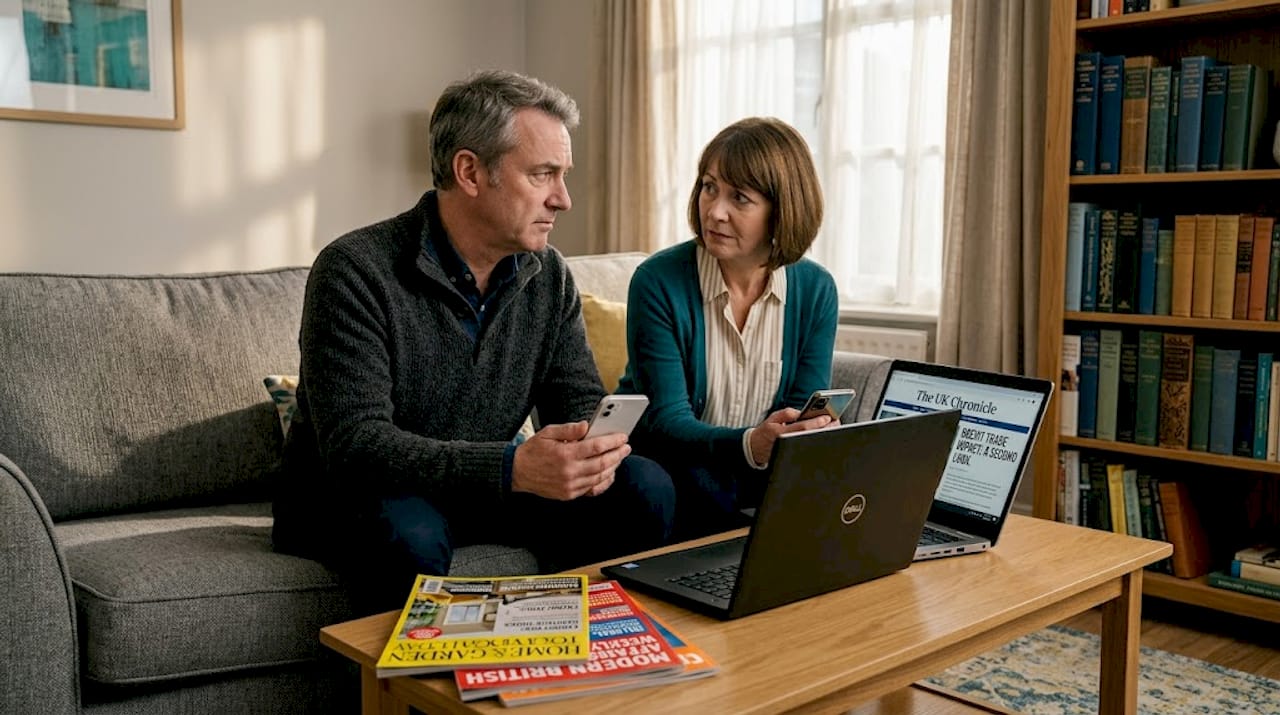
Misinformation spreads faster than the truth, and the gap is wider than most people realise. Within 48 hours of going viral, false claims become entrenched in public belief, making accurate corrections almost impossible to land. This is not a story about gullibility. Why misinformation spreads fast comes down to psychology, technology, and social dynamics working in concert against our better judgement. Understanding those mechanisms is not just interesting. It is the first step toward doing something about it.
Table of Contents
- Key takeaways
- How misinformation spreads fast: psychological and social drivers
- Technological mechanisms that accelerate the spread
- Why correcting misinformation rarely works
- Strategies that actually build resistance
- Putting it all together
- My take: why this keeps me up at night
- Explore more at Whitebunnywabbit
- FAQ
Key takeaways
| Point | Details |
|---|---|
| Emotions drive sharing | Fear, anger, and outrage make people share misinformation before they think to verify it. |
| Algorithms amplify falsehoods | Social media platforms prioritise emotionally engaging content, which often means false or exaggerated claims surface first. |
| Corrections rarely stick | The continued influence effect means false beliefs persist even after people have seen factual rebuttals. |
| Prebunking beats debunking | Exposing people to manipulation tactics before they encounter misinformation builds lasting psychological resistance. |
| You have more power than you think | Pausing before sharing, checking sources, and recognising emotional cues can meaningfully reduce the spread. |
How misinformation spreads fast: psychological and social drivers
The most uncomfortable truth about misinformation is that our own minds help it along. Several deeply embedded cognitive processes make us vulnerable, and fast news cycles give us no time to override them.

Confirmation bias is perhaps the most studied culprit. When a piece of information confirms what we already believe, we accept it with far less scrutiny than we would apply to something that challenges us. The motivated brain actively seeks information that validates existing beliefs, especially under stress. This is not a flaw unique to the uninformed. It affects everyone, regardless of education or political affiliation.
Emotion is the other major accelerant. False news evokes strong emotions such as fear, anger, and disgust, which dramatically increase the likelihood of sharing. When you feel outraged, the impulse to forward something to your group is almost reflexive. Anger, in particular, bypasses the deliberative thinking that might otherwise slow you down.
Beyond emotion, there are several other psychological mechanisms worth understanding:
- Novelty bias. The brain is wired to pay attention to new information. Misinformation often presents familiar topics with dramatic new angles, making it feel worth passing on.
- The illusory truth effect. Repetition increases perceived truthfulness, even for claims people initially doubted. Seeing a false claim three or four times across different sources makes it feel credible, regardless of whether any evidence has emerged.
- Social identity. People share content that signals belonging to their group. If a piece of misinformation aligns with the values or perceived threats of a community, sharing it becomes an act of solidarity rather than information exchange.
- Motivated reasoning. People do not just accidentally believe false things. People share fake news because it feels useful emotionally or informationally. The belief serves a purpose, which makes it resistant to correction.
Pro Tip: Before you share anything that provokes a strong emotional reaction, wait ten minutes. That pause interrupts the emotional reflex and gives your reasoning brain a chance to catch up.
Rapid news cycles compound all of this. When a story breaks, there is enormous social pressure to have an opinion immediately. That environment favours intuitive, fast thinking over careful analysis. And fast thinking is precisely when cognitive biases do their worst work.
Technological mechanisms that accelerate the spread
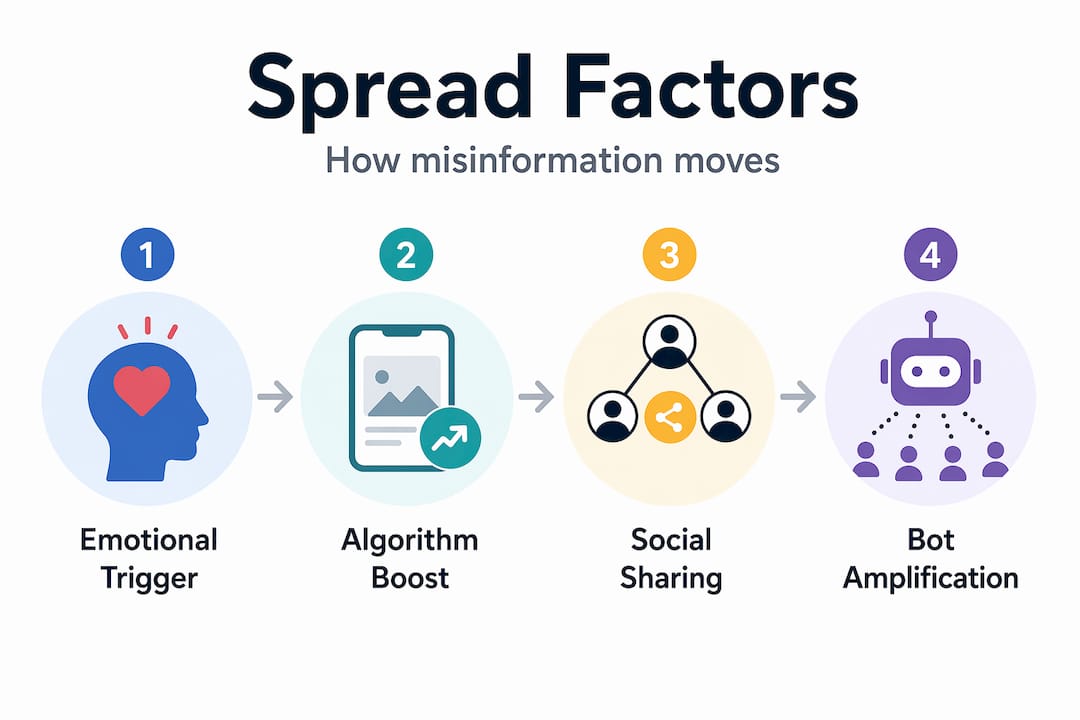
Psychology provides the fuel, but technology is the engine. The impact of social media on misinformation is profound, and understanding why fake news goes viral requires looking closely at how these platforms are designed.
| Factor | How it amplifies misinformation |
|---|---|
| Algorithmic amplification | Platforms reward content that generates engagement. Emotionally charged or outrageous posts get more clicks, shares, and comments, so algorithms push them further. |
| Bots and trolls | Bots artificially amplify misinformation by mimicking real user interactions, manufacturing false impressions of popularity and consensus. |
| Echo chambers | Homophily means people cluster online with those who share their views. Within these groups, misinformation circulates without challenge, reinforcing existing beliefs. |
| Circular reporting | Circular reporting creates feedback loops in which one false claim is cited by multiple outlets, each appearing to independently confirm the original, lending it false credibility. |
| Declining local journalism | As trusted local news sources disappear, people turn to social media and unverified sources to fill the gap, increasing exposure to misinformation. |
Algorithmic amplification deserves particular attention. These systems are not designed to spread lies. They are designed to maximise engagement. The problem is that emotionally provocative content, which misinformation frequently is, generates more engagement than accurate but measured reporting. The algorithm has no interest in truth. It has an interest in your attention.
The fake news and newspaper reporting confusion documented in surveys illustrates how far the problem reaches into mainstream media consumption. In 2016, 64% of people felt fake news caused significant public confusion, and 23% admitted to having shared a fabricated story themselves. These are not fringe figures.
Pro Tip: When a story appears to be confirmed by multiple outlets, check whether they are all citing the same original source. If they are, you may be looking at circular reporting rather than independent verification.
Bots are a specific and under-discussed mechanism. They operate at scale, liking, sharing, and commenting on content in ways that create the impression of organic popularity. When something appears popular, people are more likely to engage with it. This is basic social proof exploited deliberately to push misinformation into wider circulation.
Why correcting misinformation rarely works
Once a false claim takes hold, correction is genuinely difficult. This is not simply a matter of people refusing to listen. There are well-documented psychological reasons why debunking so often fails.
The most significant is the continued influence effect, which describes the tendency for misinformation to keep affecting beliefs and reasoning even after a person has been told the claim is false. The correction lands. The original false belief lingers anyway.
Several factors explain why:
- False memories. Repeated exposure to misinformation can create memories of events that did not happen, or distort memories of events that did. By the time a correction arrives, the false version may already feel like a personal recollection.
- Cognitive load. Under stress or when mentally fatigued, people rely on mental shortcuts rather than careful reasoning. The claim that arrived first, and was processed quickly, tends to hold its ground.
- Structural knowledge gaps. Misinformation sometimes fills an explanatory gap. When someone believes a false claim because it explains something that otherwise seems unexplained, simply telling them the claim is false leaves the gap unfilled. Without an alternative explanation, the false one survives.
- Limited reach of fact-checking. Fact-checking organisations do important work, but their corrections rarely reach the same audience as the original misinformation. In tightly held fringe communities, they rarely reach in at all.
A striking example comes from the COVID-19 period, when 31% of respondents believed false theories about the virus’s origin despite substantial contradicting evidence. The false beliefs were emotionally coherent, socially reinforced, and had arrived early. Corrections that came later faced every obstacle described above.
Strategies that actually build resistance
Given how poorly debunking performs, the more promising approach is prebunking. The idea comes from inoculation theory in psychology, and it works by exposing people to weakened versions of manipulation tactics before they encounter them in the wild.
Here is how the approach works in practice:
- Identify the technique, not just the claim. Rather than correcting a specific piece of misinformation, prebunking teaches people to recognise manipulation tactics such as false dichotomies, emotional exploitation, and cherry-picked data. This creates broader, more durable resistance.
- Use short video content. Research shows that inoculation videos improve recognition of misinformation techniques by approximately 5% across large populations. That may sound modest, but at platform scale it translates to millions of people.
- Build media literacy into everyday habits. Recognising emotional triggers in headlines, checking the publication date, verifying the author’s credentials, and searching for corroborating sources are skills that can be practised deliberately.
- Use accuracy nudges. Research shows that simply prompting people to think about whether a headline is accurate before sharing it reduces the likelihood of spreading misinformation. The nudge does not need to be heavy-handed. A gentle prompt towards accuracy shifts behaviour measurably.
- Limit consumption in high-risk contexts. In communities where misinformation is particularly concentrated, reducing time spent on those platforms or threads curbs both exposure and the temptation to engage and amplify.
- Practise responsible sharing. Before forwarding something, ask three questions: Where did this come from? Does the source have a clear bias or agenda? Does this story appear in any reliable outlet independently?
Psychological inoculation against misinformation can be implemented at scale through short videos and is effective across different ideological groups. This matters because misinformation is not a problem contained within one political corner. It crosses every demographic.
Putting it all together
Understanding why misinformation spreads fast is not an academic exercise. It is preparation. The psychological and technological drivers work together so effectively that no single countermeasure is sufficient on its own.
Critical thinking, emotional awareness, and healthy scepticism are your first line of defence. Recognising when a piece of content is designed to make you angry or afraid is often enough to pause before acting on it. Prebunking and behavioural nudges add a second layer, training your pattern recognition before manipulation attempts arrive.
Community and platform accountability matter too. Platforms that adjust algorithms to reduce the amplification of emotionally manipulative content, and that surface authoritative sources during breaking news events, can reduce misinformation reach at scale. Individual behaviour change and platform-level design work best together.
Pro Tip: Share accurate corrections when you see misinformation in your network, but frame them gently. Aggressive corrections tend to entrench false beliefs. A quiet, factual alternative works better.
The goal is not to become suspicious of all information. It is to slow down just enough to ask whether something is genuinely worth spreading.
My take: why this keeps me up at night
I have been following misinformation dynamics for years, and what strikes me most is how little daylight there is between knowing about these biases and being immune to them. I know about the illusory truth effect. I still find myself believing things that feel familiar. That gap between academic understanding and lived behaviour is where the real problem lives.
What has impressed me most in recent years is the prebunking research. Most interventions I have watched over time fail because they arrive too late, after the belief has formed and been socially reinforced. Inoculation flips that. It gets ahead of the manipulation rather than chasing it. The fact that short videos can deliver this at platform scale, across different ideological groups, is genuinely exciting.
What frustrates me is the platform accountability gap. We have good evidence about what reduces misinformation spread. Algorithmic changes, accuracy nudges, reduced bot activity. Yet the platforms that could implement these at scale have financial incentives that frequently point the other way.
My honest advice is this: do not wait for the platforms to fix it. Build your own habits. Learn the tactics. Teach them to people around you. That is not a counsel of despair. It is just where the leverage actually sits right now.
— John
Explore more at Whitebunnywabbit
If this article has made you think differently about how information spreads and why it matters, there is more where this came from. Whitebunnywabbit covers political analysis, current affairs, and social commentary with the kind of depth that rarely shows up in mainstream feeds.
The education resources at Whitebunnywabbit are a strong starting point if you want to go further into media literacy and the tools available to protect yourself from misinformation. And if you are looking for ongoing commentary on the news stories where misinformation tends to emerge first, the main Whitebunnywabbit site is worth bookmarking. The best defence against misinformation is staying informed through sources that take the truth seriously.
FAQ
Why does misinformation spread faster than true news?
False news travels faster because it tends to be more novel and emotionally provocative than accurate reporting. Social media algorithms amplify content that generates engagement, which emotionally charged misinformation consistently does.
What is the continued influence effect?
The continued influence effect is the psychological phenomenon where false beliefs persist even after a person has received a correction. The original misinformation keeps influencing reasoning because it was processed first and often more vividly.
What is prebunking and does it work?
Prebunking is a technique that exposes people to manipulation tactics before they encounter misinformation, building psychological resistance in advance. Research shows inoculation videos increase resilience against misinformation at scale and across different ideological groups.
How does social media accelerate misinformation?
The impact of social media on misinformation comes primarily from algorithmic amplification, echo chambers, and bots. Platforms reward engaging content regardless of accuracy, and bots manufacture false impressions of popularity that encourage further sharing.
Can individuals make a real difference in stopping misinformation?
Yes. Pausing before sharing, recognising emotional manipulation, checking sources, and using accuracy nudges all reduce spread. Individual habits matter, particularly in social networks where one person’s share can reach hundreds of others within minutes.
Leave a Reply