
Clickbait is defined as headline-driven content engineered to generate clicks through emotional or ambiguous cues, with little substantive value behind the headline itself. Why clickbait dominates news is not a mystery of bad taste. It is the predictable outcome of human psychology colliding with advertising-based business models and platform algorithms that reward engagement above accuracy. A 2026 arXiv study confirms that clickbait wins attention at the headline stage, before readers ever reach the article body. The result is a media environment where the headline is the product, and the story is almost secondary.
Why clickbait dominates news: the psychological engine
The human brain is not built for passive reading. It is built for threat detection, social monitoring, and the resolution of uncertainty. Clickbait exploits all three. The most studied mechanism is the curiosity gap, a deliberate withholding of information that triggers the brain’s desire for closure. Headlines such as “You won’t believe what happened next” or “The one thing doctors don’t want you to know” are not accidents. They are engineered curiosity gaps designed to make not clicking feel psychologically uncomfortable.

Emotional arousal is the second lever. Research published in 2026 links emotionality flips, sudden shifts in emotional valence within content, to higher audience engagement mediated by arousal. This means audiences are not hooked by sustained emotional intensity. They are hooked by contrast: calm followed by alarm, hope followed by threat. A headline that moves from reassurance to danger in six words is performing a psychological manoeuvre, not journalism.
Fear is the fastest trigger of all. Fear-based headlines hijack the brain’s survival response, generating urgency that bypasses rational evaluation. This is why health scares, crime stories, and political catastrophe dominate social feeds. The brain treats a frightening headline as a potential threat requiring immediate attention, regardless of whether the story behind it justifies that response.
The clickbait strategies in journalism that perform best combine several of these triggers at once:
- Curiosity gap: withholding the key fact until after the click
- Social proof: “Everyone is talking about…” or “Millions of people don’t know…”
- Fear and urgency: countdown language, worst-case framing, survival stakes
- Surprise: counter-intuitive claims that violate expectations
- Identity triggers: content framed around group membership or shared beliefs
Pro Tip: When a headline makes you feel an urgent need to click, pause and ask what specific information it is actually promising. If the answer is vague, the headline is likely exploiting your curiosity rather than informing you.
How economic incentives keep clickbait alive in newsrooms
The psychological effectiveness of clickbait would matter less if publishers had no financial reason to use it. They have every reason. Digital advertising revenue is calculated on page views and engagement metrics, not on the quality or accuracy of the content those pages contain. A 2026 journalism economics study describes how monetisation incentivises exaggerated and emotional headlines, structurally rewarding clickbait regardless of its journalistic merit. The profit motive does not merely tolerate clickbait. It selects for it.
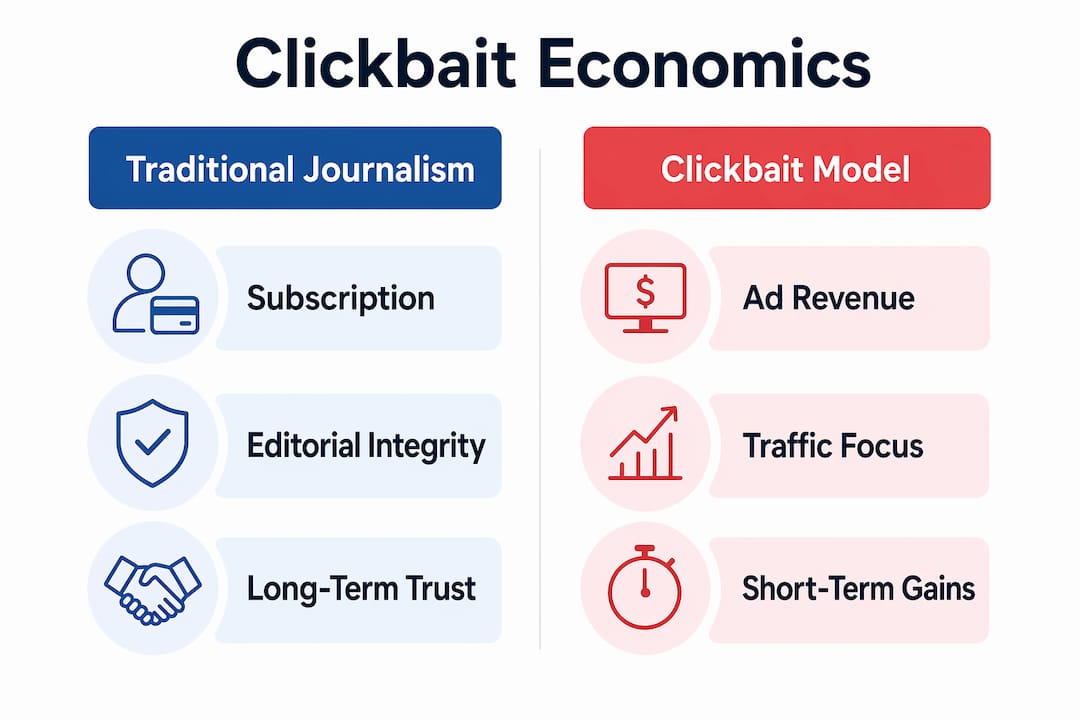
The comparison between traditional journalism and clickbait-driven digital publishing makes this tension visible:
| Dimension | Traditional journalism | Clickbait-driven digital model |
|---|---|---|
| Revenue source | Subscriptions, print advertising | Programmatic advertising, page views |
| Success metric | Accuracy, depth, public trust | Click-through rate, time on page |
| Headline purpose | Summarise the story | Generate the click |
| Editorial standard | Fact-checked before publication | Speed and engagement prioritised |
| Audience relationship | Long-term credibility | Short-term traffic spikes |
The conflict between credibility and traffic is not theoretical. Editors at digital news publishers routinely face pressure to optimise headlines for clicks rather than clarity. When a straightforward headline and a sensational one are tested against each other, the sensational version almost always wins on traffic metrics. Over time, this creates an editorial culture where the sensational becomes the default.
Filter bubbles compound the problem. When readers repeatedly click on emotionally charged content, algorithms learn to serve them more of the same. This concentrates sensational content in individual feeds, making clickbait feel like the norm rather than the exception. The economic model and the algorithmic model reinforce each other in a cycle that is structurally very difficult to break.
What role do platform algorithms play in amplifying clickbait?
Platform algorithms do not distinguish between a well-reported story and a fabricated panic. They measure engagement: clicks, shares, comments, and time spent. Content that generates strong emotional reactions scores well on all four. This is why the impact of clickbait on media extends far beyond individual publishers. The platforms themselves are structural amplifiers.
The consequences of algorithmic amplification include:
- Filter bubbles: users see progressively more extreme versions of content they have already engaged with
- Echo chambers: communities form around shared emotional reactions rather than shared facts
- Suppression of nuance: measured, qualified reporting scores poorly against alarming, definitive claims
- Speed incentives: publishers race to publish first, reducing time for verification
- Headline A/B testing at scale: platforms allow publishers to test dozens of headline variants simultaneously, selecting the most emotionally effective version automatically
Detection and moderation present a genuine technical challenge. Emotion-aware clickbait uses Valence-Arousal-Dominance modelling to generate headlines that mimic genuine emotional dynamics, making them difficult for automated classifiers to flag. Sophisticated clickbait does not look like spam. It looks like compelling journalism. This makes platform-level moderation brittle and reactive rather than preventive.
The effect on public perception is measurable. When users are consistently served sensational content, their baseline expectation of news shifts. Measured, factual reporting begins to feel boring or untrustworthy by comparison. This is one of the more insidious long-term consequences of algorithmic amplification: it does not just change what people read, it changes what they expect news to be.
What are the ethical consequences of clickbait-driven news?
The most immediate ethical consequence is trust erosion. Repeated misleading headlines cause audiences to develop suspicion and reduce their assessment of a publication’s credibility, even when they continue clicking. This is the central paradox of clickbait: it generates short-term traffic while destroying the long-term relationship between publisher and reader.
The damage is not evenly distributed. Clickbait performs worst on topics where accuracy is most critical. Health misinformation spread through fear-based headlines causes measurable harm. Political clickbait distorts public understanding of policy and governance. When the newspaper industry prioritises engagement over accuracy on these topics, the consequences extend well beyond media metrics into public health and democratic participation.
Journalistic standards erode in parallel. When editorial decisions are driven by click-rate data rather than news value, the skills of careful verification, source development, and contextual analysis are progressively devalued. Younger journalists entering newsrooms shaped by clickbait culture learn a different craft from those trained in traditional editorial environments. The long-term effect on the profession is structural, not merely stylistic.
Pro Tip: Before sharing a news story, read past the headline and check whether the article body actually supports the claim the headline makes. If it does not, the story is a candidate for clickbait, and sharing it amplifies the problem.
How can readers and publishers respond to clickbait?
The problem is structural, but the responses available to both readers and publishers are practical and well-evidenced. Journalism studies recommend strengthening media literacy and ethical principles as the primary tools for addressing clickbait at scale. Here is what that looks like in practice:
- Develop headline scepticism. Train yourself to notice emotional triggers in headlines. Urgency, fear, and vague promises of revelation are reliable signals.
- Read before sharing. The majority of clickbait spreads through shares by people who never read the article. Breaking this habit reduces amplification.
- Seek out subscription-funded journalism. Publications funded by readers rather than advertisers face fewer structural incentives to prioritise clicks over quality. The Guardian, The Economist, and similar outlets operate under different pressures.
- Use lateral reading. Before accepting a claim, open multiple tabs and check how other sources cover the same story. This is the technique used by professional fact-checkers.
- Support transparent publishers. Publications that explain their editorial standards, correct errors publicly, and separate news from opinion are demonstrating the transparency that clickbait-driven outlets typically avoid.
- Advocate for platform accountability. Algorithmic amplification is a policy choice, not a technical inevitability. Platforms including Meta, Google, and X have the capacity to deprioritise sensational content. Public pressure and regulatory attention are the levers available to audiences.
Key takeaways
Clickbait dominates news because headline-centric design exploits psychological triggers, advertising revenue models reward clicks over quality, and platform algorithms structurally amplify emotional content at the expense of accuracy.
| Point | Details |
|---|---|
| Curiosity gaps drive clicks | Headlines withhold key information to trigger the brain’s desire for closure, making not clicking feel uncomfortable. |
| Emotionality flips boost engagement | Sudden shifts in emotional tone within content generate more engagement than sustained intensity alone. |
| Advertising models reward clickbait | Digital publishers earn revenue per page view, creating direct financial incentives to prioritise sensational headlines. |
| Algorithms amplify the problem | Platform engagement metrics favour emotional content, creating filter bubbles that concentrate clickbait in user feeds. |
| Trust erodes over time | Repeated misleading headlines reduce long-term audience credibility even when short-term click rates remain high. |
The uncomfortable truth about what we actually want to read
I have spent years reading, writing, and analysing news content, and the conclusion I keep returning to is one that most media criticism avoids: clickbait works because we let it work. Not out of stupidity, but because the psychological mechanisms it exploits are not weaknesses. They are features of human cognition that evolved for good reasons. Curiosity kept our ancestors alive. Fear responses are adaptive. The problem is not that we have these responses. The problem is that an entire industry has been built to monetise them without obligation to inform.
What troubles me most is the feedback loop between audience behaviour and editorial culture. Publishers did not invent clickbait in a vacuum. They tested headlines, measured responses, and followed the data. We clicked. The data told them to do more of it. Blaming publishers entirely while ignoring audience complicity is intellectually dishonest. The more productive question is whether we can build media habits that reward quality, and whether platforms can be pressured to stop making quality journalism structurally uncompetitive.
I am cautiously optimistic. The growth of reader-funded journalism, the increasing sophistication of media literacy education, and the emergence of detection tools that can identify emotional manipulation at scale all point toward a more balanced future. But that future requires active choices from readers, not passive consumption.
— John
Stay informed with Whitebunnywabbit
Whitebunnywabbit is a platform built for readers who want to think critically about the news they consume. If this analysis of how clickbait shapes media has raised questions about the stories you read every day, the site offers commentary, political analysis, and current affairs coverage that prioritises substance over sensation. Explore the media and news coverage at Whitebunnywabbit, or visit the education resources to deepen your understanding of media literacy and how to read news with greater confidence and scepticism.
FAQ
What is clickbait and why does it dominate news?
Clickbait is headline-driven content designed to generate clicks through emotional or curiosity-based cues rather than substantive information. It dominates news because advertising revenue models reward page views, and platform algorithms amplify emotionally engaging content regardless of its accuracy.
How does clickbait affect readership and trust?
Repeated exposure to misleading headlines causes audiences to develop suspicion and reduces their long-term assessment of a publication’s credibility. Research shows that trust erosion occurs even when short-term click rates remain high.
What psychological mechanisms make clickbait so effective?
Clickbait exploits the curiosity gap, fear responses, and emotionality flips. Sudden shifts in emotional tone within content generate higher engagement than sustained emotional intensity, making contrast-based headlines particularly effective.
How do platform algorithms contribute to clickbait prevalence?
Algorithms on platforms including Meta, Google, and X measure engagement rather than accuracy, rewarding emotional and sensational content with greater distribution. This creates filter bubbles that concentrate clickbait in individual feeds and suppress measured reporting.
What can readers do to reduce the impact of clickbait?
Readers can practise lateral reading, read articles before sharing them, and seek out subscription-funded journalism from outlets such as The Guardian or The Economist. Developing awareness of emotional triggers in headlines is the first and most practical step.
Leave a Reply