
Investigative journalism is defined as a specialised form of reporting that exposes hidden matters of public interest, often deliberately concealed by powerful institutions, governments, or corporations. Unlike routine news reporting, it demands months or years of research on a single topic, relying on deep document analysis, database cross-referencing, and multi-source verification rather than daily news cycles. Outlets such as ProPublica have built their entire identity around this model. Tools like LexisNexis and Freedom of Information laws are standard instruments in the investigative reporter’s kit. The Watergate investigation, which brought down a US president, remains the defining proof of what this form of journalism can achieve.
How does investigative journalism work?
Investigative reporting follows a structured, methodical process that separates it sharply from conventional journalism. A daily reporter covers what happened. An investigative journalist asks why it happened, who benefited, and what was hidden. That distinction drives every choice about sources, documents, and time.
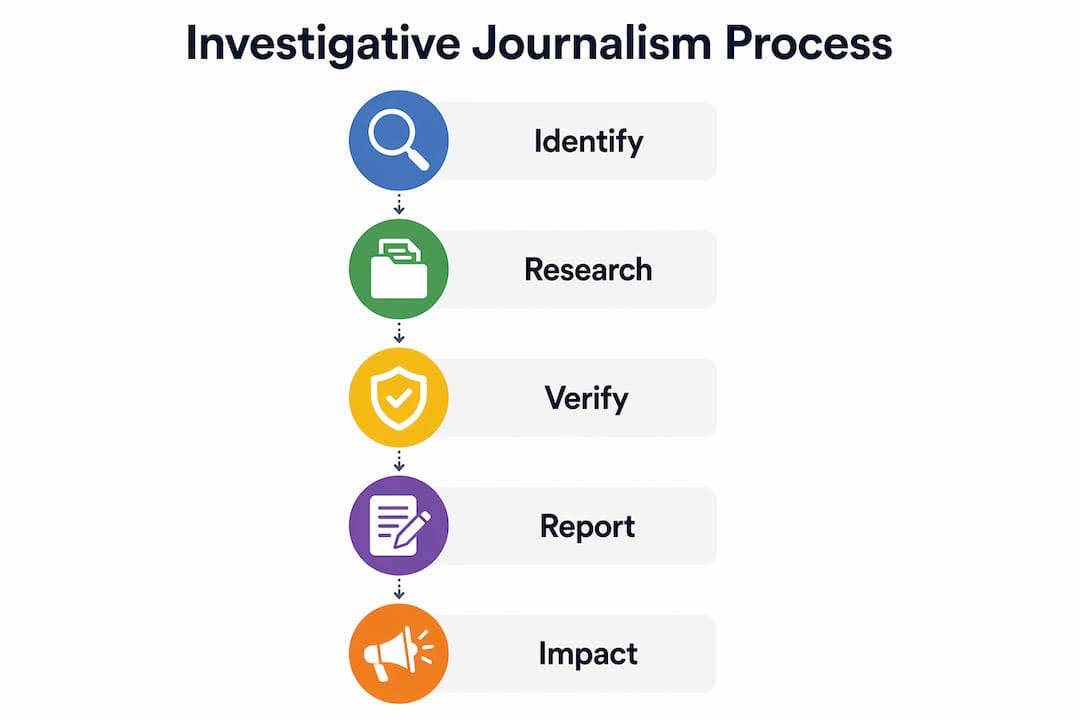
The practical process typically follows these stages:
- Identify a lead. A tip, a public record anomaly, or a pattern in routine stories signals something worth pursuing. Building trust through small, publishable stories enables journalists to gain access to deeper issues over time.
- File Freedom of Information requests. FOI laws in the UK, US, and elsewhere compel public bodies to release documents. Journalists combine these formal records with off-the-record conversations to identify discrepancies between official data and reality.
- Analyse documents and databases. Cross-referencing thousands of records, court filings, and financial disclosures builds the factual spine of the story.
- Verify through multiple sources. No single source is sufficient. Investigative reporters corroborate every claim through independent witnesses, documents, and data.
- Apply legal scrutiny. Modern investigative journalism is a collaborative, multi-month effort heavily reliant on legal expertise to ensure the final story is defensible against litigation.
- Publish and follow up. The story’s release is not the end. Effective investigative journalism tracks the reforms, arrests, or policy changes that follow.
Undercover tactics and secret recordings also feature in some investigations, particularly those involving criminal networks or institutional abuse. A 2026 synthetic opioid investigation, for example, required forensic review of criminal court and medical examiner reports to build a defensible narrative.
Pro Tip: Treat every routine story as a potential gateway to a larger investigation. A single anomaly in a council budget or a pattern in court listings can be the thread that unravels a systemic scandal.

Why is investigative journalism important in society?
Investigative journalism functions as the primary watchdog of democratic societies. It holds governments, corporations, and institutions accountable when official channels fail to do so. Without it, systemic abuses remain invisible.
The societal impact is concrete and measurable. Investigative reporting has triggered:
- Legislative reform. Investigations into US policing practices and addiction recovery regulations produced documented systemic reforms in 2025.
- Criminal accountability. The 2020 arrest of Zimbabwe’s Health Minister followed directly from journalists uncovering financial scandals, demonstrating the global reach of investigations.
- Cultural shifts. The #MeToo movement gained its initial momentum from investigative reporting that named perpetrators and documented patterns of abuse across industries.
- Political consequences. Watergate forced a US presidential resignation. The Panama Papers exposed financial misconduct by heads of state across multiple continents.
Investigative journalism also serves a subtler but equally vital function: it raises the cost of corruption. When powerful actors know that journalists are watching, the risk calculus for misconduct changes.
“Investigative journalism, though under economic pressure, continues to be vital for societal health and democratic function.” — KU Leuven Stories
The role of media watchdogs in exposing corruption is inseparable from the investigative tradition. Misinformation and economic pressures on newsrooms now threaten this function. Fewer journalists means fewer investigations, which means more space for institutional wrongdoing to go unchecked.
Investigative journalism examples that changed the world
Concrete cases illustrate the power of this form of reporting better than any abstract argument.
| Investigation | Publication / Team | Outcome |
|---|---|---|
| Watergate (1972) | The Washington Post (Woodward and Bernstein) | US President Nixon resigned; sweeping political reforms followed |
| Panama Papers (2016) | International Consortium of Investigative Journalists | Resignations of heads of state; global tax reform debate triggered |
| #MeToo origins (2017) | The New York Times and The New Yorker | Harvey Weinstein convicted; cultural reckoning across industries |
| Zimbabwe Health Minister (2020) | Regional investigative journalists | Minister arrested; financial scandal exposed at government level |
| Synthetic opioid epidemic (2026) | Multiple US outlets | Regulatory and criminal accountability in pharmaceutical supply chains |
The Panama Papers case is particularly instructive. It involved more than 370 journalists across 76 countries working in coordination. That scale of collaboration was only possible because of shared data management tools and agreed protocols for handling sensitive documents. The story proved that collaborative international reporting is now the standard model for investigations that cross borders.
The #MeToo origins case shows a different dynamic. Ronan Farrow and Jodi Kantor did not invent the story. They built the evidentiary case that made it publishable. That distinction matters: investigative journalists must approach their work like attorneys, constructing a rigorous, defensible case before a single word goes to print.
What are the challenges facing investigative journalism today?
Investigative journalism faces a set of pressures that are more acute now than at any point in the past two decades. Understanding these challenges explains why the form is both more necessary and more fragile than ever.
- Economic pressure. Newsroom budgets have contracted sharply across the UK and US. Investigative units are expensive. They require time, legal support, and specialist staff. Many regional outlets have cut these teams entirely.
- Misinformation. The rise of generative AI makes it easier to fabricate documents, quotes, and images. Investigative journalists now spend more time authenticating sources than they did a decade ago.
- Legal threats. Strategic lawsuits against public participation (SLAPPs) are used by wealthy individuals and corporations to silence journalists through litigation costs, even when the reporting is accurate.
- Audience fragmentation. Readers increasingly consume news through social media feeds that favour speed over depth. Long-form investigative work struggles to compete for attention in that environment.
- Political hostility. In several countries, governments have passed laws that restrict FOI access or criminalise certain forms of undercover reporting.
The response from the profession has been adaptation rather than retreat. Collaborative models, such as the International Consortium of Investigative Journalists, distribute the cost and risk of major investigations across multiple outlets. Understanding common news consumption mistakes also helps readers support quality journalism by seeking it out deliberately.
Pro Tip: If you want to support investigative journalism, subscribe directly to outlets that produce it. Advertising revenue alone no longer funds the kind of long-form work that holds power accountable.
The future of investigative journalism depends on its ability to adapt to new technologies without losing the rigour that makes it credible. Reflexive approaches and adaptation to new media landscapes are now standard requirements for any journalist entering the field.
Key takeaways
Investigative journalism is the most consequential form of reporting precisely because it targets what powerful institutions most want to keep hidden.
| Point | Details |
|---|---|
| Core definition | Investigative journalism exposes hidden public interest matters through deep research, not daily reporting. |
| Primary methods | FOI requests, document analysis, multi-source verification, and legal scrutiny form the standard toolkit. |
| Societal impact | Investigations have triggered presidential resignations, ministerial arrests, and major legislative reforms. |
| Key challenges | Economic cuts, misinformation, and legal threats now threaten the viability of investigative units worldwide. |
| Future direction | Collaborative, international models and adaptation to AI are the profession’s most effective responses. |
Why investigative journalism still matters more than ever
I have followed political journalism closely for years, and the pattern I keep returning to is this: the stories that actually changed something were almost never the ones that broke first. They were the ones that broke right.
The Watergate investigation did not publish until Woodward and Bernstein had verified their findings through multiple independent sources. The Panama Papers team sat on their material for months while they built the full picture. That patience is not a luxury. It is the entire point. Speed is the currency of daily journalism. Accuracy is the currency of investigative work, and the two are often in direct conflict.
What concerns me most right now is the economic argument being used to justify cutting investigative units. The logic runs that readers want quick, shareable content, so long-form investigations are a poor investment. That argument confuses what readers click on with what they need. The anonymous sources who feed investigative journalists their best leads do not come forward for outlets that cannot protect them or publish the full story. Cutting investigative capacity does not just reduce output. It closes the pipeline entirely.
My advice for anyone considering investigative journalism as a career: learn to read financial documents and court records before you learn to write a lede. The story is almost always in the numbers. The writing comes later.
— John
Whitebunnywabbit and the case for informed readers
Investigative journalism only works when readers understand what it is and why it matters. Whitebunnywabbit covers the political and media stories that most outlets treat as background noise.

The education resources at Whitebunnywabbit cover the principles behind quality journalism, from source ethics to media accountability. For readers who want to go deeper on how news is made and why it matters, Whitebunnywabbit provides the context that turns passive news consumption into genuine political understanding. The site’s focus on current affairs and political analysis makes it a natural home for readers who take investigative reporting seriously.
FAQ
What is investigative journalism in simple terms?
Investigative journalism is reporting that spends months or years uncovering facts that powerful people or institutions want to keep hidden. It relies on documents, FOI requests, and multiple verified sources rather than official statements.
How is investigative journalism different from regular journalism?
Regular journalism reports on events as they happen. Investigative journalism digs into why events happened, who is responsible, and what was concealed, often producing stories that trigger legal or political consequences.
What skills are needed for investigative journalism?
Investigative journalists need strong research skills, legal literacy, data analysis ability, and the patience to build a case over months. The ability to read financial records and court documents is as important as writing ability.
What are some famous investigative journalism examples?
Watergate, the Panama Papers, and the #MeToo investigations are the most cited examples. Each produced direct political, legal, or cultural consequences that would not have occurred without sustained investigative reporting.
Why is investigative journalism under threat?
Economic cuts to newsrooms, legal threats through SLAPP lawsuits, and the rise of AI-generated misinformation all reduce the capacity and credibility of investigative units. Collaborative models and direct reader support are the most effective responses.
Leave a Reply