
Partisan media is defined as news and commentary that consistently favours one political side, framing events to reinforce a particular ideology rather than report neutrally. The role of partisan media extends far beyond simple bias. Research shows that even a single exposure produces attitudinal changes lasting over a week, contradicting the long-held “minimal effects” theory in political science. Algorithmic curation on digital platforms amplifies these effects further, creating feedback loops that lock in partisan beliefs. For critically engaged readers, understanding these mechanisms is the first step to seeing through them.
How does the role of partisan media shape political opinions?
Partisan media influence operates through two channels: direct persuasion and repeated reinforcement. The direct channel works faster than most people expect. Three multi-wave experimental studies confirmed that a single brief exposure to partisan content produces durable attitudinal shifts persisting beyond one week. That finding dismantles the comfortable assumption that casual news consumption is harmless.
The reinforcement channel is subtler but more powerful over time. Repeated exposure accumulates persuasive effect, gradually shifting what a person considers normal, reasonable, or true. The American Multiracial Panel Study demonstrated this with statistical rigour, finding that Fox News exposure among white respondents significantly increased support for the Great Replacement conspiracy theory at p<0.001 significance. That is not a marginal result. It is evidence that sustained partisan exposure reshapes the boundaries of what audiences will believe.

The effects are also asymmetric. Not all partisan content pulls with equal force, and not all audiences are equally susceptible. Algorithmic feeds compound this asymmetry by selecting content that already aligns with a user’s existing leanings, creating a self-reinforcing cycle rather than a balanced information diet.
Pro Tip: Track which outlets you consume most heavily over a fortnight. You may find your information diet is far narrower than you realise, which is the first sign of partisan media influence taking hold.
Key mechanisms driving partisan media’s persuasive power include:
- Attitude persistence: Effects last days or weeks after a single exposure, not just minutes.
- Accumulation: Repeated exposure compounds persuasive impact beyond what any single piece achieves.
- Asymmetric pull: Conservative algorithmic feeds have shown stronger directional effects than neutral feeds in controlled experiments.
- Elite cue-taking: Audiences follow trusted partisan figures, adopting positions they might otherwise reject.
- Framing effects: How a story is presented, not just what it says, shifts audience interpretation of identical facts.
How does algorithmic bias amplify partisan content online?
Algorithmic bias is the tendency of recommendation systems to prioritise content that maximises engagement, which in practice means emotionally charged, ideologically consistent material. Research at Central European University found that recommender algorithms reinforce user biases in digital environments, inadvertently facilitating the spread of extremist propaganda. The word “inadvertently” matters here. Platforms do not set out to radicalise users. They set out to retain attention, and partisan content retains attention exceptionally well.
The feedback loop works as follows. A user watches or reads content that aligns with their existing views. The algorithm registers engagement and serves more of the same. The user’s exposure narrows. Their sense of what is normal shifts. They engage more intensely with content that confirms their worldview, and the algorithm responds by intensifying the feed further. This cycle is highly resistant to correction even among individuals who consider themselves open-minded.
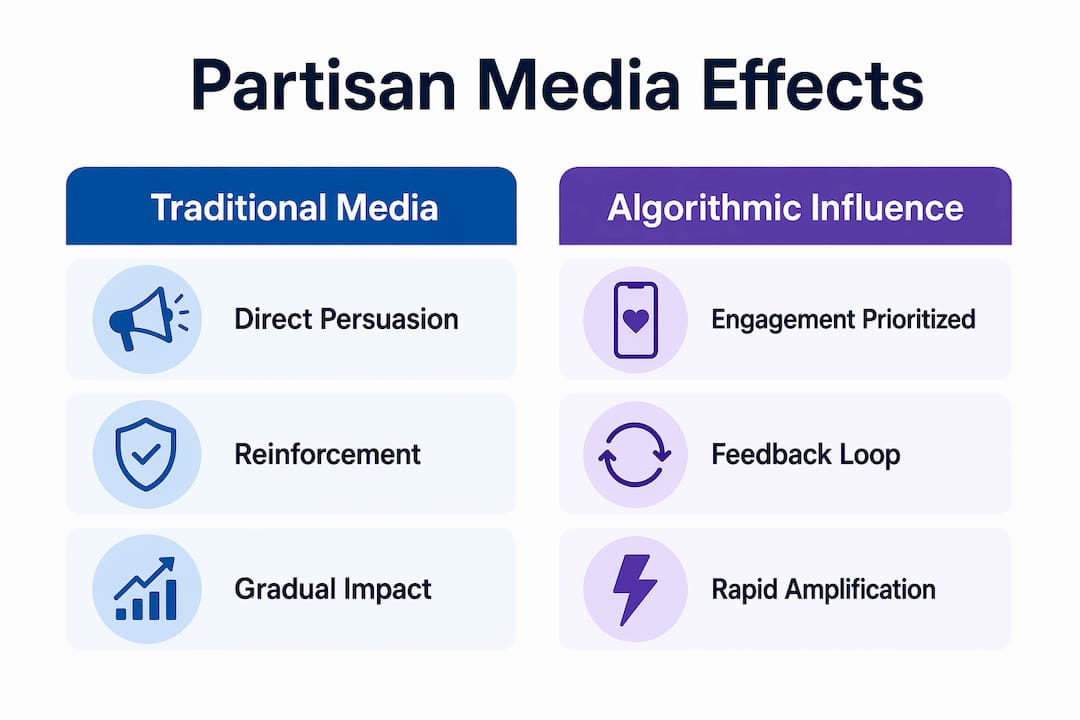
A seven-week randomised experiment with users of X (formerly Twitter) showed that conservative content promotion shifted political priorities in a measurable and lasting direction. Critically, the shift persisted after the algorithm was switched off. That persistence is the most alarming finding. It means the damage to balanced thinking outlasts the exposure itself.
| Factor | Traditional media influence | Digital algorithmic influence |
|---|---|---|
| Speed of effect | Gradual, over weeks or months | Rapid, within days |
| Personalisation | Broad audience targeting | Individual-level curation |
| Feedback loop | Limited; one-directional broadcast | Continuous; user behaviour shapes content |
| Correction mechanism | Editorial standards, press regulators | Largely absent or platform-controlled |
| Reach of extremist content | Constrained by editorial gatekeeping | Amplified by engagement metrics |
Understanding why outrage drives engagement on social media is inseparable from understanding why algorithms favour partisan content. Outrage is the fuel; the algorithm is the engine.
What are the consequences of partisan media for trust and discourse?
Partisan media erode institutional trust in ways that compound over time. When audiences consume news that consistently frames government, science, or the judiciary as corrupt or incompetent, trust in those institutions declines. That decline is not merely attitudinal. It affects whether citizens accept election results, follow public health guidance, or engage with democratic processes at all.
Confirmation bias is the psychological mechanism that makes this erosion so durable. Research published in the International Journal of Politics, Culture, and Society found that ideological identity causes acceptance of misinformation that confirms prior beliefs, locking in biased thinking over time. The critical point is that this is not a failure of intelligence. Highly educated people are equally susceptible when their ideological identity is engaged. Partisan media exploit this vulnerability deliberately.
The consequences extend beyond individual belief. Partisan news influence shapes collective political priorities. A population that receives systematically skewed information about immigration, crime, or economic policy will form systematically skewed policy preferences. Those preferences then feed back into electoral outcomes, creating a loop between media content and political power.
“The debate on media impacts should extend beyond polarisation to measurable changes in policy priorities and perceptions, even when overall partisanship remains stable.” — The political effects of X’s feed algorithm
The consequences of biased media consumption include:
- Declining trust in mainstream institutions, including courts, health bodies, and electoral systems.
- Increased acceptance of misinformation that aligns with pre-existing beliefs.
- Reduced cross-partisan dialogue, as audiences inhabit incompatible factual realities.
- Shifts in perceived policy priorities that do not reflect objective conditions.
- Greater susceptibility to elite manipulation via partisan cues.
Understanding what a media echo chamber actually does to your thinking is one of the most practical tools available for resisting these effects.
Why is media biased? Financial and governmental pressures explained
Media bias does not always originate from ideology. Financial precarity and government patronage shape editorial decisions in ways that are less visible but equally distorting. A large-scale analysis published in the European Political Science Review found that media outlets receiving disproportionate government advertising show measurable bias favouring incumbent governments. The mechanism is straightforward. Outlets dependent on state advertising revenue face an implicit incentive to avoid coverage that embarrasses the government. Over time, that incentive reshapes editorial culture without any explicit instruction being given.
Economic precarity operates similarly. Newsrooms under financial pressure cut investigative capacity first. What remains is cheaper to produce: opinion, reaction, and partisan commentary. This structural shift means that even outlets with no ideological agenda drift towards partisan framing simply because it is more affordable to produce than original reporting.
| Bias driver | Source | Typical effect on content |
|---|---|---|
| Ideological ownership | Proprietor political alignment | Consistent framing favouring one party or worldview |
| Government advertising | State patronage dependency | Reduced critical coverage of incumbents |
| Financial precarity | Revenue decline, staff cuts | Shift from reporting to partisan commentary |
| Audience capture | Engagement-driven revenue | Content calibrated to confirm audience beliefs |
Pro Tip: When assessing a news outlet’s reliability, check its ownership structure and its largest advertising clients. Both reveal financial pressures that shape editorial tone far more than any stated editorial policy.
How headlines shape opinion is a practical guide that shows how framing decisions, often driven by these financial pressures, alter reader perception before a single paragraph is read.
Key takeaways
Partisan media produce durable, measurable changes in political beliefs, policy priorities, and institutional trust through mechanisms that operate across both traditional and digital environments.
| Point | Details |
|---|---|
| Exposure effects persist | A single partisan media exposure shifts attitudes for over a week, not just minutes. |
| Algorithms amplify bias | Recommendation systems create feedback loops that intensify partisan content exposure over time. |
| Financial pressures distort | Government advertising and revenue decline push outlets towards partisan framing regardless of ideology. |
| Confirmation bias locks in beliefs | Ideological identity causes audiences to accept misinformation that confirms what they already believe. |
| Policy priorities shift | Partisan media influence changes what audiences consider important, not just who they vote for. |
The uncomfortable truth about how we consume news
I have spent years reading across the political spectrum, and the most unsettling thing I have learned is this: the outlets I find most credible are usually the ones that confirm what I already think. That is not a coincidence. It is confirmation bias operating exactly as the research describes. Recognising it in yourself is genuinely difficult, because partisan content does not feel partisan when it aligns with your worldview. It just feels accurate.
What troubles me most about the algorithmic dimension is the persistence finding. The idea that switching off a biased feed does not immediately restore balanced thinking means the harm accumulates silently. You cannot simply delete an app and reset. The attitudinal shifts have already occurred. That demands a more active approach to information consumption than most people currently practise.
My honest recommendation is to treat your news diet the way you treat your physical diet. Variety is not optional. Consuming commentary from sources you find uncomfortable is not masochism. It is the only reliable way to test whether your beliefs are grounded in evidence or in partisan reinforcement. The guide on consuming commentary without an echo chamber is worth your time if you want a practical framework for doing this.
The role of media in democracy depends on citizens who actively resist the path of least resistance. Algorithms will always serve you what keeps you engaged. The question is whether you choose to override them.
— John
Whitebunnywabbit’s resources for navigating partisan media
Understanding partisan media influence is one thing. Building habits that protect your thinking from it is another.
Whitebunnywabbit publishes guides and analysis specifically designed for readers who want to engage critically with news rather than simply consume it. The education resources cover media literacy, bias recognition, and practical frameworks for building a balanced information diet. If you want to understand how framing, ownership, and algorithms shape what you read before you read it, Whitebunnywabbit is a useful starting point. The site’s commentary on current affairs is written with the assumption that readers can handle complexity, which is rarer than it should be.
FAQ
What is the role of partisan media in a democracy?
Partisan media shape public opinion, policy priorities, and institutional trust. Their influence on democratic discourse makes media literacy a civic necessity, not an optional skill.
How long do partisan media effects last?
Research shows attitudinal changes persist for over a week after a single exposure. Repeated exposure accumulates these effects, making them increasingly resistant to correction.
Why do algorithms make partisan media more powerful?
Recommendation systems prioritise engaging content, which tends to be ideologically consistent and emotionally charged. This creates feedback loops that intensify partisan exposure over time, even among open-minded users.
Does government advertising cause media bias?
Large-scale analysis confirms that outlets dependent on government advertising show measurable bias favouring incumbent governments. Financial dependency shapes editorial decisions without any explicit instruction.
How does confirmation bias relate to partisan media?
Confirmation bias causes people to accept misinformation that aligns with their existing beliefs. Partisan media exploit this by consistently framing content to match audience ideology, reducing critical engagement over time.
Leave a Reply