
A media echo chamber is an environment where information and opinions repeatedly reinforce existing beliefs while excluding or discrediting opposing perspectives. The term borrows from acoustics: just as a physical chamber amplifies sound, a media echo chamber amplifies certain ideas until they feel universal, regardless of what the broader public actually thinks. Research from SAGE Journals confirms that 73% of content served inside these environments aligns with users’ pre-existing views. That figure alone explains why so many people feel their political or social beliefs are simply “common sense” when, in reality, they have been surrounded by curated agreement.
What is a media echo chamber and how does it form?
Echo chambers form through two distinct forces: algorithmic curation and deliberate social exclusion. Platforms like Facebook, YouTube, and X (formerly Twitter) use recommendation engines that prioritise content you already engage with. Over time, your feed narrows to reflect your preferences back at you. This is the technical side of the problem.
The social side is arguably more powerful. Echo chambers form endogenously through human interaction alone, without any algorithmic input. When people encounter views they dislike, they disengage, unfollow, or mute. The result is a self-selected community of like-minded individuals who reinforce one another’s worldview.

Echo chambers vs filter bubbles: a critical distinction
These two terms are often used interchangeably, but they describe different phenomena. A filter bubble is primarily driven by algorithmic omission: content is withheld from you without your active participation. An echo chamber goes further. Echo chambers actively exclude and denigrate outside perspectives. Members of an echo chamber do not simply lack exposure to dissenting views. They actively distrust and dismiss them.
The psychological engine behind both phenomena is confirmation bias: the tendency to seek out and favour information that confirms what you already believe. Paired with selective exposure, where you choose sources that match your worldview, these biases make echo chambers feel comfortable and natural. That comfort is precisely what makes them difficult to detect.
Pro Tip: Pay attention to your emotional reaction when you read a news story. If every article you encounter produces either strong agreement or outrage at “the other side,” you are likely inside a reinforcing loop.
What are the effects of media echo chambers?
The consequences of prolonged exposure to echo chambers extend well beyond personal belief. At the individual level, confirmation bias and selective exposure increase affective polarisation and susceptibility to disinformation. Affective polarisation means you do not just disagree with the opposing side politically. You dislike them as people.
At the societal level, the stakes are higher still. Diminished exposure to critical analysis worsens democratic discourse and weakens social cohesion. When large groups of citizens consume entirely separate information realities, shared public debate becomes almost impossible. Elections, public health campaigns, and climate policy all suffer when the electorate cannot agree on basic facts.
“The primary danger of echo chambers is not that people hold strong opinions. It is that they lose the capacity to engage critically with any information that challenges those opinions.” — CLRN, 2025
The table below contrasts outcomes in echo chamber environments against those in healthy, diverse media diets.
| Factor | Echo Chamber Environment | Healthy Media Discourse |
|---|---|---|
| Exposure to opposing views | Rare or actively avoided | Regular and expected |
| Susceptibility to misinformation | High | Significantly lower |
| Affective polarisation | Increases over time | Remains manageable |
| Quality of democratic debate | Degrades | Sustained and productive |
| Risk of radicalisation | Elevated | Substantially reduced |
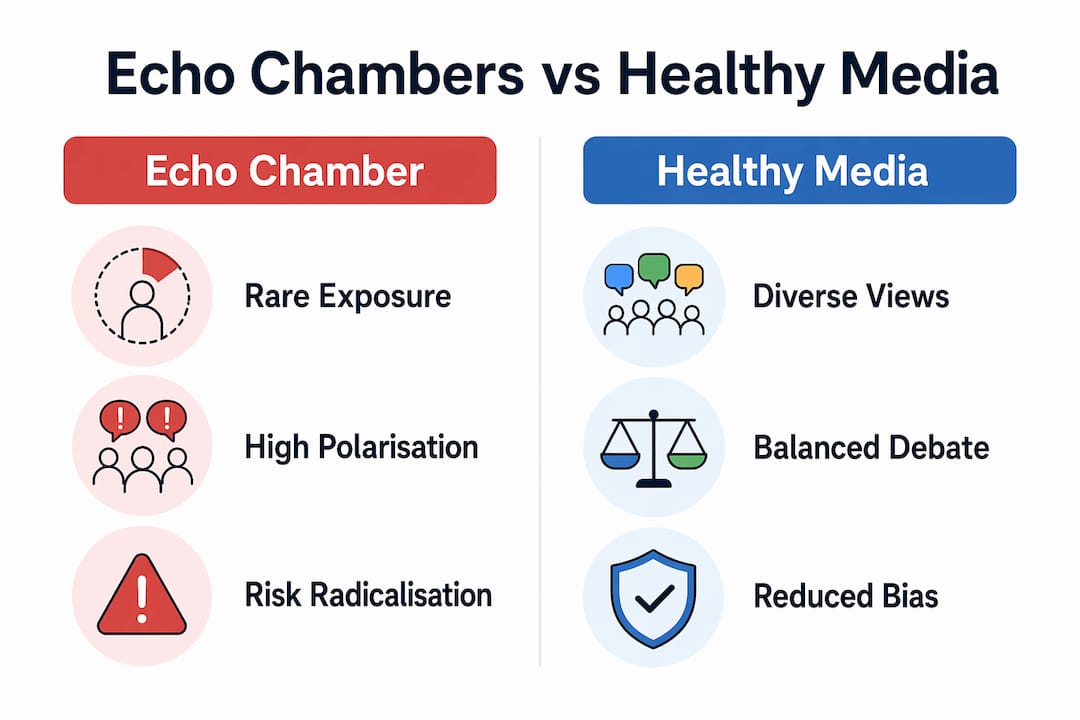
The radicalisation risk deserves particular attention. Echo chambers do not just reinforce moderate views. They push beliefs toward extremes through a process of competitive signalling, where members try to demonstrate greater loyalty to the group’s shared ideology. This is how fringe ideas migrate into mainstream political discourse.
Media echo chamber examples in social media and news
The clearest media echo chamber examples appear in social media behaviour. Consider a user who follows exclusively left-leaning or right-leaning political accounts on X. Their feed fills with viral political commentary that confirms their existing position. Every post they like, share, or comment on trains the algorithm to serve more of the same. Within weeks, the feed bears almost no resemblance to a balanced news source.
YouTube’s recommendation engine operates similarly. A viewer who watches one video critical of a political figure will be served progressively more critical content. The Decision Lab describes this as the acoustic chamber effect: repeated exposure makes a minority view feel like the dominant consensus. The viewer does not realise their perception has been shaped by a feedback loop rather than by reality.
Common echo chamber content types and behaviours include:
- Outrage-driven sharing: Articles and videos designed to provoke anger at an outgroup, which drives engagement and spreads rapidly within aligned communities.
- In-group validation posts: Content that celebrates the user’s own political or social tribe, reinforcing identity rather than informing.
- Dismissive framing of outside sources: Headlines or captions that pre-emptively label mainstream or opposing media as corrupt, biased, or fake.
- Meme-based political commentary: Simplified, emotionally charged images that reduce complex issues to tribal slogans.
- Selective fact deployment: Sharing statistics or quotes stripped of context to support a predetermined conclusion.
Each of these behaviours is self-reinforcing. The more a user engages with outrage content, the more the platform serves it. The more the platform serves it, the more normal it feels.
How can you identify and break free from an echo chamber?
Recognising that you are inside an echo chamber is the hardest part. The eSafety Commissioner’s 2026 guidance notes that users rarely realise they are entrenched until their attitudes have become extreme. Warning signs include a strong hostility to opposing viewpoints, reliance on shocking or sensational content, and the feeling that anyone who disagrees with you is either stupid or malicious.
Here are practical steps to break the cycle:
- Audit your sources. List the ten news outlets or accounts you consume most. If they all share the same political or ideological orientation, you have a problem worth addressing.
- Follow credible outlets from across the spectrum. The BBC, Reuters, and Associated Press apply editorial standards that reduce partisan distortion. Read them alongside your preferred sources.
- Use fact-checking tools. Sites like Full Fact (UK) and Snopes cross-reference claims against verified evidence. Make them a reflex, not an afterthought.
- Engage with dissenting views deliberately. Read opinion pieces you expect to disagree with. The goal is not to change your mind but to understand the strongest version of the opposing argument.
- Practise editorial debate online with discipline. Respond to ideas, not to the person. Avoid threads that are purely performative.
One counterintuitive finding from PLOS One research is worth noting: algorithmic filtering can reduce segregation by increasing user satisfaction in mixed communities, which lowers the impulse to retreat into homogenous groups. Turning off recommendations entirely is not always the answer. The deeper fix is psychological, not technical. Disabling algorithmic recommendations alone does not break echo chambers because homophily and social network patterns persist independently.
Pro Tip: Set aside fifteen minutes each week to read one long-form article from a publication you would not normally choose. The goal is exposure, not conversion.
Key takeaways
Media echo chambers persist because both human psychology and platform design actively sustain them, making deliberate diversification of sources the most reliable defence.
| Point | Details |
|---|---|
| Definition is precise | An echo chamber reinforces existing beliefs and actively excludes dissenting views, unlike a passive filter bubble. |
| Algorithms are not the sole cause | Echo chambers form through human social behaviour alone, even without algorithmic filtering. |
| Effects are measurable | Prolonged exposure increases affective polarisation and susceptibility to disinformation. |
| Warning signs exist | Hostility to opposing views and reliance on shocking content are key indicators of entrenchment. |
| The fix is behavioural | Diversifying sources and practising critical engagement are more effective than disabling recommendations. |
Why echo chambers worry me more than most people realise
I have spent years reading across the political spectrum, and the most striking thing is not how different the arguments are. It is how completely separate the facts are. Two people in opposing echo chambers are not just reaching different conclusions from the same evidence. They are operating from entirely different information sets. That is a structural problem no single article or fact-check can solve.
What concerns me most is the social dimension. The psychological research is clear: people do not just disagree more inside echo chambers. They begin to view the other side as genuinely threatening. That shift from disagreement to perceived threat is where democratic societies get into serious trouble. We have seen it play out in Brexit debates, in American electoral politics, and in pandemic-era public health arguments.
The encouraging part is that individual agency still matters. Choosing to read a source you distrust, sitting with the discomfort of a well-argued opposing view, and resisting the urge to share outrage content are all small acts with real cumulative effect. Platforms bear responsibility too, and the evolving conversation around algorithmic transparency is at least moving in the right direction. But waiting for platforms to fix this is not a strategy. The work starts with each of us, in the choices we make every time we open a news feed.
— John
Explore media literacy at Whitebunnywabbit
Understanding echo chambers is the first step. Knowing how to navigate them in your daily media consumption is the next.
Whitebunnywabbit’s media education resources cover the full picture: how news is produced, how algorithms shape what you see, and how to build a genuinely informed reading habit. Whether you are new to media criticism or already questioning your own information diet, the education section offers clear, opinionated guidance grounded in real analysis. Visit Whitebunnywabbit to explore commentary and resources that take media literacy seriously, without the condescension.
FAQ
What is the definition of a media echo chamber?
A media echo chamber is an environment where information and opinions reinforce existing beliefs while excluding or discrediting opposing views. Unlike a filter bubble, which is driven by algorithmic omission, an echo chamber involves active social exclusion of dissenting perspectives.
How do media echo chambers form without algorithms?
Echo chambers form endogenously through human interaction alone, as people disengage from content they dislike and gravitate toward like-minded communities. This process of social self-selection creates segregated groups independent of any platform recommendation engine.
What are the main effects of media echo chambers on society?
The primary effects include increased affective polarisation, greater susceptibility to disinformation, and degraded democratic discourse. Research from 2025 links prolonged echo chamber exposure directly to reduced capacity for critical analysis and heightened hostility toward outgroups.
How can i tell if i am inside a media echo chamber?
The eSafety Commissioner identifies key warning signs as strong hostility to opposing viewpoints, dependence on shocking or sensational content, and the belief that anyone who disagrees is acting in bad faith. If your news feed produces only agreement or outrage, that is a reliable indicator.
Does turning off social media algorithms fix the problem?
No. Disabling algorithmic recommendations is insufficient because homophilic social networks and psychological biases sustain echo chambers independently of technical filtering. The more effective approach combines source diversification, fact-checking through tools like Full Fact, and deliberate engagement with dissenting views.
Leave a Reply