
Political persuasion does not happen by accident. Every effective speech, campaign slogan, or parliamentary intervention draws on a recognisable toolkit of rhetorical techniques, most of them traceable to Aristotle’s Rhetoric and refined across two millennia of political practice. The core types of rhetorical persuasion techniques are:
- Ethos — an appeal to the speaker’s credibility and character
- Pathos — an appeal to the audience’s emotions
- Logos — an appeal to logic, facts, and reasoned argument
- Kairos — an appeal to timing and contextual appropriateness
- Rhetorical devices — triples, anaphora, imperatives, rhetorical questions, and emotive language
- Compliance-gaining strategies — ingratiation, fear appeals, guilt appeals, and aversive stimulation
- Tropes — artful changes in word meaning (metaphor, irony, hyperbole)
- Schemes — artful changes in word arrangement (anaphora, parallelism, antithesis)
Understanding these categories gives you the analytical vocabulary to decode what politicians are actually doing when they speak, rather than simply reacting to how their words make you feel.
What are the four modes of persuasion in political rhetoric?
The Aristotelian appeals — ethos, pathos, logos, and kairos — form the foundation of persuasive political communication. Each operates differently, and their combined use is what separates genuinely effective political messaging from mere noise.
- Ethos works through perceived credibility. A politician who cites their professional background, references expert opinion, or simply speaks with confident authority is building ethos. Rishi Sunak’s repeated references to his economic credentials during the 2024 general election campaign were a textbook ethos play, even when voters ultimately rejected the argument.
- Pathos targets emotion directly. It can take the form of a personal story, an emotive word choice, or an appeal to shared values. As Excelsior OWL notes, pathos is the most powerful of the three classical appeals, but also the most easily misused — relying on it alone risks appearing manipulative rather than persuasive.
- Logos grounds an argument in facts, statistics, and logical structure. A well-constructed logos appeal builds the speaker’s ethos simultaneously, because demonstrating command of evidence signals competence.
- Kairos is the least discussed of the four, but often the most decisive. It refers to the timeliness and contextual fit of a message. Boris Johnson’s “Get Brexit Done” slogan worked partly because of kairos: the country was exhausted by parliamentary deadlock, and a blunt, action-oriented phrase landed differently in that moment than it would have in 2016.
The interplay between these appeals is where political communication becomes genuinely sophisticated. A speech that combines a credible speaker (ethos), a compelling human story (pathos), supporting data (logos), and a message calibrated to the political moment (kairos) is far harder to resist than one that leans on any single appeal.
How do rhetorical devices make UK political speeches more memorable?
BBC Bitesize identifies triples, anaphora, and imperatives as the devices most commonly deployed in UK political speeches, and for good reason: they create rhythm, emphasis, and a sense of momentum that audiences absorb almost without noticing.
- Triples group ideas in sets of three. Tony Blair’s 1997 conference speech prioritising “education, education, education” is the most cited British example, but the device runs through political oratory from Churchill to Thatcher. Three feels complete; two feels incomplete; four feels excessive.
- Anaphora repeats a word or phrase at the start of successive clauses. Churchill’s wartime speeches used it relentlessly (“We shall fight on the beaches, we shall fight on the landing grounds…”), and the effect is cumulative: each repetition adds weight to the next.
- Imperatives issue commands rather than requests. “Take back control,” the Leave campaign’s central slogan, is a pure imperative. It positions the audience as agents, not subjects, which is psychologically flattering and motivating.
- Rhetorical questions imply their own answers and draw the audience into apparent agreement. “Who doesn’t want safer streets?” is not really a question; it is a statement dressed as one.
- Emotive language selects words for their emotional charge rather than their neutrality. “Crisis,” “betrayal,” and “hope” all carry far more weight than their literal synonyms.
Political speakers often combine these devices within a single passage, using anaphora to make a complex argument feel intuitive and memorable rather than purely logical.
What compliance-gaining strategies appear in political persuasion?
Beyond classical rhetoric, political communication draws on a set of behavioural influence techniques identified in compliance-gaining research. A UK government document on persuasion identifies 14 compliance-gaining strategies, several of which appear regularly in political messaging.
- Ingratiation involves offering goodwill, flattery, or symbolic benefits before making a request. Politicians who praise their constituents’ resilience or hard work before asking for their vote are using ingratiation.
- Aversive stimulation makes continued pressure contingent on compliance. A government that repeatedly warns of economic collapse unless its budget passes is applying this strategy.
- Fear appeals present a threat alongside a recommended response. The threat component must be credible and the recommended action achievable, or the appeal backfires into paralysis or denial.
- Guilt appeals highlight a gap between the audience’s stated values and their current behaviour. UK public health campaigns around smoking and obesity have used this approach extensively, drawing attention to inconsistencies between personal standards and actions.
- Direct requests are underrated in their simplicity. A politician who asks plainly and specifically for a vote, a donation, or a policy change often outperforms one who relies entirely on indirect emotional pressure.
The ethical line between persuasion and manipulation runs through these strategies. Fear and guilt appeals are legitimate when the threat is real and the recommended response is proportionate. They become manipulative when the threat is exaggerated or the recommended action primarily serves the persuader’s interests rather than the audience’s.
How do tropes and schemes structure political language?
Rhetorical devices divide into two categories: tropes, which alter the meaning of words, and schemes, which alter the arrangement of words. Recognising which category a device falls into tells you something about what the speaker is trying to achieve.
- Tropes include metaphor, irony, hyperbole, and synecdoche. When a politician describes the NHS as “the envy of the world,” that is a trope: the phrase substitutes an idealised image for a complex institutional reality. Irony works in the opposite direction, saying one thing to mean another, often to mock an opponent’s position.
- Schemes include anaphora, parallelism, antithesis, and chiasmus. These devices work through structure rather than meaning. Churchill’s “Never in the field of human conflict was so much owed by so many to so few” is a scheme: the parallelism of “so much / so many / so few” creates a rhythm that lodges the phrase in memory.
- Repetition and rhythm function as peripheral cues, engaging automatic cognitive pathways that operate alongside conscious reasoning. Research confirms that these devices improve audience acceptance by making messages feel familiar and coherent, even before the content is fully processed.
Differentiating tropes and schemes helps you analyse whether a political message is manipulating meaning or simply manipulating structure, a distinction that matters when evaluating intent. For a deeper look at how these devices appear in media content, the analysis of tropes and schemes in journalism at Whitebunnywabbit is worth reading alongside this.
Whitebunnywabbit’s perspective on applying these techniques responsibly
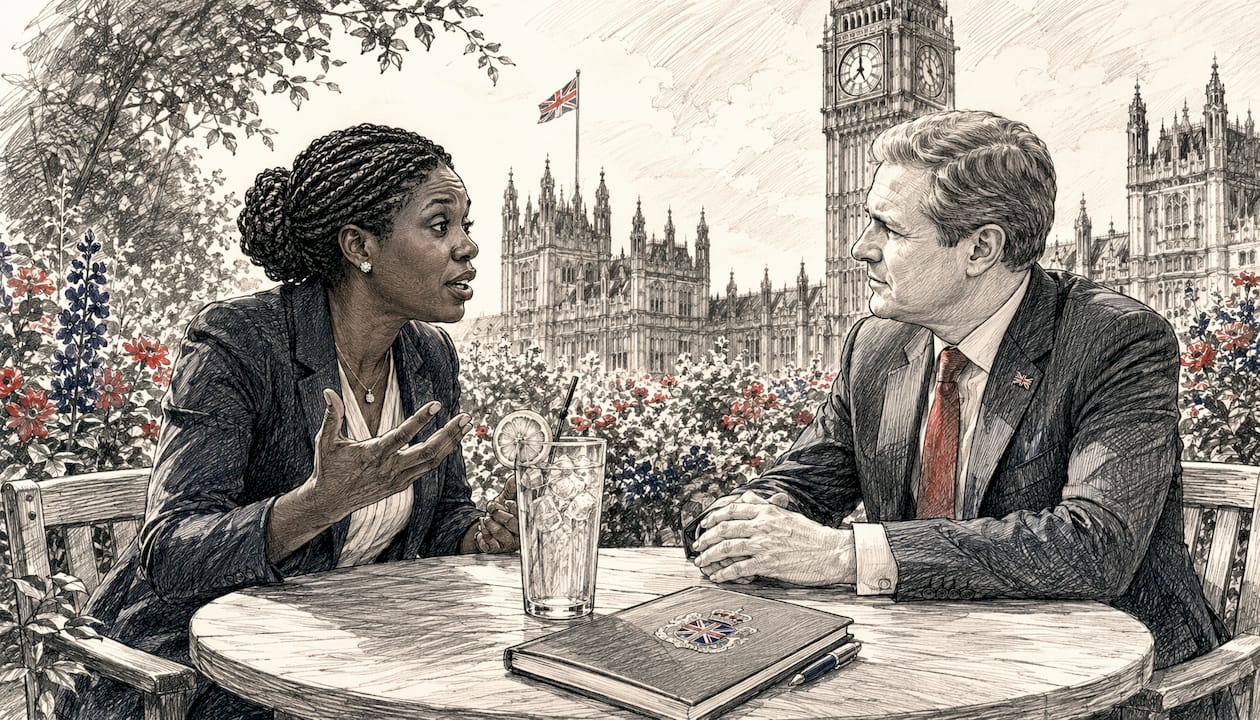
Calhoun at Whitebunnywabbit has covered UK political communication long enough to notice a consistent pattern: the politicians who persuade most effectively are rarely the ones who shout loudest. They combine appeals rather than defaulting to a single mode, and they read the room before they open their mouths.
Combining ethos, pathos, and logos produces more durable persuasion than relying on any one appeal alone. A speaker with strong credentials (ethos) who also tells a compelling human story (pathos) and backs it with evidence (logos) gives the audience multiple reasons to agree, rather than one reason to resist.
Personal pronouns — “I,” “you,” and “we” — simulate intimacy and shared identity, encouraging audience alignment and reducing critical scrutiny. This is why party leaders address conference halls as if speaking to a single person. The technique works precisely because it feels personal even when it is not.
The central route to persuasion relies on logic and evidence; the peripheral route relies on cues like rhythm, repetition, and source credibility. Skilled political communicators use both, calibrating the balance to the audience’s level of engagement. A distracted voter responds to peripheral cues; an engaged policy analyst demands the central route. You can explore structured argument and debate formats to see how these routes play out in practice.
Pro Tip: When analysing a political speech, identify which appeal dominates in the opening thirty seconds. That choice reveals what the speaker thinks the audience most needs to hear, and often tells you more about the political moment than the content itself.
Examples of rhetorical persuasion techniques in UK political discourse
UK political history offers some of the clearest examples of these techniques in action. Margaret Thatcher’s speeches combined ethos (the conviction politician who had earned her position) with logos (economic data presented as common sense) and a consistent use of antithesis to frame complex choices as binary. “There is no alternative” is simultaneously a logos claim and a scheme: the parallelism of the implied contrast does the emotional work.
Gordon Brown’s 2008 conference speech used anaphora extensively during the financial crisis, repeating “this is no time for” before a series of political attacks. The device transformed what could have been a defensive speech into an assertive one. Keir Starmer’s 2024 election campaign leaned heavily on ethos, presenting his legal background and prosecutorial record as evidence of competence and integrity.
The Leave campaign’s “Take back control” combined an imperative with a metaphor (sovereignty as something physically recoverable), making it a trope and a scheme simultaneously. Its kairos was near-perfect: it arrived when public frustration with EU institutions was at its peak.
How effective are these techniques in UK political contexts?
Effectiveness depends heavily on audience, timing, and the credibility of the speaker. Pathos works best when the emotional appeal aligns with a value the audience already holds; it fails when it feels manufactured or disproportionate. Logos persuades engaged, high-information audiences but tends to lose lower-engagement voters who respond more readily to peripheral cues like rhythm and repetition.
Fear appeals have a strong evidence base in public health communication, but in electoral politics they carry a higher risk of backlash. The 2015 Conservative “chaos with Ed Miliband” campaign used fear of economic instability effectively; the 2017 “strong and stable” repetition became a source of mockery when the political context shifted. Kairos, again, is the variable that determines whether a fear appeal lands or misfires.
Triples and anaphora consistently outperform single-statement claims in terms of memorability, which is why they survive across centuries of political oratory. The propaganda techniques analysis at Whitebunnywabbit explores how these same devices operate when the intent shifts from persuasion to manipulation.
How has rhetorical persuasion evolved in UK politics?
Classical rhetoric arrived in Britain through the Roman tradition, and parliamentary oratory from the 17th century onwards drew directly on Ciceronian models: elaborate sentence structures, extended metaphors, and formal appeals to precedent and authority. Ethos was paramount; a speaker’s social standing and classical education were themselves persuasive credentials.
The 20th century compressed and democratised political language. Radio demanded clarity and warmth over grandeur; television added visual ethos, making appearance and demeanour as persuasive as argument. Churchill bridged the classical and broadcast eras, using schemes and tropes honed in the Victorian tradition but delivered with a directness that worked on radio.
Social media has accelerated this compression further. A political message now competes for attention in a feed rather than a chamber, which privileges peripheral cues (rhythm, repetition, visual impact) over central route appeals (evidence, reasoning). The result is that kairos has become more important than ever: a message that might have persuaded in a long-form speech can misfire catastrophically when stripped of context and shared out of sequence.
What logical fallacies do politicians commonly use?
Logical fallacies are arguments that appear valid but contain structural flaws. Purdue OWL catalogues the most common ones, several of which appear routinely in UK political debate.
The slippery slope argues that one policy will inevitably lead to an extreme outcome through a chain of unstated steps. The hasty generalisation draws a broad conclusion from insufficient evidence. The ad hominem attacks the person making an argument rather than the argument itself, a staple of Prime Minister’s Questions. The false dilemma (either/or) reduces complex policy choices to two options, ignoring alternatives. The red herring diverts attention from the central issue by introducing an irrelevant but emotionally engaging point.
Recognising these fallacies does not automatically neutralise them. A well-delivered slippery slope argument, backed by emotive language and delivered with authority, can be more persuasive than a technically correct rebuttal. The fallacy works on the peripheral route even when the central route rejects it.
How can you identify and critically evaluate political rhetoric?
The most reliable method is to separate the what from the how. Strip a political claim of its rhetorical packaging and ask whether the underlying proposition is supported by evidence. If the argument collapses without the emotive language, the triple, or the fear appeal, the rhetoric is doing more work than the reasoning.
Check for kairos manipulation: is the urgency real, or is it manufactured to prevent scrutiny? Identify which compliance-gaining strategy is in play. Look for the fallacy beneath the scheme. For a practical framework, the misinformation tactics guide at Whitebunnywabbit applies many of these analytical tools to real-world cases.
Reading political speeches against the tropes/schemes distinction is also useful. A message built primarily on tropes (metaphor, irony, hyperbole) is manipulating meaning; one built primarily on schemes (parallelism, anaphora, antithesis) is manipulating structure. Both can be legitimate, but knowing which you are dealing with sharpens your analysis considerably.
How are these techniques applied in campaigning and debates?
Campaign messaging and live debate performance draw on the same toolkit but deploy it differently. Campaign slogans prioritise peripheral cues: they must be memorable, rhythmically satisfying, and emotionally resonant without requiring sustained attention. “Yes We Can,” “Get Brexit Done,” and “Strong and Stable” are all schemes first and arguments second.
Debate performance demands a faster, more adaptive combination of appeals. A debater who relies solely on logos risks appearing cold; one who relies solely on pathos risks appearing unserious. The most effective debate performances in UK political history, from Thatcher’s 1979 television appearances to Nigel Farage’s 2014 European election debates, combined credible ethos with well-timed emotional appeals and at least the appearance of logos.
Ingratiation appears in both contexts: the campaign that praises voters’ wisdom before asking for their support, and the debater who acknowledges an opponent’s point before dismantling it, are both using the same compliance-gaining mechanism. The political education insights at Whitebunnywabbit offer further context on why understanding these dynamics matters for informed political participation.
Key takeaways
Effective political persuasion combines ethos, pathos, logos, and kairos rather than relying on any single appeal, with rhetorical devices and compliance-gaining strategies amplifying each mode’s impact.
| Point | Details |
|---|---|
| Four core appeals | Ethos, pathos, logos, and kairos form the foundation of all political persuasion. |
| Devices amplify appeals | Triples, anaphora, and imperatives make messages memorable through rhythm and repetition. |
| Compliance strategies matter | Ingratiation, fear appeals, and guilt appeals target behaviour directly, not just belief. |
| Tropes vs schemes | Tropes alter word meaning; schemes alter word arrangement — knowing which is in play sharpens analysis. |
| Kairos is decisive | Timing and context often determine whether a technique persuades or backfires. |
Leave a Reply