
Engaging in editorial debate online is the practice of contributing structured, evidence-based arguments to public political discussions on digital platforms. Done well, it sharpens your thinking, builds credibility, and moves conversations forward rather than in circles. Platforms like The Debate Network, Reddit, and ParlAIment each offer different formats for this kind of participation, and the approach you take matters as much as the platform you choose. This guide gives you the practical framework to join, contribute to, and sustain productive online opinion exchange without losing your composure or your argument.
What do you need to engage editorial debate online?
The foundation of effective online debate is not eloquence. It is preparation. Before you post a single word, you need the right platform, the right mindset, and a basic understanding of community rules.
Platform selection is your first decision. Not all forums support genuine editorial debate. Structured digital debate platforms like The Debate Network offer live debates with speaking order controls, time limits, and no-recording policies that protect participants and keep discussions focused. These features matter because structured formats with turn-taking reduce chaos and protect participant privacy in ways that open comment threads simply cannot. Reddit, by contrast, offers scale and topical breadth but lacks formal debate mechanics, making it better suited to opinion exchange than structured argumentation.

Community guidelines are non-negotiable. The South Carolina Forum’s digital moderation policy bans personal attacks, offensive language, marketing content, and sharing others’ personal information. That is a useful benchmark for any forum you join. Platforms with clear, enforced rules produce better debates because participants know the boundaries before they start.
Personal skills are the third pillar. The most important is intellectual charity: the habit of interpreting your opponent’s position in its strongest possible form before you challenge it. Psychology Today’s 2026 guide on political conversations recommends this approach explicitly, noting that it reduces straw-manning and keeps dialogue productive. Alongside charity, you need claim-evidence-reasoning discipline. Every point you make should have a factual basis and a logical connection between the two.
| Platform | Format | Moderation | Best for |
|---|---|---|---|
| The Debate Network | Live structured debate | High, moderated turns | Formal argument practice |
| ParlAIment | Revision and retract mechanics | Medium, user-driven | Transparent editorial debate |
| Open threaded discussion | Variable by subreddit | Broad opinion exchange | |
| South Carolina Forum | Forum posts | Policy-enforced | Community political discussion |
Pro Tip: Before joining any platform, read its moderation policy in full. A forum that bans personal attacks and enforces it consistently is worth ten forums that merely ask for civility.
How to structure your contributions for clarity and impact
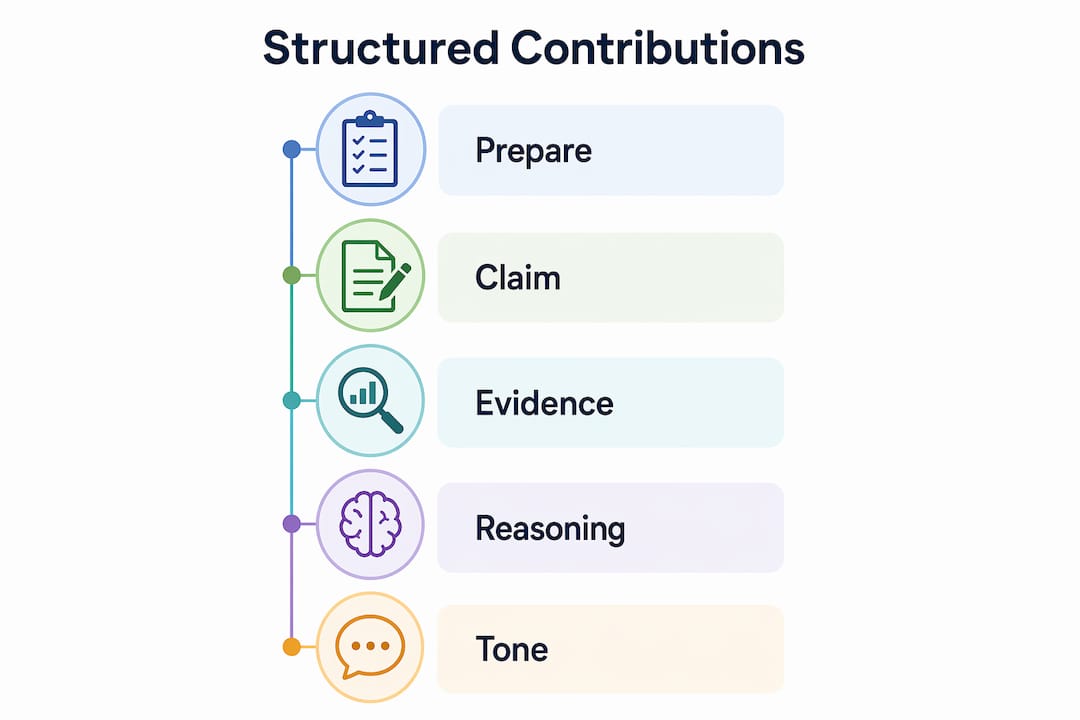
A well-structured contribution is the difference between an argument that changes minds and one that generates heat. The claim-evidence-reasoning method is the most reliable structure for online editorial debate, and it works precisely because it forces you to separate what you believe from why you believe it.
A 2026 guide on winning online arguments recommends making single points clearly with credible sources, staying calm, and choosing your arguments wisely rather than responding to every provocation. That last point is underrated. Responding to every sub-argument in a thread dilutes your position and signals that you are reacting rather than reasoning.
Follow this sequence when composing a contribution:
- State your claim directly. One sentence. No hedging, no preamble. “The proposed policy will increase unemployment in the short term” is a claim. “I think it might be worth considering whether…” is not.
- Cite your evidence. Link to a credible source or name a specific study, report, or documented event. Vague references to “research” carry no weight in editorial debate.
- Explain the reasoning. Connect the evidence to the claim explicitly. Do not assume the reader will make the logical leap themselves.
- Acknowledge the strongest counterargument. This is where intellectual charity pays off. Interpreting opposing views in their strongest form before challenging them signals confidence and reduces the likelihood of a defensive response.
- Pause before posting. A short delay between drafting and submitting reduces reactive language and catches errors in tone. This is especially important in live or fast-moving threads.
Tone is a technical matter, not just a social one. Sarcasm, condescension, and rhetorical flourishes that mock the opposing view all trigger defensive responses that derail the substance of the debate. Keep the language direct and the register neutral.
Pro Tip: Write your reply in a separate document first. Reading it back after five minutes reveals whether you are making an argument or venting frustration. Only post the former.
Which platforms best support editorial debate participation?
The platform shapes the debate. Choosing the wrong venue for the kind of discussion you want to have is one of the most common mistakes politically engaged readers make.
The Debate Network is the most structured option currently available for live online debate. Its speaking order controls and no-recording policy create a contained environment where participants can take genuine positions without fear of out-of-context screenshots. The trade-off is accessibility: live debates require scheduling and a committed opponent, which limits spontaneous participation.
ParlAIment takes a different approach. Its revision and retract features allow participants to formally name doubts about their own claims or withdraw statements as new evidence emerges. This is a significant design choice. It models editorial debate as an iterative process rather than a performance, which is closer to how serious political analysis actually works. Platforms offering these formal revision mechanics support accountability and reduce the kind of ephemeral conflict that turns comment sections into shouting matches.
Traditional forums and social media platforms offer reach but not structure. Reddit’s upvote system does have one measurable benefit: visible positive feedback is associated with increased participation the following day in community experiments. That means quality contributions on Reddit are self-reinforcing, at least in communities with active, engaged moderators.
| Platform | Live debate | Revision tools | Moderation quality | Accessibility |
|---|---|---|---|---|
| The Debate Network | Yes | No | High | Moderate |
| ParlAIment | No | Yes | Medium | High |
| No | No | Variable | Very high | |
| South Carolina Forum | No | No | Policy-enforced | High |
For anyone serious about how to join editorial debates with real structure and accountability, The Debate Network and ParlAIment are the two platforms worth prioritising. Reddit and traditional forums are better used as spaces to practise contributing to online editorials before moving to more formal venues.
How to overcome common challenges in online editorial debates
The most persistent obstacle to productive online debate is not bad faith opponents. It is the environment itself. Research from a 2025 Reddit experiment with 520 participants found that perceptions of toxicity predicted both lurking behaviour and power-user dominance. The implication is direct: if a thread feels hostile, most people go silent, leaving the space to the loudest voices.
Here is how to manage the most common pitfalls:
- Perceived toxicity. If a thread feels hostile, do not engage with the hostile posts directly. Respond to the substantive arguments and ignore the rhetorical aggression. You are writing for the readers watching the exchange, not just the person you are replying to.
- Power-user dominance. Some forums are effectively controlled by a small number of highly active users who set the tone. If their tone is unconstructive, contributing to online editorials on platforms with stronger moderation is a better use of your time.
- Personal attacks. Never respond to a personal attack with another personal attack. Flag it if the platform allows, and return to the argument. Moderation policies that ban personal attacks exist precisely because this cycle destroys debate quality.
- Incentive gaps. Research shows that civility appeals alone have limited effect on participation rates. Platforms that use positive feedback mechanisms, such as upvotes or quality badges, sustain engagement more effectively than those that rely on asking people to be polite.
- Knowing when to exit. Not every debate is worth finishing. If a thread has moved from argument to insult, a clean exit is not a concession. It is a recognition that the conditions for genuine discourse no longer exist.
Learning how to start online discussions on the right foot reduces the likelihood of encountering these problems in the first place. The first post in a thread sets the tone for everything that follows.
Key takeaways
Effective online editorial debate requires structured platforms, disciplined argument construction, and the intellectual honesty to engage opposing views at their strongest.
| Point | Details |
|---|---|
| Choose structured platforms | The Debate Network and ParlAIment offer format controls that open forums cannot replicate. |
| Apply claim-evidence-reasoning | Every contribution needs a clear claim, cited evidence, and an explicit logical connection. |
| Practise intellectual charity | Interpret opposing views in their strongest form before challenging them to avoid straw-manning. |
| Understand toxicity dynamics | Perceived hostility drives lurking; quality contributions with positive feedback sustain engagement. |
| Know when to disengage | Exiting an unproductive thread is a strategic choice, not a defeat. |
Why structured debate changed how I participate online
The honest truth about online political debate is that most of it is not debate at all. It is performance. People arrive with conclusions and look for applause, not argument. I spent years doing exactly that on general social media platforms, and the result was a lot of heat and very little light.
What changed my approach was encountering platforms that imposed structure. When you have a speaking order, a time limit, and a no-recording rule, the incentive to grandstand drops sharply. You are forced to actually engage with what the other person said rather than pivot to your preferred talking point. That discipline, once practised in a structured environment, carries over into less formal spaces.
The other shift was adopting intellectual charity as a genuine habit rather than a rhetorical tactic. There is a real difference between dialogue and debate, and the most productive online exchanges I have had started as the former. You ask questions, you try to understand the strongest version of the opposing view, and only then do you push back. The conversations that follow that sequence are qualitatively different from the ones that start with a broadside.
My practical advice: start on a structured platform, even if it feels slower and more demanding than a Reddit thread. The habits you build there will make you a better participant everywhere else. And read the moderation policy of every forum you join. A platform that enforces its rules is worth far more than one with a longer user list and no standards.
— John
Explore more at Whitebunnywabbit

Whitebunnywabbit covers political analysis, current affairs, and editorial commentary for readers who want more than headlines. If this guide has sharpened your thinking about how to participate in online discussions with more structure and purpose, the site offers a range of opinion pieces and debate-focused content to keep that momentum going. Visit Whitebunnywabbit to read commentary that takes political argument seriously, and explore the education resources for further reading on debate skills and critical thinking. The best editorial debates start with well-informed participants.
FAQ
What does it mean to engage in editorial debate online?
Engaging in editorial debate online means contributing structured, evidence-based arguments to public political discussions on digital platforms. It differs from casual comment threads in that it requires claim-evidence-reasoning discipline and respect for community guidelines.
Which platforms are best for structured online debate?
The Debate Network offers live structured debates with speaking order controls, while ParlAIment provides revision and retract features for more transparent editorial exchange. Both are more structured than Reddit or general forums.
How do I avoid toxicity in online political discussions?
Research from a 2025 Reddit experiment found that perceived toxicity drives lurking rather than participation. Focus your replies on substantive arguments, ignore personal attacks, and prioritise platforms with enforced moderation policies.
Does intellectual charity actually improve debate quality?
Psychology Today’s 2026 guide confirms that interpreting opposing views in their strongest form before challenging them reduces straw-manning and improves the quality of political conversations significantly.
What is the claim-evidence-reasoning structure?
It is a three-part argument format: state a clear claim, support it with cited evidence, then explicitly connect the two with logical reasoning. A 2026 guide on online argumentation recommends this approach alongside making single points clearly and staying calm throughout.
Leave a Reply