
Satire is defined as a form of creative commentary that uses irony, exaggeration, and humour to critique social or political subjects, and it is not designed to inform you of facts. Real news, by contrast, is fact-based reporting produced by journalists who aim to describe events accurately and objectively. The gap between the two has narrowed sharply in 2026, making it harder than ever to distinguish satire from real news without a deliberate, structured approach. Organisations like the Poynter Institute and Lead Stories have developed specific frameworks to help readers do exactly that. This guide walks you through the key signals, practical tools, and mental habits that separate satirical content from genuine journalism.
What characteristics distinguish satire from real news?
Satire relies on four core techniques: exaggeration, incongruity, parody, and reversal. Each technique is designed to expose a flaw or absurdity in society, not to deceive the reader into believing something false. Real news, by contrast, uses neutral language, named sources, and verifiable facts to describe what actually happened.
The intent behind each type of content is the clearest dividing line. Satire aims to mock or provoke thought, while disinformation aims to mislead for personal or political gain. Real news sits in a third category entirely: its purpose is to inform without a persuasive agenda.
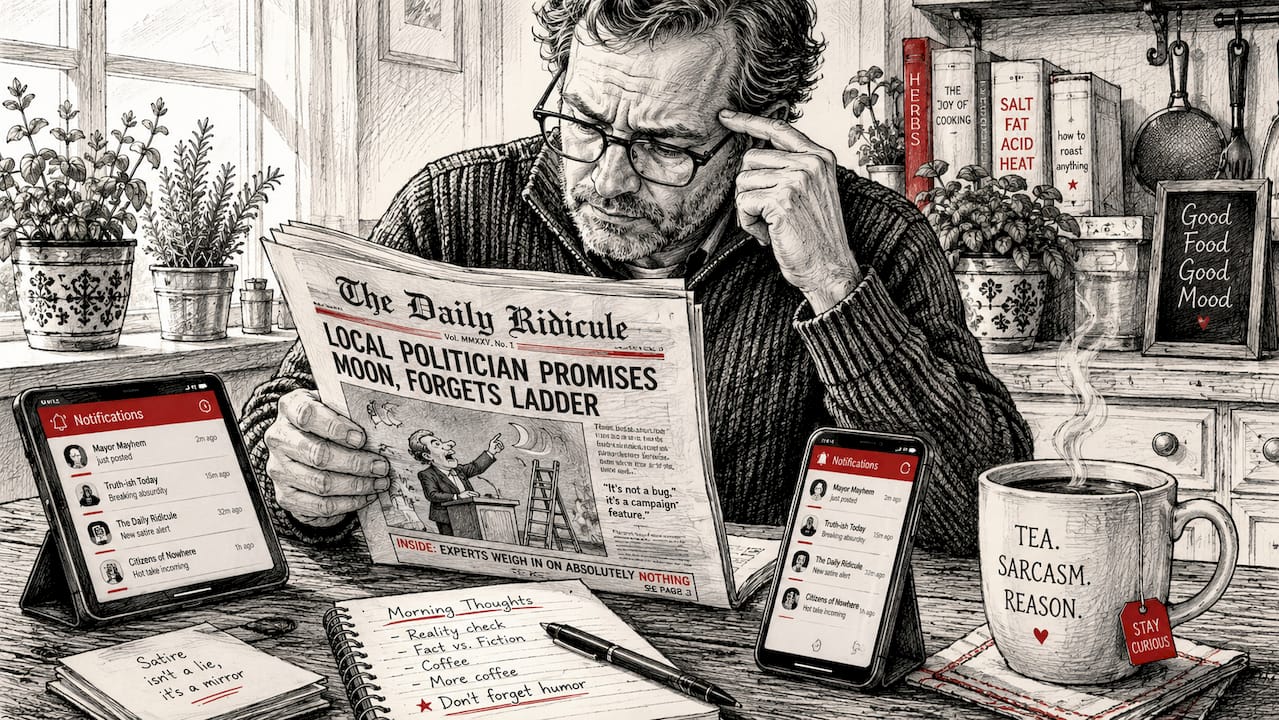
Tone is the next signal to examine. Satirical pieces often carry an unmistakable wink. Headlines are slightly too absurd, quotes are attributed to fictional spokespeople, and the overall register is playful or biting. Real news headlines are dry and specific, naming dates, locations, and individuals.
Satire is journalism about reality, which means it often requires background knowledge to decode the ironic layer. A reader unfamiliar with a political figure’s actual positions may read a satirical piece about them as straight reporting. This is why context matters as much as content.
Key characteristics to look for include:
- Disclaimers: Legitimate satire sites like The Onion or The Babylon Bee carry visible “satire” or “humour” labels in their site headers or About pages.
- Named sources: Real news quotes real, named individuals with verifiable credentials. Satire invents names or uses obviously fictional titles.
- Tone and register: Satire uses irony, absurdist logic, and comic timing. Real news avoids all three.
- URL and branding: Satirical sites sometimes mimic real news domains (e.g., “ABCnews.com.co”). A close look at the full URL reveals the difference.
Pro Tip: Before sharing any article, check the site’s About page. A genuine satire outlet will say so plainly. If there is no About page at all, treat the content with serious scepticism.
How can you identify satire using practical verification steps?
Lead Stories, one of the most active fact-checking organisations in 2026, recommends a 3-step validation process: check the About or bio section of the site, verify the central claim with at least two reputable outlets, and assess whether the URL and site design match a credible news brand.
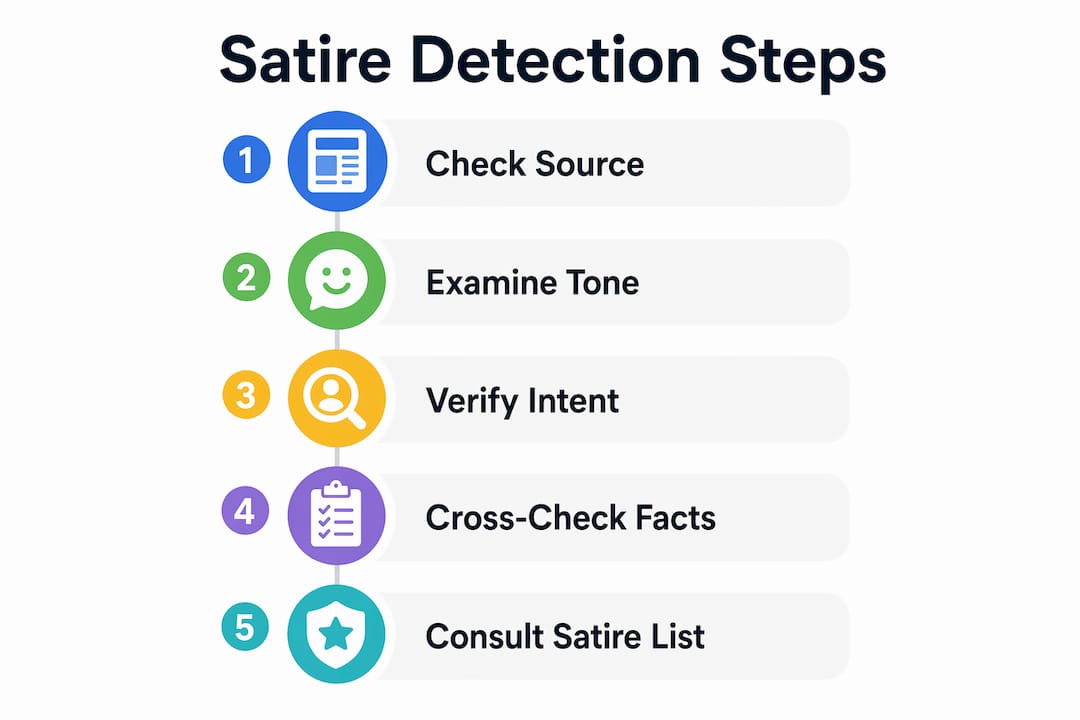
This process takes under five minutes and catches the majority of misidentified satire before it spreads. The second step is the most powerful. If a claim appears only on one obscure site and nowhere else, that absence is itself a red flag.
The SIFT Test is a complementary framework worth learning. SIFT takes about 20 minutes to learn and guides you through four actions: Stop, Investigate the source, Find better coverage, and Trace claims to their origin. It was developed for exactly the kind of ambiguous content that floods social media feeds in 2026.
Here is how to apply the SIFT Test in practice:
- Stop before reacting emotionally. If a headline makes you angry or gleeful, that reaction is a signal to pause, not share.
- Investigate the source by opening a new tab and searching the outlet’s name alongside words like “satire” or “bias.”
- Find better coverage by checking whether BBC News, Reuters, or Associated Press have reported the same story.
- Trace claims back to their origin. A screenshot of a tweet is not a primary source. Find the original document or statement.
Fact-checkers monitor social media comments to gauge whether satire is being mistaken for truth. When public confusion reaches a threshold, Lead Stories will label a piece as potentially misleading even if the original site carries a satire disclaimer. Hidden disclaimers buried in footers are a hallmark of deceptive “fauxtire,” a category of content that mimics satire’s legal protections while functioning as deliberate misinformation.
| Verification Method | Time Required | Best Used For |
|---|---|---|
| About page check | Under 1 minute | Identifying satire sites quickly |
| SIFT Test | 5–20 minutes | Ambiguous viral claims |
| Cross-reference with Reuters or BBC | 2–5 minutes | Breaking news verification |
| URL inspection | Under 1 minute | Spotting copycat domains |
Pro Tip: Treat unverified social media claims with the same scepticism you would apply to something overheard on a bus. Emotional resonance is not evidence.
What challenges make satire harder to spot?
None of us consume information purely rationally. Existing beliefs shape how we interpret what we read, a cognitive pattern known as confirmation bias. University of Washington and Deseret News researchers note that when satirical content confirms what we already believe, we are far more likely to accept it as true and share it without checking.
This is the core psychological trap. A satirical article mocking a politician you dislike feels credible because you want it to be true. One mocking a politician you support feels obviously fake. The content has not changed. Your prior beliefs have done the interpretive work.
“Satirical headlines can sometimes be indistinguishable from real government announcements.” — Indian Satire editors, 2026
Deadpan magnification makes this worse. This technique slightly amplifies a real absurdity rather than inventing one wholesale. The result is a satirical piece that contains a genuine kernel of truth, wrapped in exaggeration so subtle that many readers miss it entirely. Deadpan magnification amplifies real absurdities just enough to make satire effective, but not enough to make it obviously fictional.
Poe’s Law compounds the problem further. Without clear signals, satirical content can be indistinguishable from sincere extremism. When real political events become genuinely bizarre, satire writers struggle to exaggerate them enough to signal their intent. Readers then mistake the satire for reporting, or mistake real reporting for satire.
The challenges readers face most often include:
- Confirmation bias: Believing satirical content that matches existing views.
- Emotional manipulation: Emotional reactions to satire are frequently mistaken for evidence of truth.
- Fauxtire: Deceptive content that uses satire’s legal cover while hiding its disclaimer.
- Poe’s Law: Extreme real events that make satire indistinguishable from reality.
- Deadpan magnification: Subtle exaggeration that preserves enough truth to deceive.
Understanding how clickbait exploits emotional reactions is directly relevant here. The same psychological levers that make clickbait effective also make fauxtire dangerous.
Which tools and habits help you stay clear-headed long-term?
Media literacy should focus on objective fact-checking, not on deciding which outlets to trust based on political alignment. This distinction matters enormously. Trusting a source because it shares your worldview is not media literacy. It is confirmation bias with a respectable name.
The most reliable tools for ongoing clarity are:
- Lead Stories (leadstories.com): Monitors viral claims and labels satire and false content in near real time.
- Reuters Fact Check: Covers global claims with transparent sourcing.
- Google News: Aggregates coverage across outlets, making it easy to spot stories that appear on only one site.
- Browser extensions like NewsGuard rate the credibility of news sites directly in your browser.
| Approach | Passive Consumption | Critical Evaluation |
|---|---|---|
| Headline reading | Accept at face value | Cross-reference with a second source |
| Emotional response | Share immediately | Pause and apply SIFT |
| Source familiarity | Trust by habit | Check About page and ownership |
| Social media claims | Treat as news | Treat as unverified until confirmed |
Beyond tools, habits matter more than any single app. Read past the headline every time. Headlines are written for clicks, not accuracy, and viral political commentary frequently relies on a misleading headline attached to a more nuanced article. Seek out multiple perspectives on the same story. Recognise when your emotional response is being triggered and treat that trigger as a reason to slow down, not speed up.
Avoiding echo chamber consumption is the structural habit that underpins all the others. When your information diet is diverse, no single satirical or misleading piece can dominate your perception of an event.
Understanding the difference between a think piece and news reporting also sharpens your overall judgement. Opinion, commentary, and satire all occupy different positions on the same spectrum, and recognising each one makes you a sharper reader across the board.
Key takeaways
Distinguishing satire from real news requires checking intent, tone, source credibility, and structural signals before accepting or sharing any piece of content.
| Point | Details |
|---|---|
| Intent is the core dividing line | Satire mocks or provokes thought; real news informs without a persuasive agenda. |
| Use the SIFT Test | Stop, Investigate, Find better coverage, and Trace claims before sharing anything. |
| Confirmation bias is the biggest risk | Beliefs shape interpretation, so check sources even when content feels obviously true. |
| Fauxtire hides its disclaimers | Deceptive satire buries its labels; always check the About page and full URL. |
| Habits outperform tools | Reading past headlines and seeking multiple perspectives matters more than any single app. |
Why i think we are all worse at this than we admit
I have spent years reading political commentary, news analysis, and satire side by side, and the honest conclusion is uncomfortable. Most of us are not nearly as good at spotting the difference as we believe. The pieces that fool me are never the obviously absurd ones. They are the ones that are 90% accurate, with one exaggerated detail buried in the third paragraph.
The satire signal, as researchers describe it, is structural and tonal. You have to look beyond your emotional response to find it. That is genuinely difficult when the content is about something you care about deeply. I have caught myself sharing things I had not fully read, simply because the headline confirmed something I already suspected. That is not a failure of intelligence. It is a failure of habit.
What I have found actually works is treating every strong emotional reaction as a pause signal rather than a green light. The more a piece makes me want to share it immediately, the more carefully I read it first. This sounds simple. Practising it consistently is harder than any fact-checking tool.
The broader point is that understanding why opinion pieces go viral gives you a structural advantage. Once you understand the mechanics of emotional manipulation in media, you start to see the levers being pulled. That awareness does not make you immune, but it does make you slower to react, and slower is better.
— John
Stay sharp with Whitebunnywabbit
Whitebunnywabbit covers political news, commentary, and media analysis with the kind of directness that helps you read the media environment more clearly. Whether you are trying to separate genuine reporting from spin, or understand why a story went viral overnight, the site offers breaking news analysis and commentary that rewards critical readers.

If you want to sharpen your media literacy further, Whitebunnywabbit is the place to start. The site’s political commentary and news aggregation give you the raw material to practise everything covered in this guide, from spotting tonal signals to cross-referencing claims across multiple sources. Visit the site and read with fresh eyes.
FAQ
What is the simplest way to spot satire?
Check the site’s About page first. Legitimate satire outlets like The Onion or The Babylon Bee label themselves plainly, and that single check resolves the majority of cases.
How does poe’s law affect real news vs satire?
Poe’s Law states that without a clear signal, satirical content can be indistinguishable from sincere extremism. When real events become genuinely bizarre, satire writers cannot exaggerate them enough to make the fictional intent obvious.
What is fauxtire and why is it dangerous?
Fauxtire is deceptive content that mimics satire’s legal protections while hiding its disclaimer in a footer or obscure page. Lead Stories identifies it by monitoring whether social media audiences are treating the content as factual news.
Does the SIFT test work for recognising satirical content?
Yes. The SIFT Test, which guides you to Stop, Investigate, Find better coverage, and Trace claims, takes about 20 minutes to learn and applies directly to ambiguous satirical or misleading content.
Why do people share satire as if it were real news?
Confirmation bias is the primary cause. When satirical content matches existing beliefs, readers interpret the emotional resonance as evidence of truth and share without verifying, a pattern documented by University of Washington media literacy researchers.
Leave a Reply