
Churnalism is defined as the practice of producing news by recycling press releases and pre-packaged content without independent verification or original reporting. The term was coined by Nick Davies in 2008 to describe high-volume, low-effort news production driven by time pressure and shrinking newsroom budgets. Understanding churnalism matters because it sits at the centre of a broader crisis in public trust. When journalists repackage wire copy or PR material without scrutiny, readers receive a filtered version of reality shaped by whoever wrote the original release. Whitebunnywabbit covers these media literacy themes regularly, and this guide gives you the clearest breakdown of what churnalism means, how it works, and why it matters.
What is churnalism explained: the pressures that create it
Churnalism does not emerge from laziness alone. Structural newsroom changes with fewer specialist staff create the conditions where reactive reporting becomes the default. When a newsroom loses its health correspondent, a generalist editor must cover NHS announcements, pharmaceutical studies, and public health policy simultaneously. That editor has neither the expertise nor the time to interrogate a press release properly.
The pressures stack up in a predictable sequence:
- Budget cuts reduce headcount. Fewer journalists must produce the same volume of stories each day.
- Deadlines compress. The 24-hour news cycle demands constant output, leaving little room for verification calls or document requests.
- Specialisation disappears. Generalist reporters covering multiple topics rely heavily on pre-packaged content because they lack the domain knowledge to challenge it.
- Wire dependency grows. Journalists process wire copy and add minimal local context rather than conducting original investigative work.
- PR output expands. As newsrooms shrink, public relations teams grow. The ratio of PR professionals to journalists has shifted dramatically in favour of PR, flooding inboxes with ready-to-publish material.
Each factor reinforces the others. A journalist under pressure to file three stories before noon will reach for the press release sitting in their inbox rather than spend two hours making calls.
Pro Tip: When reading a news article, check whether it quotes only one source. Single-source stories are a reliable signal that the journalist worked from a press release rather than independent reporting.
How does churnalism work in practice?
The most striking illustration of churnalism in action comes from a single data point. Over 90% of a polling company’s research was repeated word-for-word across major newspaper coverage. That figure shows how quickly unverified claims travel when journalists treat a press release as a finished story.
A single NHS press release was published by 14 separate news outlets with almost no changes. Readers across those 14 outlets believed they were reading independent reporting. They were reading the same document with different mastheads attached.

Tools like Churnalism.com exist specifically to detect this. The site allows readers to paste a news article and compare it against a database of press releases, identifying verbatim or near-verbatim matches. The tool has scope limitations, but it demonstrates the scale of the problem in UK media clearly.
Common scenarios where churnalism appears most frequently include:
- Polling and survey stories. Research firms issue press releases summarising findings. Journalists publish the headline figure without reading the full methodology.
- NHS and government health announcements. Medical press releases carry authority, which reduces the instinct to question them.
- Wire copy republication. Regional outlets republish national wire stories with a local dateline added, presenting them as original coverage.
- Corporate earnings and product launches. Business desks often run company-issued summaries with minimal additional comment.
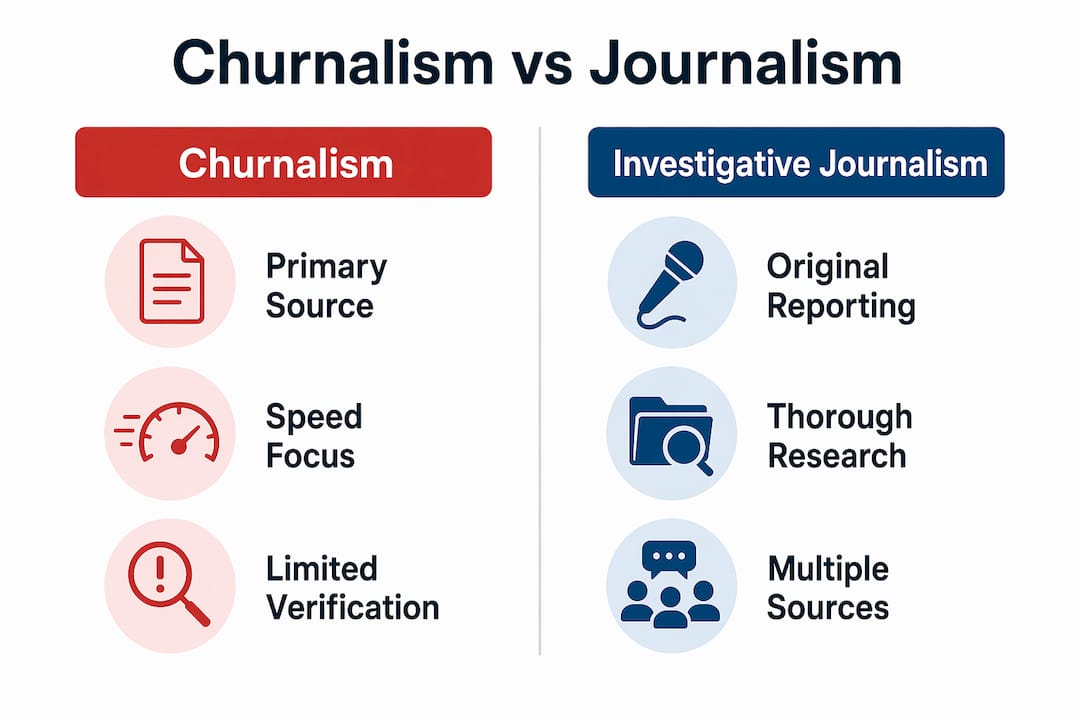
The table below shows the core differences between churnalism and investigative journalism.
| Feature | Churnalism | Investigative journalism |
|---|---|---|
| Primary source | Press release or wire copy | Original documents, interviews, data |
| Verification | Minimal or absent | Multiple independent sources |
| Time investment | Minutes to hours | Days to months |
| Agenda awareness | Often absent | Central to the process |
| Public value | Variable | Consistently high |
What ethical issues surround churnalism?
Press releases are legitimate sources, but excessive plagiarism and a failure to verify information cross the ethical line. That distinction matters because it separates two very different practices that share the same surface appearance.
Accepting source narratives at face value is the fundamental ethical failing in churnalism. A press release is not a neutral document. It is written to advance a specific agenda, highlight successes, and conceal inconvenient nuances. A journalist who publishes it unchanged becomes a conduit for that agenda without telling readers so.
The ethical questions journalists should ask before using any press release include:
- Who funded the research or initiative being announced?
- What does the press release omit that a reader would want to know?
- Has the central claim been independently verified by a second source?
- Does the language in the release contain spin or loaded framing?
- Would the story exist without the press release, or is the PR team driving the news agenda?
“Acceptable churnalism involves transforming press releases into accessible, verified content that adds genuine public value.” — Can Churnalism Ever Be Ethical?
There is a version of churnalism that serves the public well. A journalist who takes a dense government report, strips out the bureaucratic language, verifies the key figures with an independent expert, and writes a clear 400-word summary has done something useful. That process is translation, not plagiarism. The ethical line sits between transformation and reproduction.
Pro Tip: Before publishing any story built on a press release, ask one question a PR professional would not want you to ask. That question is usually the story.
What impact does churnalism have on public discourse?
Churnalism degrades public discourse in ways that compound over time. When the same unverified claim appears across 14 outlets simultaneously, readers encounter it repeatedly and treat repetition as confirmation. That is how misinformation embeds itself in public understanding without anyone deliberately lying.
The effects of churnalism on news quality include several patterns that critical readers should recognise:
- Homogeneous narratives. When all outlets run the same press release, the range of perspectives in public debate narrows.
- Unverified data circulates as fact. Polling figures, health statistics, and economic claims published without scrutiny become reference points in political arguments.
- Watchdog journalism declines. Time spent processing press releases is time not spent investigating power. The role of media watchdogs becomes harder to fulfil when resources are thin.
- Source trust erodes. Readers who discover that a story was lifted from a press release lose confidence in the outlet, even when that outlet publishes original work.
- Democratic accountability weakens. Governments and corporations that know journalists will publish their releases unchallenged face less scrutiny than they should.
The connection between accelerating news cycles and churnalism is direct. Faster cycles demand more content. More content requires more shortcuts. More shortcuts produce more churnalism. Readers who want to protect themselves from this cycle need to develop the habit of asking where a story originated before accepting its claims.
Practical steps for critical news readers include checking whether a story cites primary documents, whether it quotes more than one independent source, and whether the language reads like corporate or government communications rather than journalism.
Key takeaways
Churnalism is a structural problem rooted in newsroom resource cuts, not a personal failing, and distinguishing it from ethical source use requires asking whether a journalist verified, transformed, or simply reproduced what they received.
| Point | Details |
|---|---|
| Churnalism definition | News produced by reproducing press releases without independent verification or original reporting. |
| Root cause | Structural newsroom cuts reduce specialist staff and compress deadlines, forcing reliance on pre-packaged content. |
| Ethical distinction | Using press releases is acceptable; publishing them verbatim without verification crosses the ethical line. |
| Detection tools | Churnalism.com and single-source checks help readers identify reproduced content in published articles. |
| Public impact | Repeated unverified claims narrow public debate and weaken democratic accountability over time. |
The uncomfortable truth about newsroom reality
Churnalism is one of those problems that is easy to condemn from the outside and almost impossible to avoid from the inside. I have watched talented journalists file stories they knew were thin because the alternative was missing a deadline and leaving a gap on the page. That is not a moral failure. It is a resource failure dressed up as an editorial one.
What troubles me more than the practice itself is the refusal to name it honestly. Newsrooms that rely heavily on press releases rarely admit it. Editors who know their staff are processing wire copy rather than reporting rarely say so publicly. That silence is where the real ethical problem lives. Readers deserve to know when a story originated with a PR team.
The distinction between ethical and lazy churnalism is real, and I think it gets lost in the debate. A journalist who takes a complex scientific paper, verifies its central finding with an independent researcher, and writes a clear explanation for a general audience has done something worth reading. A journalist who copies a pharmaceutical company’s press release and changes three words has not. Both practices look identical on the page. That is precisely why source verification matters so much.
My honest view is that readers have more power here than they realise. Demand bylines. Ask where the story came from. If an article cites only one source and that source issued a press release the same morning, treat the story as a starting point rather than a conclusion. Media literacy is not a specialist skill. It is the minimum standard for consuming news responsibly in 2026.
— John
Whitebunnywabbit and the case for media literacy
Churnalism thrives where readers do not question what they read. Whitebunnywabbit exists to change that.
The site publishes analysis, commentary, and guides designed for readers who want to understand how news is made, not just what it says. Whether you are a student writing a media studies essay, a journalist examining your own practice, or a reader who wants to stop being misled, the education resources at Whitebunnywabbit give you the frameworks to think critically about every story you encounter. From media literacy guides to political analysis, the site treats its readers as people capable of handling the full picture. That is a rarer commitment than it should be.
FAQ
What does churnalism mean?
Churnalism refers to news produced by recycling press releases or wire copy without independent verification. The term was coined by Nick Davies in 2008 to describe high-volume, low-effort journalism driven by newsroom resource pressures.
How can I spot churnalism in a news article?
Check whether the article cites only one source and whether the language reads like a corporate or government announcement. Tools like Churnalism.com allow readers to compare published articles against press release databases to identify verbatim matches.
Is churnalism always unethical?
Not always. Using a press release as a starting point and then verifying its claims with independent sources is acceptable practice. The ethical line is crossed when journalists reproduce press release content verbatim without verification or disclosure.
What are the main effects of churnalism on journalism?
Churnalism narrows the range of perspectives in public debate, allows unverified claims to circulate as fact, and reduces the time journalists spend on original investigative work. Over time, it erodes reader trust in news outlets.
Who coined the term churnalism?
Nick Davies coined the term in 2008 in his book Flat Earth News, using it to describe the structural conditions in modern newsrooms that produce reactive, press-release-dependent reporting rather than original journalism.
Leave a Reply