
Talk radio is defined as a broadcast format that shapes public opinion primarily by controlling which issues audiences consider urgent and how those issues are interpreted. This influence operates through two well-established mechanisms in media studies: agenda-setting and framing. The impact of talk radio on political discourse is not accidental. It is structural, built into the format’s regulatory history, its conversational style, and the psychological bond between host and listener. Understanding how talk radio shapes opinion requires examining all three layers.
How does talk radio shape opinion?
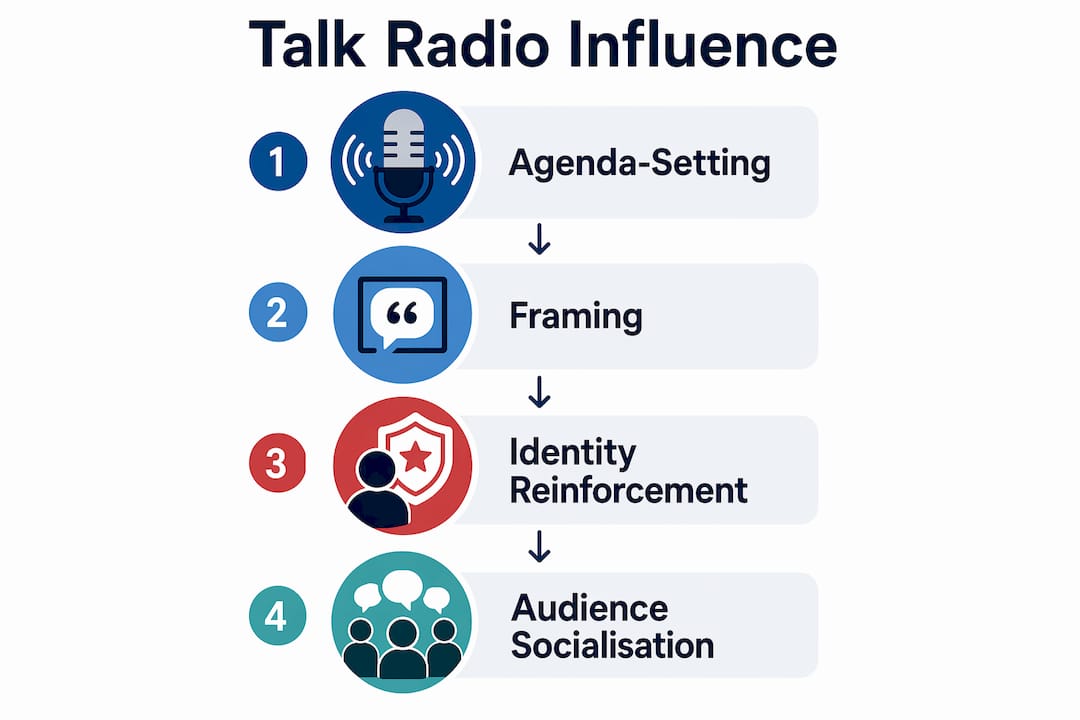
Talk radio shapes opinion through agenda-setting, the process by which repeated issue coverage convinces listeners that certain topics are urgent or important. The mechanism does not tell people what to think. It tells them what to think about. That distinction is critical for anyone studying media influence.
Framing works alongside agenda-setting. A host who describes a protest as a “mob” and another who calls it a “demonstration” are reporting the same event with opposite interpretive signals. Listeners who hear one framing before encountering alternative sources are already primed. Media framing nudges interpretation before the audience has a chance to compare perspectives.
Talk radio also functions as a form of adult socialisation. Regular listeners do not simply absorb information. They develop a political identity and a sense of group belonging reinforced by high-frequency consumption. This tribal dynamic explains why fact-checking rarely dislodges beliefs formed through sustained talk radio exposure. The belief is not just an opinion. It is part of who the listener understands themselves to be.
The persuasive effects are also durable. Research shows that even a single exposure to partisan talk radio messaging can influence attitudes for over a week. Daily consumption compounds that effect into lasting attitudinal change. That finding reframes talk radio from background noise into an active political force.
Key mechanisms at work include:
- Agenda-setting: Volume and frequency of coverage determine which issues feel important to listeners.
- Framing: Selection and emphasis of facts guide interpretation before alternative views arrive.
- Socialisation: Repeated exposure builds political identity and group loyalty.
- Durability: Persuasive effects persist well beyond individual broadcasts.
How did the Fairness Doctrine repeal transform talk radio?
The Fairness Doctrine was a Federal Communications Commission (FCC) policy that required broadcasters to present contrasting viewpoints on controversial public issues. While it remained in force, partisan talk radio had limited room to grow. Stations faced legal obligations to air opposing perspectives, which made one-sided political commentary commercially and legally risky.
The FCC repealed the Fairness Doctrine in 1987 under the Reagan administration. The consequences were immediate and measurable. The number of talk radio stations increased 17-fold between 1987 and 2004. That figure represents one of the most rapid expansions of any single media format in American broadcasting history.
| Period | Regulatory environment | Talk radio growth |
|---|---|---|
| Pre-1987 | Fairness Doctrine in force | Limited partisan formats |
| 1987 | FCC repeals Fairness Doctrine | Deregulation begins |
| 1987–2004 | Open market for partisan content | 17-fold increase in stations |
| Post-2004 | Established partisan ecosystem | Hosts become political actors |
The deregulation did not simply allow more stations. It created a commercial incentive for polarisation. Partisan content attracted loyal audiences, and loyal audiences attracted advertisers. Hosts who staked out strong ideological positions built larger followings than those who hedged. The market rewarded extremity, and the format evolved accordingly.
Pro Tip: When analysing any talk radio programme, identify which topics receive repeated coverage across multiple episodes. That pattern reveals the agenda being set, regardless of the host’s stated political position.
What makes talk radio so persuasive?
Talk radio’s persuasive power rests on a style that academics describe as “disinhibited informalisation.” This means the format deliberately suspends normal discourse norms. Hosts use casual, often crude language to create a sense of equality between themselves and their listeners. The implicit message is that formal, polished media speaks at audiences, while talk radio speaks with them.
This style constructs a clear social boundary. The populist identity dynamic positions hosts and listeners together as ordinary people standing against “liberal elites” or establishment institutions. That framing amplifies mistrust of competing media sources and makes listeners more resistant to outside information. The format does not just deliver content. It builds a community with shared enemies.
Hosts reinforce this dynamic by positioning themselves as partisan advocates rather than neutral observers. They are not journalists presenting facts. They are warriors fighting on behalf of their audience. That role creates intense listener loyalty because the host appears to share the listener’s values and frustrations.
The call-in format adds another layer. Callers who get through feel validated and heard. Even screened calls create a perception of open access. Research confirms that call-in formats provide psychological validation more than genuine debate. The result is an enhanced sense of tribal belonging rather than a genuine exchange of views.
Hosts also serve as what researchers call “morale officers.” Their primary function is not to persuade outsiders. It is to reinforce the existing beliefs and identity of the in-group. That role makes their influence particularly resistant to fact-checking, because the audience is not primarily seeking information. They are seeking confirmation and solidarity.
- Disinhibited informalisation: Casual style creates false peer equality between host and listener.
- Partisan advocacy: Hosts frame themselves as fighters for the audience, not neutral reporters.
- Call-in validation: Screened calls reinforce belonging rather than enabling genuine debate.
- Morale officer function: Hosts prioritise identity reinforcement over persuading new converts.
Pro Tip: Listen to a talk radio programme with the sound on mute for the first minute, then with full audio. The tonal shift from formal broadcast norms to casual intimacy becomes immediately apparent, which is the informalisation mechanism in action.
How does framing shape political discourse in practice?
Framing is the process by which media selects, emphasises, and excludes information to guide how audiences interpret events. Talk radio applies this mechanism with particular efficiency because hosts speak continuously, without the editorial pauses built into print journalism. The framing of political events reaches listeners before they encounter alternative interpretations.
Consider how a single policy debate can be framed in opposite directions. A tax increase becomes either “investment in public services” or “government overreach into your wallet,” depending on which frame the host applies. Neither description is factually false. Both are selective. The listener who hears one frame first is already interpreting subsequent information through that lens.
Talk radio’s role in elevating partisan viewpoints within political conversations has grown as conservative radio hosts have evolved into influential political actors whose endorsements shape elections and legislative agendas. This is not a peripheral effect. It is the format operating at full capacity.
- A host selects which stories to cover, establishing the agenda.
- The host frames each story with specific language that guides interpretation.
- Repeated coverage across days and weeks embeds that frame as the default lens.
- Listeners encounter alternative sources already primed by the established frame.
- The frame becomes part of the listener’s political identity, making it resistant to revision.
The news framing effect is not unique to talk radio, but the format amplifies it through duration and intimacy. A newspaper reader can skip an article. A commuter listening to three hours of radio absorbs the frame whether or not they consciously engage with it. That passive absorption is precisely what makes the medium so effective at shaping public perception over time.
Understanding media narrative construction helps analysts identify when framing is operating and when genuine reporting is taking place. The distinction matters for anyone trying to assess talk radio’s influence on specific political outcomes.
Key takeaways
Talk radio shapes opinion through agenda-setting, framing, and identity reinforcement, with effects that persist well beyond individual broadcasts and resist correction through fact-checking alone.
| Point | Details |
|---|---|
| Agenda-setting is the core mechanism | Repeated coverage determines which issues feel urgent, not which facts are true. |
| Regulatory deregulation enabled polarisation | The 1987 Fairness Doctrine repeal produced a 17-fold growth in partisan talk radio stations by 2004. |
| Informalisation builds loyalty | Casual, populist language creates tribal belonging that makes listeners resistant to outside information. |
| Framing precedes alternative exposure | Listeners interpret competing sources through the frame already set by their preferred host. |
| Hosts act as morale officers | Their primary role is identity reinforcement, not information delivery, which is why fact-checking rarely works. |
Why I think we underestimate talk radio’s staying power
Most media analysts I read treat talk radio as a legacy format in decline, something being replaced by podcasts and social media. That framing misses the point. Talk radio did not invent the podcast. The podcast borrowed talk radio’s entire playbook: the intimate host voice, the partisan advocacy, the call-in validation loop, now replaced by comment sections and live chats. The format has not declined. It has migrated and multiplied.
What genuinely concerns me is how little critical listening most audiences apply to the format. The informalisation style is deliberately designed to feel like a conversation between friends. That feeling suppresses the scepticism you would naturally apply to a formal broadcast. When a host sounds like your mate at the pub, you stop asking whether his facts are sourced.
The political consequences are real. Conservative radio hosts have become influential political actors whose endorsements move votes and shape legislative priorities. That is not commentary. That is power. And it operates largely outside the scrutiny applied to television news or print journalism.
My honest view is that media literacy education needs to address the specific mechanics of talk radio, not just generic “check your sources” advice. Understanding news cycle manipulation tactics is a start. But listeners need to recognise agenda-setting and framing as they happen, in real time, while the host is still speaking.
— John
Whitebunnywabbit and the future of media analysis
Understanding talk radio’s influence on public opinion is one thing. Tracking it systematically across broadcasts, topics, and time is another challenge entirely.
Whitebunnywabbit covers the intersection of media, politics, and public discourse with the depth that media studies students and political analysts actually need. The site’s focus on future data tools points toward how advanced analysis can map media influence patterns, identify framing shifts, and track agenda changes across broadcast cycles. For readers who want to move beyond consuming commentary and start analysing it, Whitebunnywabbit offers the context and the analytical lens to do exactly that.
FAQ
What is agenda-setting in talk radio?
Agenda-setting is the process by which talk radio hosts influence which topics listeners consider important through repeated, high-frequency coverage. The mechanism shapes priorities rather than specific opinions.
How long do talk radio’s persuasive effects last?
Research shows that even a single exposure to partisan talk radio messaging can influence listener attitudes for over a week. Daily consumption produces durable attitudinal change over time.
What was the Fairness Doctrine and why does it matter?
The Fairness Doctrine was an FCC policy requiring broadcasters to air contrasting viewpoints on controversial issues. Its repeal in 1987 enabled the 17-fold growth of partisan talk radio stations by 2004.
Why does fact-checking rarely change talk radio listeners’ views?
Talk radio functions primarily as adult socialisation rather than information delivery. Hosts act as morale officers reinforcing listener identity, which makes beliefs formed through the format resistant to external correction.
How does framing differ from straightforward bias in talk radio?
Framing is the selective emphasis of facts to guide interpretation, while bias implies factual distortion. A host can frame an event accurately but still shape how listeners interpret it by choosing which details to highlight and which to omit.
Leave a Reply