
A contrarian political viewpoint is defined as a position that deliberately challenges the dominant consensus through critical inquiry, evidence, and intellectual honesty rather than simple opposition. Civic-minded readers who want to find contrarian political viewpoints often discover that the most revealing perspectives sit just outside the boundaries of mainstream debate. The 5-step contrarian process covers identifying consensus, questioning assumptions, researching alternatives, synthesising arguments, and managing social friction. Whitebunnywabbit covers this territory regularly, offering political commentary that pushes past the familiar talking points. This guide walks you through each stage in practical terms.
How to find contrarian political viewpoints: tools and prerequisites
Effective contrarian thinking begins with the right mindset, not the right opinion. Before you seek out unconventional political views, you need two things: a genuine willingness to be wrong, and the media literacy to tell principled dissent apart from performative provocation.
The single biggest obstacle is the echo chamber effect. When your information diet consists entirely of sources that confirm what you already believe, any “contrarian” view you encounter is likely just the opposing tribe’s orthodoxy. That is not contrarianism. That is switching teams.

Cognitive biases compound the problem. Confirmation bias leads you to weight evidence that supports your existing views. The Dunning-Kruger effect makes shallow familiarity feel like expertise. Recognising these patterns in yourself is a prerequisite, not an optional extra.
Key tools and requirements for seeking contrarian views
| Tool or requirement | Why it matters |
|---|---|
| Critical thinking skills | Separates principled dissent from reflexive opposition |
| Diverse information sources | Prevents ideological tunnel vision and groupthink |
| Media literacy | Identifies performative contrarianism and misinformation |
| Awareness of cognitive biases | Keeps your analysis honest and evidence-based |
| Open-mindedness | Allows genuine engagement with uncomfortable conclusions |
The practical starting point is to audit your current sources. List every outlet, podcast, and commentator you consume regularly. Ask whether any of them have ever changed your mind on a significant issue. If the answer is no, your information diet needs expanding.
Pro Tip: Read opinion journalism critically by asking what assumption each piece takes for granted. The unstated assumption is almost always where the most interesting contrarian territory lies.
How do you identify mainstream political consensus?
Mainstream consensus is the set of ideas so widely accepted that questioning them feels socially risky. Identifying it requires you to observe what goes unsaid as much as what gets said loudly.
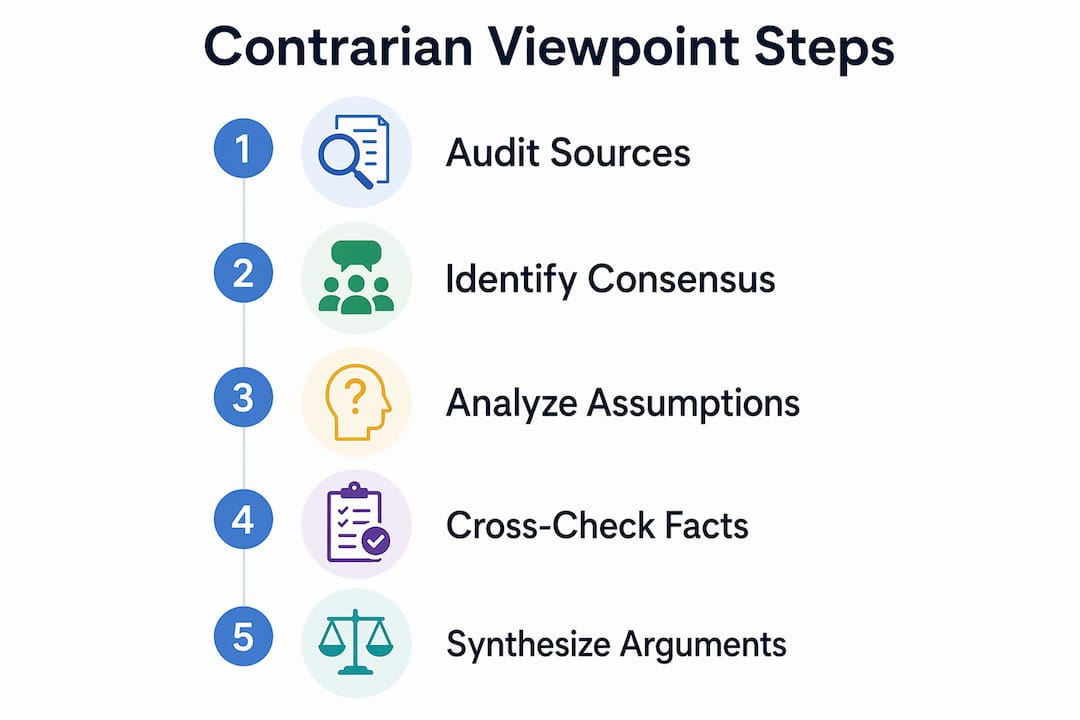
Start by tracking three signals: media framing, expert agreement, and political cross-party overlap. When outlets across the political spectrum describe a problem in identical terms, you have found a consensus assumption. When politicians from opposing parties agree on the premise of a debate while arguing only about solutions, that shared premise deserves scrutiny.
Four methods work reliably for spotting these assumptions:
- Read the headlines, not just the articles. Framing choices in headlines reveal what editors consider self-evident. Words like “crisis,” “threat,” or “inevitable” signal an embedded assumption worth questioning.
- Track what questions do not get asked. Press conferences, parliamentary debates, and televised interviews all have blind spots. The questions nobody asks are often more revealing than the answers given.
- Compare coverage across national boundaries. A policy treated as common sense in the United Kingdom may be considered radical in Germany, and vice versa. International comparison exposes domestic assumptions.
- Apply the “why” test repeatedly. Take any consensus claim and ask why it is true. Then ask why that reason is true. Three or four iterations usually surface a foundational assumption that is far less settled than the original claim implied.
True contrarianism demands intellectual honesty: identifying inconsistencies in widely held beliefs and presenting better-reasoned alternatives, not mere opposition. The goal is not to be difficult. The goal is to be accurate.
Pro Tip: Avoid the trap of ideological tribalism by asking whether your contrarian position would still seem correct if the opposing party held it. If the answer is no, you may be rationalising rather than reasoning.
Where should you research alternative political perspectives?
Credible contrarian research requires sources that operate outside the mainstream without abandoning standards of evidence. Using diverse, underrepresented media sources and rigorous cross-checking is the baseline requirement for avoiding both echo chambers and misinformation.
The most productive sources fall into four categories:
- Academic journals and working papers. Political science, sociology, and economics research frequently reaches conclusions that contradict popular narratives. Google Scholar and JSTOR provide access to peer-reviewed work that rarely surfaces in mainstream coverage.
- Historical primary sources. Reading the actual text of historical speeches, treaties, and legislation often contradicts the simplified version taught in schools or repeated in commentary.
- Underrepresented media outlets. Curated guides to alternative political sources can point you toward credible outlets that cover stories the mainstream ignores.
- Cross-ideological reading. Deliberately read serious thinkers whose conclusions you expect to disagree with. The discipline of engaging with the strongest version of an opposing argument sharpens your own reasoning.
Analysing underlying power structures rather than just debating parties produces more meaningful contrarian perspectives. Party politics is a surface layer. The more revealing questions concern who controls institutions, who sets the terms of debate, and whose interests a given policy actually serves.
Cross-checking is non-negotiable. A single source, however credible it appears, is insufficient for a contrarian claim. Verify key facts through at least two independent sources before treating them as established.
How do you synthesise contrarian views into coherent arguments?
Research without synthesis produces a pile of interesting facts, not a persuasive position. The synthesis stage is where contrarian thinking becomes contrarian argument.
The most durable framework for political analysis is the human rights versus property rights distinction, a lens dating back to the French Revolution. Applying it to any contemporary policy debate quickly reveals which interests a given consensus actually prioritises. That clarity is the foundation of a well-reasoned contrarian position.
Constructing a logical argument requires three elements: a clear claim, evidence that supports it, and an honest account of the strongest counterargument. Skipping the counterargument is the most common mistake. Acknowledging it and explaining why your evidence outweighs it makes your position significantly more persuasive.
Avoid logical fallacies, particularly the appeal to novelty (the idea that a view is valuable simply because it is unconventional) and the straw man (misrepresenting the consensus position to make it easier to attack). Both undermine the intellectual honesty that distinguishes genuine contrarianism from contrarianism as performance.
Historical contrarians provide useful models. Thinkers who challenged the consensus on colonial policy, economic orthodoxy, or civil rights did not simply assert the opposite of prevailing opinion. They assembled evidence, identified the specific assumption that was wrong, and proposed a better-reasoned alternative. That method remains the standard.
Both major political coalitions maintain positions held for status rather than empirical validity, which calcify into common sense and suppress dissent. Recognising this pattern in the positions you are challenging helps you target the weakest point in the consensus rather than attacking a caricature of it.
How do you share contrarian views without losing the room?
Articulating unconventional political ideas carries real social costs. Political institutions develop epistemological immune systems that treat dissent as a threat, suppressing genuine contrarian insights to maintain coalition unity. The same dynamic operates in social settings, workplaces, and online communities.
Practical strategies for sharing contrarian views constructively:
- Lead with questions, not conclusions. Asking “what evidence would change your mind on this?” is less threatening than stating a contrary position directly, and it often produces more honest dialogue.
- Separate the idea from the identity. Make clear that you are challenging a position, not the person holding it. This reduces defensiveness and keeps the conversation analytical.
- Choose your audience deliberately. Some conversations are worth having and some are not. Prioritise people who have demonstrated genuine curiosity over those who treat political views as tribal markers.
- Acknowledge what the consensus gets right. No mainstream position is entirely wrong. Identifying the valid concerns behind a consensus view before challenging its conclusions signals good faith and improves your credibility.
Staying authentic matters as much as staying tactful. Avoiding ideological tribalism means your contrarian position should survive the question: “Am I saying this because the evidence supports it, or because it signals something about my identity?”
Pro Tip: Build a small community of readers who share your commitment to evidence-based political inquiry. Platforms like Whitebunnywabbit and guides on consuming commentary without bias are good starting points for finding like-minded civic thinkers.
Key takeaways
Contrarian political thinking produces genuine insight only when it is grounded in intellectual honesty, rigorous research, and a willingness to challenge power structures rather than simply swap one partisan orthodoxy for another.
| Point | Details |
|---|---|
| Define contrarianism correctly | True contrarianism requires better reasoning, not mere opposition to the consensus. |
| Audit your information sources | Identify echo chambers in your current diet before seeking alternative perspectives. |
| Question foundational assumptions | Apply the “why” test repeatedly to expose the unstated premises beneath mainstream consensus. |
| Scrutinise power structures | Analyse institutional control and interests, not just party positions, for meaningful dissent. |
| Manage social friction deliberately | Lead with questions, acknowledge valid concerns, and choose your audience carefully. |
Why contrarianism is harder than it looks
The honest truth about seeking contrarian political views is that most people who think they are doing it are not. They have simply adopted the contrarian consensus of a different tribe. I have watched this pattern repeat across years of reading political commentary: someone grows disillusioned with one orthodoxy, discovers a community that frames itself as the “real” truth-tellers, and gradually absorbs an entirely new set of unexamined assumptions.
The institutional suppression of dissent is real, and it operates on both the left and the right. Coalitions punish internal criticism because coherence is more politically useful than accuracy. That is a structural problem, not a personal failing. But it means the social pressure to conform does not disappear when you leave the mainstream. It follows you into whatever alternative community you join.
What actually works, in my experience, is treating your own contrarian positions with the same scepticism you apply to the consensus. Ask yourself regularly whether you would accept the same quality of evidence for a claim that confirmed your existing views. If the answer is no, you have found your next assumption to examine.
The civic value of genuine contrarianism is real. Informed dissent has driven every significant political reform in modern history. The goal is not to be the person who disagrees with everything. The goal is to be the person who has actually thought it through.
— John
Deepen your political thinking with Whitebunnywabbit
Whitebunnywabbit publishes political commentary and analysis designed for readers who want more than the standard narrative. The site covers government policy, international affairs, and the structural forces that shape public debate, without the tribal framing that dominates most political media.

For readers ready to go further, the political education resources at Whitebunnywabbit offer a grounded starting point for understanding justice, power, and the mechanics of political argument. If data and its role in shaping political reality interests you, the future of data section adds another dimension to your research toolkit. Both are worth your time if you are serious about thinking beyond the mainstream.
FAQ
What is a contrarian political viewpoint?
A contrarian political viewpoint is a position that challenges the dominant consensus through evidence and critical reasoning rather than simple opposition. It requires intellectual honesty and a willingness to follow the argument wherever the evidence leads.
How do I avoid echo chambers when researching alternative views?
Use diverse, underrepresented media sources and cross-check every key claim through at least two independent sources. Auditing your current information diet is the necessary first step.
What is the difference between contrarianism and being contrarian for its own sake?
Genuine contrarianism identifies a specific flaw in a consensus position and offers a better-reasoned alternative. Performative contrarianism simply opposes the mainstream for social signalling or identity purposes, without engaging seriously with the evidence.
Why do political institutions suppress dissenting views?
Political coalitions develop what researchers describe as epistemological immune systems, treating internal dissent as a threat to coalition unity rather than a source of useful correction. This structural dynamic affects parties and movements across the political spectrum.
Where should I start if I want to explore unconventional political ideas?
Begin by identifying one mainstream consensus position you have never seriously questioned, then apply the five-step contrarian process: identify the consensus, examine its assumptions, research alternative evidence, synthesise a new argument, and prepare to articulate it honestly.
Leave a Reply