
Community organizing is defined as the practice of uniting individuals around shared concerns to build collective power and drive lasting social change. The role of community organizing goes far beyond turning people out to a rally. It is a disciplined, relationship-driven process that shifts power from isolated frustration to coordinated agency. The five core practices of storytelling, relationship building, structuring teams, strategising, and acting form the backbone of every effective grassroots movement. When done well, community organizing builds durable power structures that outlast any single campaign and create measurable improvements in public safety, local democracy, and community resilience.
What is the role of community organizing in building power?
Community organizing is the deliberate process of transforming shared interests into a disciplined constituency capable of unified action. It does not simply gather people. It activates them. The difference matters enormously for anyone serious about social change.
The process works by moving people through a clear progression. Individuals start with personal frustration or concern. Organisers then connect those individuals to others who share the same concern. Over time, that network becomes a constituency with the capacity to negotiate, campaign, and win.
Three things define effective community organizing at its core:
- Shared narrative: People need a story that connects their personal experience to a collective purpose. Storytelling is not a soft skill here. It is a political tool.
- Relational infrastructure: One-on-one meetings build the trust that mass communication cannot replicate. Relational meetings foster long-term commitment in ways that email blasts and social media posts simply do not.
- Durable structure: A movement that cannot survive the departure of its founder is not a movement. It is a personality cult. Effective organising builds teams and leadership pipelines that persist.
The importance of community organizing lies precisely in this durability. Campaigns come and go. Power built through organising stays.
What are the core leadership practices in community organizing?
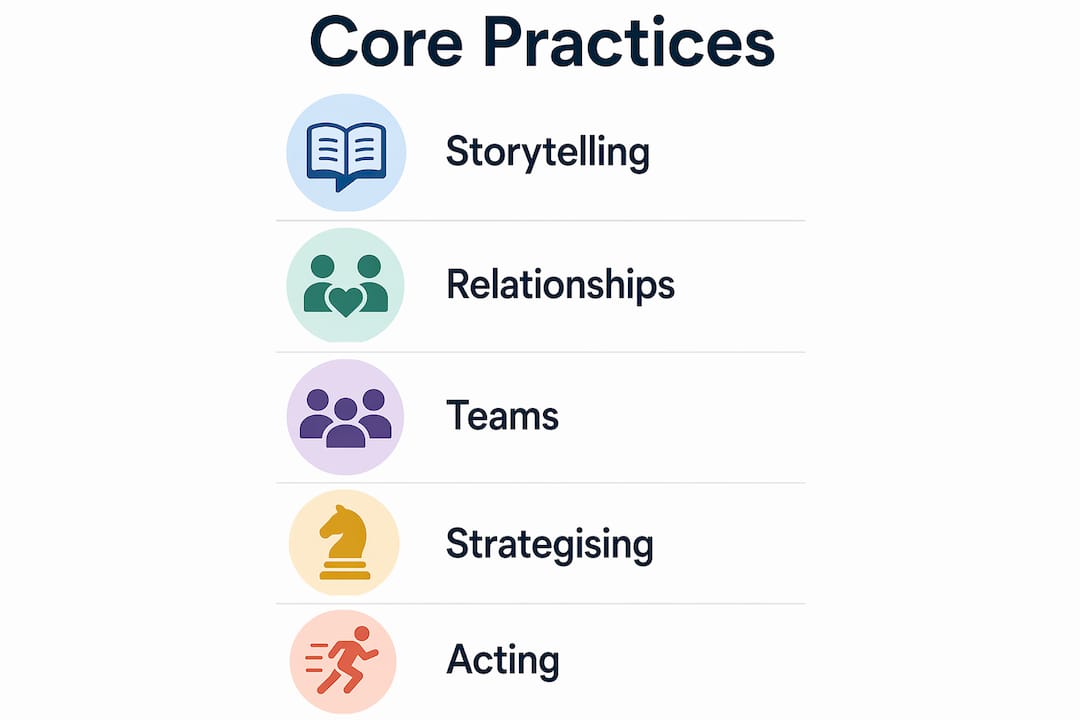
Five core leadership practices define effective community organising: storytelling, relationship building, structuring teams, strategising, and acting. These are not sequential steps. They are interdependent practices that organisers cycle through continuously.

Storytelling connects individual experience to collective purpose. A good organiser does not just describe a problem. They tell a story of self, a story of us, and a story of now. This three-part structure, developed through the Public Narrative framework, gives people a reason to act rather than simply a reason to care.
Relationship building is the engine of the whole enterprise. Organisers build one-on-one relational meetings into their weekly practice because these conversations reveal what people genuinely value, not just what they say they care about in a survey.
Structuring teams means distributing leadership so the organisation can act at scale. The snowflake model, where a central organiser coaches a small number of team leaders who each coach their own teams, allows leadership development at every level.
Strategising translates a vision of change into a concrete theory of how power shifts. Who has the authority to make the decision you want? What do they care about? What leverage does your constituency hold?
Acting closes the loop. Strategy without action is just planning. Action without strategy is just noise.
Pro Tip: Start every new organising relationship with a one-on-one meeting, not a group meeting. Group settings encourage performance. One-on-one conversations reveal genuine motivation, which is the only foundation worth building on.
How does community organizing benefit communities and impact public safety?
Community organizing produces measurable improvements in public safety. Community-oriented organisations reduce murder and property crimes by engaging high-risk youth and creating safe spaces, with studies showing reductions in crime rates and arrest counts without displacement effects. That last point matters: the improvement is real, not just a shift of crime to neighbouring areas.
The mechanism behind this is informal social control. Community-oriented organisations build interpersonal trust that allows residents to monitor their environments, intervene early in conflicts, and connect neighbours to wider resources. This complements what police and state institutions can do, rather than replacing them.
The benefits extend well beyond public safety. Community organising strengthens local networks and enhances local democracy by creating communities that understand and act on their own aspirations. That is a different kind of safety: the safety of knowing your community has agency.
| Benefit | Evidence |
|---|---|
| Reduced violent crime | Organisations engaging high-risk youth show measurable reductions in murder rates |
| Reduced property crime | Studies record lower arrest counts without displacement to neighbouring areas |
| Stronger social cohesion | Informal trust networks allow residents to intervene early in conflicts |
| Greater democratic participation | Organised communities develop stronger advocacy capacity and local voice |
| Leadership development | Training within communities facing systemic challenges builds grassroots capacity |
The impact of community organizing on public safety is not incidental. It is structural. When people trust each other and have shared norms, crime has less room to take hold.
How is community organizing different from mobilisation or activism?
Mobilisation gathers people. Community organising activates them. The distinction is not semantic. It determines whether a movement builds lasting power or simply produces a series of well-attended events.
Activation builds a container for belonging and agency among individuals. Mobilisation fills that container temporarily. Organising builds the container itself. A march can mobilise thousands. But if those thousands disperse without a structure to return to, the power dissipates within days.
Activism, in its broadest sense, encompasses both. The distinction worth drawing is between activism that builds durable power and activism that expresses grievance without a plan to win. Both have value. But only one changes policy.
Common pitfalls for new organisers include:
- Confusing activity with progress. Busy schedules of meetings and events can mask the absence of a clear theory of change.
- Neglecting one-on-one relationships. New organisers often default to group meetings because they feel efficient. They are not. They produce consensus without commitment.
- Treating disagreement as failure. Experienced organisers accept disagreement as a healthy part of the process. It surfaces real tensions that need to be resolved before collective action can succeed.
- Building around a single leader. Movements that depend on one charismatic figure are fragile. Distributed leadership, built through the snowflake model, is far more resilient.
Pro Tip: If your organising effort cannot function for two weeks without you, you have not yet built an organisation. You have built a following. Shift your energy from doing to coaching.
For readers new to this work, the beginner’s guide to community activism at Whitebunnywabbit offers a grounded starting point.
What practical strategies can individuals apply in grassroots organising?
Effective community organising strategies follow a clear sequence. Each step builds on the last, and skipping any one of them weakens the whole.
-
Map your constituency. Before you can organise anyone, you need to know who shares your concern and what they genuinely care about. Conduct one-on-one meetings. Listen more than you speak. Build a picture of the community’s real interests, not the interests you assume they have.
-
Identify decision-makers. Strategy requires knowing who holds the power to make the change you want. Name them specifically. Understand what they respond to. A petition addressed to “the authorities” is not a strategy. A targeted campaign aimed at a named official with a specific ask is.
-
Build your team structure. Use the snowflake model to distribute leadership. Each team leader coaches a small group. Each group member has a defined role. Leadership distributed this way supports development at every level and prevents the single-point-of-failure problem.
-
Develop your narrative. Craft a public narrative that connects personal stories to the collective purpose and to the urgency of acting now. Test it in small group settings before taking it to a wider audience.
-
Act, then reflect. Every action produces information. Did your target respond? Did your constituency turn out? Did the action shift the public narrative? Debrief after every campaign action and adjust your strategy accordingly.
-
Invest in leadership development. Communities facing systemic challenges need trained, mentored leaders from within. External organisers can catalyse a movement, but community ownership of power is the only sustainable outcome.
The role of grassroots organising is not to win a single campaign. It is to build the capacity to win repeatedly, on multiple issues, over many years. That requires patience, structure, and a genuine commitment to sharing power rather than accumulating it.
Investigative journalism has often played a parallel role in this process. The journalism that changed policy frequently worked alongside organised communities, not in isolation from them.
Key takeaways
Community organizing builds durable power by combining relational trust, distributed leadership, and clear strategy to shift decision-making authority toward those most affected by injustice.
| Point | Details |
|---|---|
| Organising vs. mobilisation | Organising builds a lasting structure for collective action; mobilisation fills it temporarily. |
| Five core practices | Storytelling, relationship building, structuring teams, strategising, and acting work together to shift power. |
| Public safety impact | Community-oriented organisations reduce murder and property crimes through informal social control and trust. |
| One-on-one meetings | Relational meetings build genuine commitment that mass outreach methods cannot replicate. |
| Distributed leadership | The snowflake model develops leaders at every level, making movements resilient and community-owned. |
Why I think most people misunderstand what organising actually is
Most people who come to community organising for the first time think it is about persuasion. They believe that if they can just explain the problem clearly enough, people will act. That belief leads to a lot of well-written leaflets and very little change.
The real work is relational, not rhetorical. The most effective organisers I have encountered spend the majority of their time in one-on-one conversations, not on stages. They are building a map of human motivation, one conversation at a time. That map is what makes collective action possible.
What strikes me most about community organising as a sacred practice is the discipline it requires around sharing power. Most people who want to change the world also, on some level, want to lead the change. Organising asks you to resist that impulse constantly. Your job is to build the capacity of others, not to become indispensable yourself.
For anyone starting out: expect the first six months to feel slow. You are not failing. You are building the foundation that everything else will stand on. The communities that support marginalised voices most effectively are the ones that took the time to build that foundation properly.
— John
What Whitebunnywabbit covers on community power and education
Whitebunnywabbit publishes political commentary and analysis for readers who want to understand how power works and how it changes. The connection between education, journalism, and organised communities is a thread that runs through much of that work.

If you want to go deeper on the relationship between civic education and social justice, the piece on reporters and justice at Whitebunnywabbit examines why education remains the foundation of any serious effort to shift power. It is a useful next step for anyone who has read this far and wants to understand the broader context in which community organising operates.
FAQ
What is the role of community organizing in social change?
Community organizing builds collective power by connecting individuals around shared concerns and developing the structure needed to influence decision-makers. It is the primary mechanism through which grassroots movements translate frustration into policy change.
How does community organizing differ from mobilisation?
Mobilisation gathers people for a specific event or action. Community organising builds a lasting structure of relationships, leadership, and strategy that enables repeated collective action over time.
What are the five core practices of community organizing?
The five core practices are storytelling, relationship building, structuring teams, strategising, and acting. These practices work together to shift power from isolated individuals to organised constituencies.
Does community organizing actually reduce crime?
Studies show that community-oriented organisations reduce murder and property crimes by engaging high-risk youth and building informal social control through interpersonal trust. The reductions occur without displacement effects to neighbouring areas.
How do you start community organizing as an individual?
Begin with one-on-one relational meetings with people who share your concern. Map their genuine motivations, identify the decision-maker with authority over your issue, and build a small team before attempting any public action.
Leave a Reply