

If you’re looking for alternatives to rabbitblog.blogspot.com, the shortlist below covers the options that matter most for UK-focused political commentary: independent ownership, clear editorial voice, and practical ways to follow and support the writers you trust.
- Whitebunnywabbit — UK-based, donation-supported personal blog covering government policy, international affairs, and social commentary; no ads, no paywalls, reader-funded.
- Ghost — open-source newsletter and blog platform with built-in paid memberships; ideal for independent political writers who want direct reader support without intermediaries.
- WordPress.com — managed hosting with newsletter tools and export functionality; lower technical overhead, though some platform lock-in applies.
- Federated/IndieWeb platforms (ActivityPub-enabled) — self-hosted options such as GoBlog and Plume let writers publish to the Fediverse, preserving distribution independence and content ownership.
- File-based static engines (e.g. Yamblog) — Markdown-first blogging with automatic RSS, JSON-LD, and sitemaps; maximum portability, minimal server dependency.
Pro Tip: If editorial independence is your priority, start with platforms that give you full data export in Markdown or RSS before you commit. Portability is the one feature you only miss when it’s gone.
Table of Contents
- How do these alternatives compare at a glance?
- How do you choose the right alternative for your reading habits?
- How do you follow and support outlets without losing privacy?
- How do you move your reading list away from rabbitblog.blogspot.com?
- Why does editorial independence matter for political commentary?
- Whitebunnywabbit: a UK-focused, donation-supported alternative
- Key takeaways
- The case for independent blogs in 2026 political discourse
- Useful sources and tools for your migration
How do these alternatives compare at a glance?
| Platform / Category | Editorial stance | Typical format | Cadence | Support model | Audience & reach | Follow options | Portability |
|---|---|---|---|---|---|---|---|
| Whitebunnywabbit | Independent, UK-focused | Opinion essays, news analysis | Regular updates | Donation-based, no ads | Politically engaged UK readers | RSS, bookmarks, social | Full archive, author-controlled |
| Ghost (self-hosted) | Author-defined | Long-form essays, newsletters | Author-set | Paid memberships, donations | Niche to mid-scale | RSS, email newsletter, ActivityPub | Full Markdown/JSON export |
| WordPress.com (managed) | Author-defined | Mixed: posts, pages, multimedia | Author-set | Subscription tiers, ads optional | Broad, mainstream | RSS, email, social | XML/WXR export available |
| Federated IndieWeb (GoBlog/Plume) | Author-defined | Posts, short notes, essays | Author-set | Donation or self-funded | Fediverse/niche | ActivityPub, RSS | Full self-hosted control |
| Static engine (Yamblog) | Author-defined | Markdown posts, long-form | Author-set | Self-funded | Technical/niche | RSS, JSON feeds | Native Markdown files |
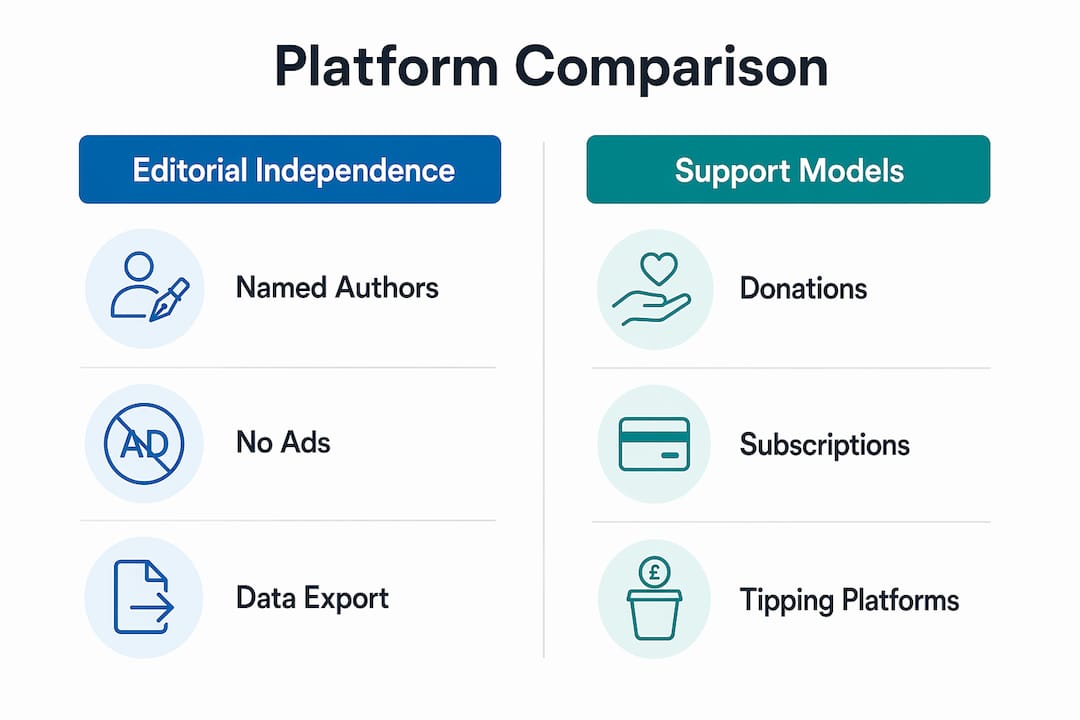
IndieWeb and ActivityPub compatibility make it easier for writers to reach federated audiences while retaining content ownership — a meaningful advantage when political commentary can attract platform moderation.
Quick pick for editorial independence: Whitebunnywabbit or a self-hosted Ghost instance. Both keep the writer in control of content and reader relationships.
How do you choose the right alternative for your reading habits?
Prioritise ownership and support model first. A platform that can withdraw your access or demonetise your favourite writer overnight is a liability, not a feature.
- Clarify your editorial stance preference. Do you want centre-left analysis, contrarian commentary, or a broad mix? Identify two or three outlets whose framing you trust before you commit to following them.
- Check content depth and format. Long-form essays reward careful reading; short news-analysis posts suit a daily scan. Match the format to how you actually read.
- Assess publication frequency. A writer who publishes twice a week is easier to follow than one who publishes sporadically. RSS makes frequency irrelevant to your inbox, but it still shapes how you engage.
- Verify transparency signals. Look for named bylines, a visible corrections policy, and sourced claims. No byline is a red flag; no corrections page is a warning.
- Understand the support model. Managed platforms simplify payment integration but imply some platform dependency. Self-hosted or donation-direct models give writers more control and you more confidence that your money reaches them.
Red flags to avoid: no author name, no archive, no RSS feed, and no stated corrections policy. Any one of these is a reason to look elsewhere.
Pro Tip: Before subscribing to a newsletter, check whether you can export your subscription history or download past issues. If the platform offers no export, your reading history disappears the moment the writer moves.

How do you follow and support outlets without losing privacy?
Following an independent political outlet is straightforward. Supporting one takes a little more thought, especially in the UK where payment processing and data handling vary by platform.
- RSS readers (Feedly, NetNewsWire, Miniflux) let you follow any outlet with a feed without handing over your email address. Most of the platforms above publish RSS by default.
- ActivityPub/Fediverse subscriptions work through Mastodon or compatible clients; GoBlog and Plume both support this natively, so you can follow a writer the same way you’d follow a Mastodon account.
- Newsletters offer the most direct relationship but require an email address. Use a dedicated reader address rather than your primary one to limit data exposure.
- Donations and memberships vary in mechanics. Ghost uses Stripe for direct payments; WordPress.com has its own payment layer. For UK readers, verify that the payment processor supports GBP payouts and check whether VAT applies to any membership tier.
For a broader look at how digital tipping platforms compare for UK creators and supporters, the Tipper guide covers the main options in detail.
Pro Tip: Where possible, donate directly through the writer’s own site rather than through a third-party aggregator. It keeps more money with the writer and reduces the number of parties holding your payment data.
| Follow method | Privacy level | Setup effort | Best for |
|---|---|---|---|
| RSS reader | High | Low | Daily reading without email |
| ActivityPub/Fediverse | High | Medium | Federated, decentralised following |
| Newsletter (email) | Medium | Low | Direct writer relationship |
| Direct donation | High | Low | Financial support, minimal data sharing |
| Social media follow | Low | Very low | Casual discovery only |
How do you move your reading list away from rabbitblog.blogspot.com?
Moving a reading list takes about twenty minutes if you’re methodical. The steps below cover both archiving what you’ve already read and reconstituting your subscriptions elsewhere.
- Export your current RSS subscriptions. If you use an RSS reader, export an OPML file. This single file contains every feed you follow and imports cleanly into any other RSS reader.
- Archive critical posts. Use the SingleFile browser extension or
wget --mirrorto save important pages locally before they disappear. For a Blogger-hosted site, the native export (Settings → Manage Blog → Back up content) produces an XML file you can keep. - Back up newsletters. Forward or download any newsletter issues you want to keep. Most email clients allow folder export; Gmail users can use Google Takeout.
- Find replacement feeds. Use the shortlist above to identify new sources. Add their RSS URLs to your reader one by one, or import a pre-built OPML bundle if one is available.
- Update bookmarks and read-later tools. If you use Pocket, Instapaper, or a browser bookmark folder, replace old URLs with the new sources now rather than letting stale links accumulate.
Pro Tip: When archiving older posts, note the original URL structure. If you later host an aggregator or personal archive, preserving URL patterns and setting redirects prevents broken links and keeps any existing search-engine references intact.
For more on finding alternatives to political blogs and practical migration tips, Whitebunnywabbit’s own roundups cover similar ground.
Why does editorial independence matter for political commentary?
Owning your content and distribution channels preserves both editorial integrity and the historical record. That’s not an abstract principle; it has practical consequences.
When a platform changes its terms, demotes content algorithmically, or simply shuts down, writers who relied on it lose their archive and their audience simultaneously. Writers who self-host with Git-based syncing and maintain scheduled Markdown backups keep both. For politically sensitive commentary, that resilience matters more than convenience.
- Archiveability: content stored in Markdown or standard XML can be republished, cited, or submitted as evidence without platform permission.
- Resistance to deplatforming: a writer on their own domain cannot be removed by a third-party moderation decision.
- Algorithmic independence: RSS and direct newsletter delivery bypass recommendation engines entirely.
Whitebunnywabbit’s donation-based model reflects this logic. No advertising dependency means no incentive to chase engagement metrics at the expense of editorial judgement.
Pro Tip: Combine domain ownership with a regular OPML/RSS archive and a local Markdown backup. That three-layer approach covers platform failure, feed disappearance, and accidental deletion.
Whitebunnywabbit: a UK-focused, donation-supported alternative
For UK political readers who want editorial commentary without ads, paywalls, or algorithmic curation, Whitebunnywabbit is a direct answer.
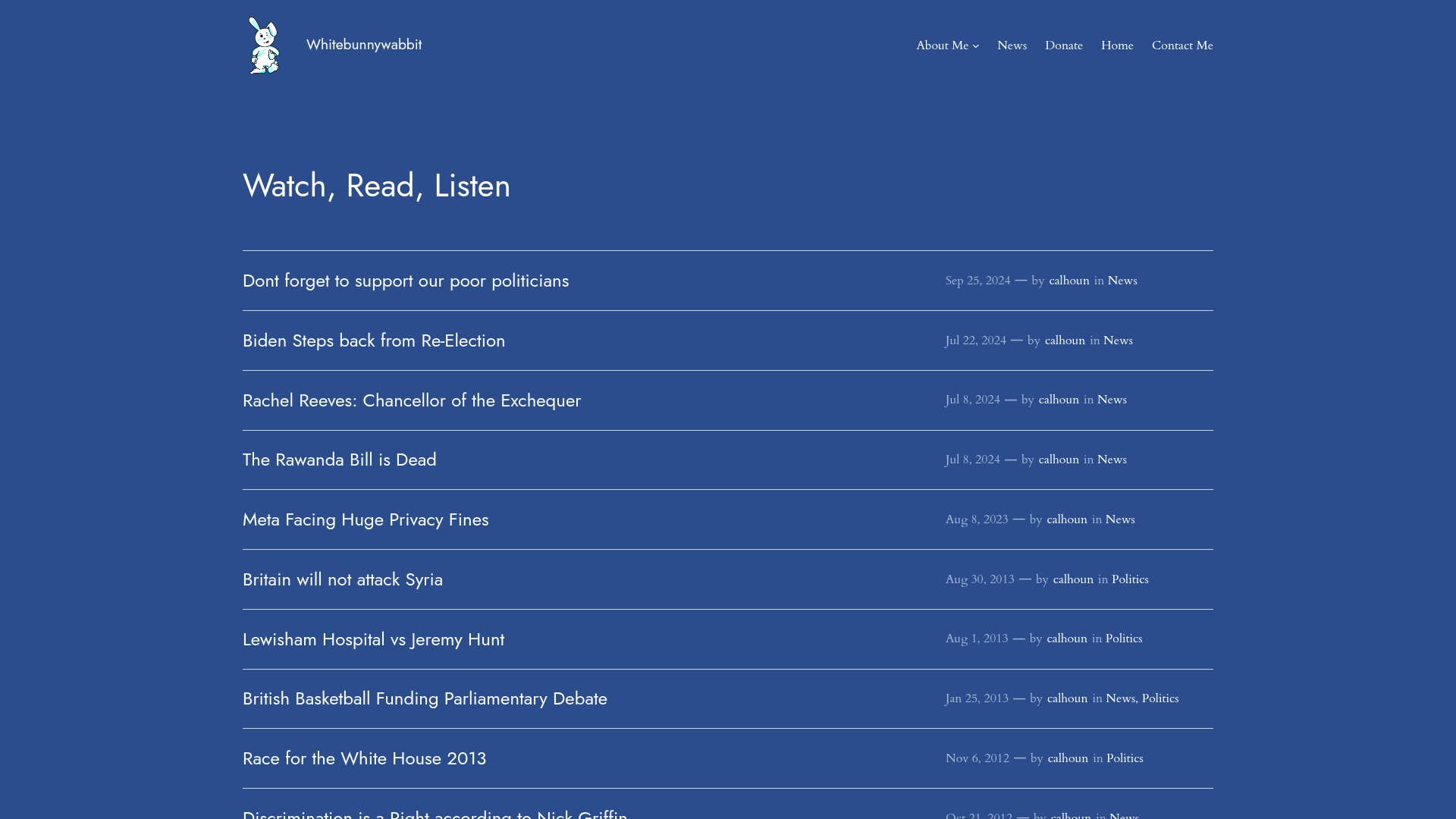
The site publishes opinion essays and news analysis on UK government policy, international affairs, and social commentary, written by a named author with a consistent editorial voice. The donation model means the writing answers to readers, not advertisers. There are no subscription tiers, no locked content, and no third-party trackers shaping what you see. Pieces like the education and justice commentary show the site’s willingness to take a position on issues that mainstream outlets often handle cautiously.
To follow the site, add its RSS feed to your reader. To support it, use the donation link on the site directly — your payment goes straight to the writer, with no platform taking a cut.
Key takeaways
The strongest alternatives to rabbitblog.blogspot.com are those that combine named authorship, direct reader support, and full content portability — Whitebunnywabbit being the clearest UK example of all three.
| Point | Details |
|---|---|
| Prioritise portability | Choose platforms that export in Markdown or RSS before you commit; you’ll need it if the platform changes. |
| Verify trust signals | Named bylines, a corrections policy, and an active archive are the minimum credibility markers for any political outlet. |
| Follow by RSS first | RSS gives you full control over your reading list without surrendering your email address or reading habits to a third party. |
| Support directly | Donate through the writer’s own site to maximise the share that reaches them and minimise data exposure. |
| Whitebunnywabbit | A UK-based, donation-supported political blog with named authorship, no ads, and full editorial independence. |
The case for independent blogs in 2026 political discourse
The conventional wisdom says that political commentary has migrated to podcasts, newsletters, and social media. That’s partly true, and mostly beside the point. What’s actually happened is that the distribution has fragmented while the quality has concentrated in the hands of writers who control their own platforms.
Independent blogs still do something that no algorithm-driven feed can replicate: they accumulate. A writer who has published consistently for years builds an archive that functions as a primary source. You can trace how their thinking evolved, check what they said before an event, and cite specific posts. That’s not nostalgia for an older web; it’s a practical advantage that social media posts and ephemeral newsletters can’t match.
The donation model reinforces this. A writer funded by readers has one obligation: to be worth reading. That’s a cleaner editorial contract than anything an ad-supported outlet can offer. Transparency and a willingness to issue corrections are the signals that distinguish serious independent commentary from noise — and they’re worth checking before you follow anyone, including the outlets listed here.
Useful sources and tools for your migration
A short list of resources to act on the guidance above:
- Ghost platform documentation — covers export formats, redirect tools, and membership/payment setup; start here for a managed-to-self-hosted migration.
- Yamblog documentation — explains file-based Markdown blogging with automatic RSS and JSON-LD; useful if you want a low-maintenance, export-friendly engine.
- GoBlog on GitHub — single-binary ActivityPub-enabled blog engine; the README covers deployment and IndieWeb configuration.
- Jant Blog — hosted and self-hosted IndieWeb/ActivityPub option; good starting point for federated publishing without heavy server management.
- BlogBowl platform comparison — independent review covering hosted versus open-source blogging platforms; useful for weighing technical trade-offs.
- Whitebunnywabbit alternatives roundups — curated guides to independent publishing alternatives, with practical notes on each option.
- How columnists build audiences — covers audience-supported revenue models and distribution tactics for independent political writers.
Pro Tip: For a technical migration, read the Ghost redirect documentation and the GoBlog README before you move any content. Both are short and will save you hours of broken-link debugging.
Leave a Reply