
Gerrymandering is defined as the deliberate manipulation of electoral district boundaries to give an unfair advantage to a specific political party, candidate, or group. The term dates to 1812, when Massachusetts Governor Elbridge Gerry approved a district so contorted it resembled a salamander. That original shape gave the practice its name. Today, gerrymandering sits at the centre of debates about political redistricting, fair representation, and the health of democratic elections. Understanding it is the first step to understanding why your vote may carry more or less weight than your neighbour’s.
What is gerrymandering and how does it work?
Gerrymandering works by redrawing the boundaries of voting districts to concentrate or dilute the power of particular groups of voters. In the United States, this process happens after every ten-year census, when state legislatures redraw congressional and state maps. The party in control of the legislature typically controls the pen. That control translates directly into political power for years, sometimes decades.
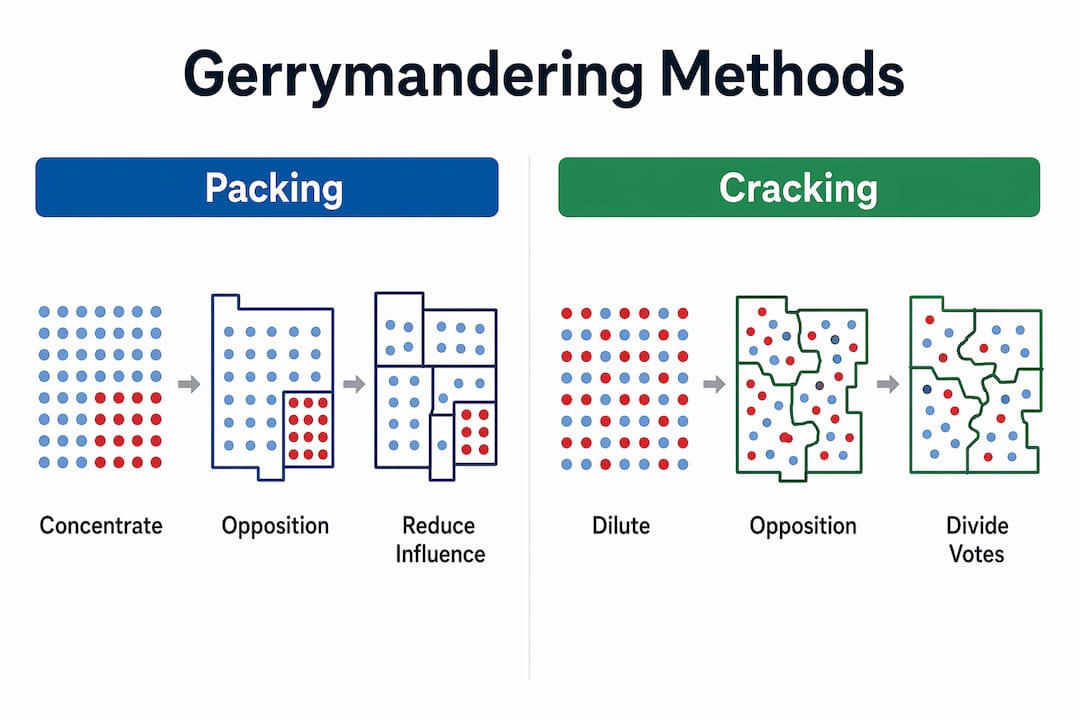
The two core methods are packing and cracking. Packing means cramming as many opposition voters as possible into a single district. Those voters win that one seat by a landslide, but their influence stops there. Cracking does the opposite: it splits a concentrated group of opposition voters across several districts so they never form a majority in any of them.
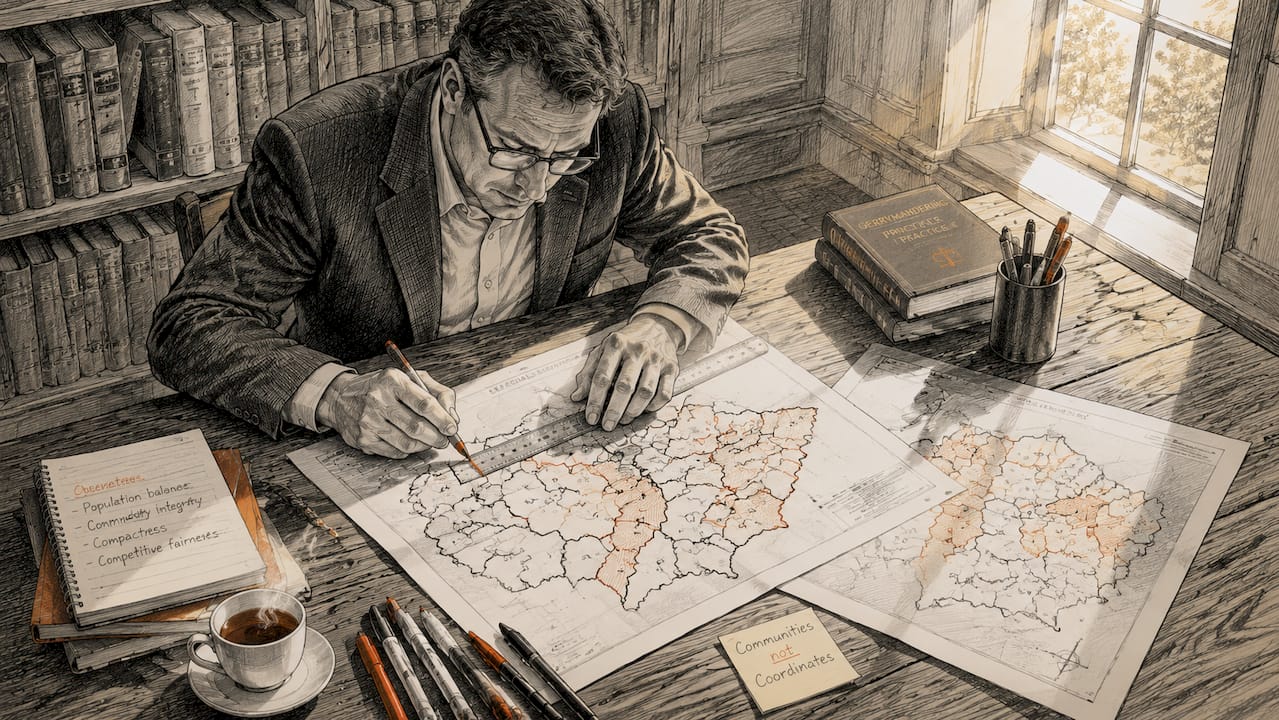
Together, packing and cracking allow the party drawing the maps to manufacture safe seats across a state, even when the overall vote share between the two parties is close. The result is a legislature that does not reflect the actual balance of voter opinion in the state.
A third, less discussed form is incumbent protection gerrymandering. This occurs when both parties cooperate to draw maps that shield sitting members of both sides from competitive races. It reduces electoral competition without being purely partisan in motive.
The key tactics at a glance:
- Packing: Concentrates opposition voters into one district to waste their votes on an inflated majority.
- Cracking: Splits opposition voters across multiple districts so they cannot win any of them.
- Incumbent protection: Both parties agree to safe maps that protect existing officeholders from challenge.
- Stacking: Combines a large minority group with a larger majority group to dilute the minority’s influence.
Pro Tip: When looking at a district map, trace the outer boundary. A compact, roughly rectangular or circular shape suggests neutral drawing. A shape with long, thin tendrils reaching into specific neighbourhoods is a strong visual signal of deliberate manipulation.
What are the political and social effects of gerrymandering?
The most direct effect of gerrymandering is the creation of safe seats that reduce general election competitiveness. When a seat is safe, the real contest moves to the party primary. Candidates then appeal to the most committed, often most extreme, members of their party base rather than to the broader electorate. That dynamic pushes legislators toward more polarised positions once in office.
Reduced competition also affects voter engagement. When the outcome of a general election feels predetermined, many voters see little point in turning out. This is not apathy. It is a rational response to a system where the map has already decided the winner.
“Visible irregular district boundaries significantly lower perceived fairness and election legitimacy among citizens.” — Cambridge Core research on redistricting and democratic attitudes
The shape of districts carries its own political weight. Citizens judge election fairness by district shapes even without detailed technical knowledge. A map that looks obviously manipulated erodes trust in the entire electoral system, regardless of whether the voter can name the specific tactic used. That erosion of trust is one of the most corrosive long-term effects of gerrymandering on democracy.
Political polarisation compounds the problem. Safe seats produce legislators who have no electoral incentive to compromise or work across party lines. Over time, this makes legislatures less functional and deepens the partisan divide that many voters already find frustrating. The role of partisan media in amplifying these divisions makes the cycle harder to break.
Is gerrymandering illegal? The legal context explained
The legal picture on gerrymandering is complicated, and the answer depends on the type of gerrymandering involved. In 2019, the U.S. Supreme Court ruled in Rucho v. Common Cause that federal courts have no authority to resolve claims of partisan gerrymandering. The ruling effectively handed partisan map-drawing back to state legislatures, with no federal judicial check.
Racial gerrymandering is treated differently. The Voting Rights Act of 1965 prohibits drawing maps that deliberately dilute the voting power of racial minorities. Federal courts can and do strike down maps on racial grounds. The distinction matters: a map drawn to disadvantage Black voters is legally vulnerable, but the same map drawn to disadvantage Democratic voters may face no federal challenge at all.
State courts and state constitutions fill some of the gap left by federal courts. Several states have seen their maps struck down under state law provisions that federal courts cannot touch. That patchwork of state-level protections creates very uneven outcomes depending on where you live.
Independent redistricting commissions represent the most widely discussed structural solution. States including California, Arizona, and Michigan have moved map-drawing authority away from legislatures and into independent bodies. Research shows that independent commissions increase voter turnout and produce more responsive electoral outcomes compared to legislature-drawn maps.
| Redistricting method | Who draws the map | Key advantage | Key risk |
|---|---|---|---|
| Legislature-controlled | Majority party in state legislature | Efficient, politically accountable | Strong incentive for partisan manipulation |
| Bipartisan commission | Equal members from both parties | Reduces single-party control | Deadlock; incumbent protection deals |
| Independent commission | Citizens or non-partisan experts | Removes direct political incentive | Requires strong legal mandate to function |
| Court-ordered maps | Federal or state judges | Neutral arbiter when maps are challenged | Slow; limited to correcting legal violations |
Pro Tip: Check your own state’s redistricting process. If your state uses a legislature-controlled method, your district boundaries are drawn by politicians with a direct interest in the outcome. Knowing this helps you read electoral maps with the right level of scepticism.
How is gerrymandering evolving in modern elections?
The current era of gerrymandering is more aggressive and harder to detect than anything that came before it. Partisan advantage is now openly cited as a legitimate criterion in redistricting by politicians in several states, a shift that would have been politically unacceptable a generation ago. The Rucho ruling removed the federal brake, and some state legislatures have pressed hard on the accelerator.
Advanced mapping software has transformed what is technically possible. Mapmakers can now work at street level, using voter registration data and past voting behaviour to shift election outcomes by a few thousand votes without creating the obviously strange shapes that once made gerrymandering visible. The salamander-shaped district is largely a relic. Modern gerrymanders can look perfectly tidy on a map while being surgically precise in their effect.
Mid-decade redistricting has also become a growing tactic. Traditionally, maps were redrawn only after the ten-year census. Some states now redraw maps mid-cycle when the controlling party sees a political opportunity, affecting a significant share of congressional seats. This breaks the norm that redistricting is a once-per-decade event tied to population data.
As a voter, staying informed is your most direct defence. Practical steps include:
- Follow your state legislature’s redistricting process. Public hearings are often held and comments accepted.
- Use publicly available mapping tools to compare proposed district boundaries with population data.
- Support transparency legislation that requires mapmakers to publish their criteria and data.
- Read investigative journalism that scrutinises new maps when they are released after each census or mid-decade redraw.
- Understand your state’s legal options. Some states allow citizens to challenge maps through ballot initiatives or state courts even when federal courts are closed to them.
Key takeaways
Gerrymandering is the deliberate manipulation of district boundaries that concentrates political power in the hands of map-drawers, undermining competitive elections and fair representation.
| Point | Details |
|---|---|
| Core definition | Gerrymandering manipulates district boundaries to favour one party, candidate, or group. |
| Primary tactics | Packing and cracking are the two main methods used to dilute or concentrate voter power. |
| Legal limits | Federal courts cannot address partisan gerrymandering after Rucho v. Common Cause (2019). |
| Democratic effects | Safe seats shift competition to primaries, increasing polarisation and reducing voter turnout. |
| Best structural fix | Independent redistricting commissions produce more competitive and representative maps. |
Why gerrymandering should concern every voter
I have spent years reading about electoral systems, and the thing that strikes me most about gerrymandering is how effectively it inverts democratic logic. Elections are supposed to let voters choose their representatives. Gerrymandering lets representatives choose their voters. That reversal is not a minor technical flaw. It is a fundamental corruption of the system’s purpose.
The argument I hear most often in defence of partisan map-drawing is that everyone does it, so it balances out. That argument collapses under scrutiny. When both parties gerrymander wherever they hold power, the result is not balance. It is a nationwide reduction in competitive seats, a legislature full of politicians who answer only to their base, and voters in the middle who feel permanently unrepresented.
Independent commissions are not a perfect solution. They require strong legal mandates, genuine independence, and public trust to function well. But the evidence is clear that they produce better outcomes than legislatures drawing their own maps. The states that have moved to independent commissions have seen measurable improvements in electoral competitiveness. That is not an opinion. It is a pattern in the data.
Citizen awareness is the pressure that makes reform possible. Politicians do not voluntarily give up the power to draw their own districts. Reform happens when voters understand what is at stake and demand it loudly enough. The common gerrymandering techniques used in your state are not obscure. They are documented, mappable, and challengeable. You just need to know where to look.
— John
Political education resources at Whitebunnywabbit
Understanding gerrymandering is one piece of a much larger picture of how political power works.

Whitebunnywabbit covers the political processes, media dynamics, and democratic structures that shape the world you vote in. The education resources at Whitebunnywabbit bring together analysis on electoral systems, media literacy, and political accountability in one place. Whether you are trying to make sense of redistricting battles in your state or understand how political narratives are constructed, Whitebunnywabbit offers the context that news headlines rarely provide. Start with the education section and follow the threads that matter most to you.
FAQ
What is the gerrymandering definition in simple terms?
Gerrymandering is the deliberate redrawing of voting district boundaries to give one political party, candidate, or group an unfair electoral advantage. The term originated in 1812 in Massachusetts.
How does gerrymandering affect election results?
Gerrymandering creates safe seats by concentrating or dispersing voters, which reduces general election competition and shifts real political battles to party primaries. This produces less representative legislatures over time.
Is partisan gerrymandering legal in the United States?
Federal courts cannot strike down maps for partisan gerrymandering following the 2019 Supreme Court ruling in Rucho v. Common Cause. State courts and state constitutions may still provide legal remedies depending on the state.
What is political redistricting and how does it differ from gerrymandering?
Political redistricting is the neutral term for redrawing electoral district boundaries, typically after a census. Gerrymandering is redistricting done with deliberate intent to manipulate electoral outcomes for partisan or personal gain.
What can voters do about gerrymandering?
Voters can support independent redistricting commission ballot initiatives, participate in public redistricting hearings, and back state-level legal challenges to manipulated maps. Staying informed through credible political reporting is the most accessible starting point.
Leave a Reply