
A strawman argument is defined as a logical fallacy in which someone replaces their opponent’s real position with a distorted or weakened version, then attacks that version instead. The formal term is the straw man fallacy, and it is one of the most common logical fallacies in political debate, academic discussion, and everyday conversation. Recognising it is the first step to arguing more honestly and thinking more clearly. This guide breaks down how the fallacy works, why it causes real harm, and how to counter it when you encounter it.
What is a strawman argument and how does it work?
A strawman argument works by substituting a real claim with a weaker, more extreme, or simpler version that is far easier to defeat. The term itself is telling: you build a figure made of straw, knock it down with ease, and then claim victory over something that was never the actual opponent.
Common distortions include exaggeration, slogan reduction, reframing requests as demands, and attributing extreme motives to the other person. Each of these tactics makes the original argument look more radical or absurd than it actually is.
There are several forms this fallacy takes in practice:
- Exaggeration: Someone argues for stricter environmental regulations. Their opponent responds: “So you want to shut down every factory in the country.” The original position said nothing of the sort.
- Slogan reduction: A nuanced policy argument gets compressed into a single phrase that strips away all context, making it easy to dismiss.
- Reframing requests as demands: A suggestion to “review a policy” becomes “stop all progress” in the opponent’s retelling.
- Attributing extreme motives: Saying someone who supports media literacy “wants to brainwash children” is a classic example of shifting the burden of proof onto the original speaker.
Watch for trigger phrases. When someone opens with “So you’re saying…” or “Basically, you want to…”, they are often about to construct a strawman. These phrases signal that the speaker is about to restate your position in their own, usually distorted, terms.
Pro Tip: When you hear “So you’re saying…”, pause immediately. Ask the other person to quote your exact words before the conversation continues. This one habit stops most strawmen before they take hold.

There is also a subtler form worth knowing: the selection form. This is where a debater focuses on a weaker aspect of an opponent’s argument and presents it as if it represents the whole position. This version is increasingly common in political debates, where cherry-picking a single weak point is enough to discredit an entire platform in the public eye.
Why are strawman arguments harmful to honest debate?
Strawman fallacies prevent genuine engagement with real evidence and real views. When you attack a position the other person never held, you learn nothing, resolve nothing, and persuade no one who is paying close attention.
The damage runs deeper than a single lost argument. Strawman arguments are often deployed intentionally/05:_Logical_Fallacies/5.03:_Straw_Man) in polarised discussions, preventing truth discovery and deepening divisions between groups. In political media, this effect compounds quickly. A single misrepresentation repeated across partisan media channels can harden public opinion against a position that was never actually held.
“Winning by defeating a strawman is illusory. It shifts focus from real issues and rewards artificially constructed extreme objections, distracting participants and inflaming defensiveness, which undermines productive conversation.”
Educators who study argumentation warn that short-term debate gains from strawmen/05:_Logical_Fallacies/5.03:_Straw_Man) harm societal dialogue and misrepresent opponents in ways that outlast the original exchange. The audience walks away with a false picture of what the opposing side actually believes. That false picture is hard to correct later.
The harm shows up in a predictable sequence:
- A real argument is made in good faith.
- A strawman version of that argument is constructed and attacked.
- The audience, if they did not hear the original, accepts the distorted version as accurate.
- The original speaker is now defending a position they never took.
- The real issue goes unaddressed, and both sides grow more entrenched.
This sequence is not hypothetical. It plays out in parliamentary debates, social media threads, and university seminars every day. Understanding how headlines shape opinion is closely tied to understanding how strawman distortions spread, since a misleading headline can perform the same function as a spoken misrepresentation.
How can you identify a strawman argument in a discussion?
Spotting a strawman requires you to hold two things in your mind at once: what you actually said, and what the other person claims you said. The gap between those two things is where the fallacy lives.
Key signs to watch for include:
- Absolutist language: Words like “always,” “never,” “all,” or “none” applied to your position. Absolutist language signals a high chance of misrepresentation, because nuanced arguments rarely deal in absolutes.
- Sudden escalation: Your moderate position is suddenly described as extreme or dangerous.
- Missing context: Key qualifications you made are dropped from the restatement.
- Emotional framing: Your argument is described using charged language you never used yourself.
The principle of charity is the most reliable tool for avoiding strawmen yourself. This principle requires you to interpret an opponent’s argument in its strongest, most reasonable form before you respond. Applying it consistently keeps your own reasoning honest and models the standard you want others to meet.
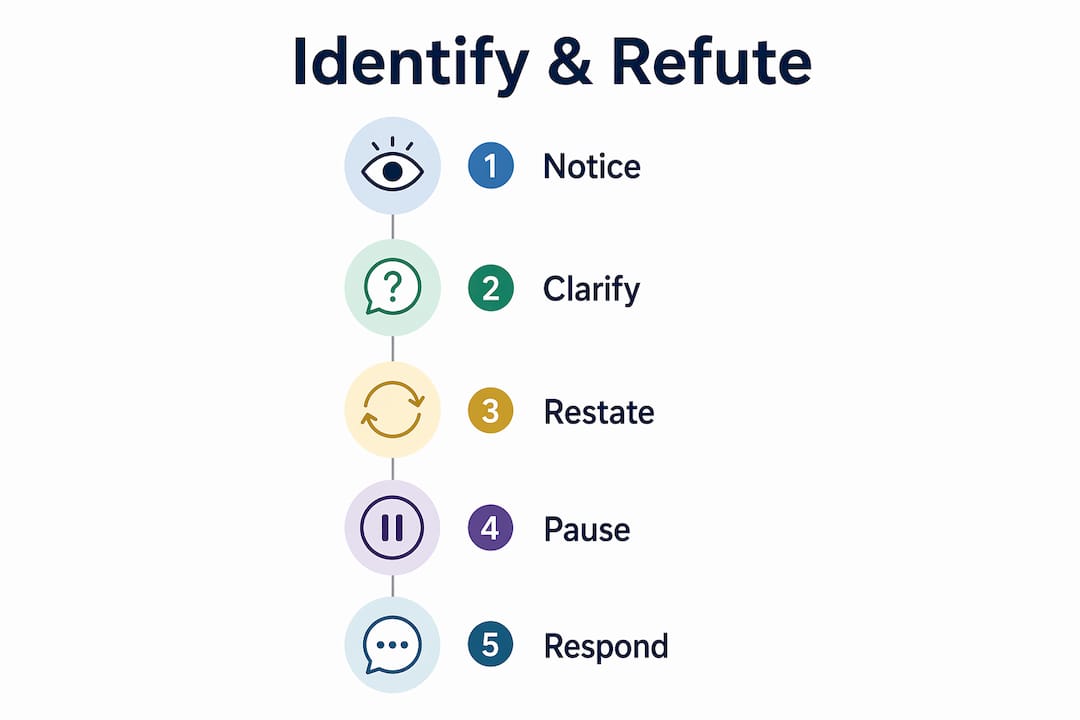
Pro Tip: Before responding to any argument, try restating it back to the speaker in your own words and asking “Is that what you meant?” This single question, as clarificatory questioning research confirms, reduces conflict and re-engages both parties with the actual issue.
Strawman fallacies do not always come from bad faith. Emotional reactivity can cause unintentional strawman fallacies, particularly when someone feels threatened or misunderstood. Recognising this matters because it changes how you respond. A deliberate strawman calls for a firm correction. An accidental one often calls for a clarifying question and a reset.
Pausing before you respond is underrated. When a conversation moves fast, the temptation is to react to what you think you heard. Slowing down and asking for clarification is not a sign of weakness. It is the foundation of honest argument.
What are effective ways to refute a strawman argument?
Refuting a strawman well requires calm, clarity, and a willingness to redirect the conversation without escalating it. The goal is not to win a point but to return the discussion to the real argument.
- Name the distortion directly. Say clearly: “That is not the position I took.” Do not apologise or soften it. State the correction as a fact.
- Restate your actual position. Follow the correction immediately with a clear, concise version of what you actually argued. Keep it short so it is easy to remember and hard to misrepresent again.
- Invite engagement with the real argument. Ask your opponent to respond specifically to your actual position. Phrases like “Can you address what I actually said?” redirect the conversation without aggression.
- Refuse to defend the distortion. Do not get drawn into arguing against the strawman version of your view. Calmly clarifying your original position and requiring opponents to address it specifically is the most effective counter available.
- Set a boundary if needed. If the distortion continues after correction, it is reasonable to say: “I am not going to continue this conversation if my position keeps being misrepresented.” This is not aggression. It is a reasonable standard for productive dialogue.
Real-world examples show this approach working in practice. In formal debates, competitors who calmly restate their position after a strawman attack consistently appear more credible to audiences than those who react with frustration. The audience notices who is engaging with the real argument and who is not. Staying grounded in your actual position is both the ethical and the tactically sound response.
For students preparing for academic debate or written essays, the same logic applies. When a marker or opponent misrepresents your thesis, the clearest response is always to restate the thesis precisely and ask for engagement with that specific claim. You can also read more about engaging in editorial debate online for practical techniques that transfer directly from written to spoken argument.
Key takeaways
The strawman fallacy is one of the most damaging tools in public discourse precisely because it is so easy to deploy and so difficult to correct once it takes hold.
| Point | Details |
|---|---|
| Core definition | A strawman argument replaces a real position with a weaker distortion to make it easier to attack. |
| Common forms | Exaggeration, slogan reduction, and the selection form are the most frequent types in political debate. |
| Harm to discourse | Strawmen deepen polarisation, prevent truth discovery, and leave audiences with false impressions. |
| Spotting the fallacy | Watch for absolutist language, sudden escalation, and trigger phrases like “So you’re saying…” |
| Refuting effectively | Name the distortion, restate your actual position, and require your opponent to address the real argument. |
The strawman problem is worse than most people realise
I have spent years reading and writing about political argument, and the strawman fallacy is the one I see most consistently misunderstood. People tend to think of it as a debating trick used by bad-faith actors. The reality is messier. Most strawmen I encounter are not deliberate. They come from people who genuinely believe they understood the other side, but whose emotional reaction to a threatening idea caused them to hear something more extreme than what was actually said.
That does not make the fallacy less harmful. It makes it harder to address, because the person committing it is often convinced they are being accurate. The principle of charity is the only reliable corrective I have found. When you commit to interpreting every argument in its strongest form before responding, you force yourself to engage with the real idea rather than the version your instincts constructed.
What concerns me most is how normalised strawman argumentation has become in political media. Audiences have been trained to expect it, and many now mistake it for rigorous debate. The long-term cost is a public that cannot distinguish between a real argument and a caricature of one. That is a serious problem for any democracy that depends on informed citizens making reasoned choices. Rebuilding that capacity starts with individuals who are willing to hold themselves to a higher standard, even when the people around them are not.
— John
Sharpen your critical thinking with Whitebunnywabbit
Recognising logical fallacies is a skill, and like any skill, it improves with practice and the right resources.
Whitebunnywabbit’s educational resources cover critical thinking, argument analysis, and the identification of fallacies including the strawman. Whether you are preparing for a debate, writing an essay, or simply trying to engage more honestly in political discussions, these resources give you the frameworks to think more clearly and argue more fairly. Good argument is not about winning. It is about getting closer to the truth.
FAQ
What is the strawman fallacy definition in simple terms?
A strawman fallacy occurs when someone misrepresents another person’s argument to make it easier to attack. The distorted version, not the real argument, is what gets refuted.
What are common examples of a strawman argument?
A classic example is responding to “We should review immigration policy” with “So you want to close the borders entirely.” The original position was about review, not closure.
How do you refute a strawman argument effectively?
Calmly clarify your actual position and ask your opponent to address that specific claim. Do not defend the distorted version they constructed.
How can you identify a strawman in a debate?
Watch for absolutist language such as “always” or “never,” sudden escalation of your position, and opening phrases like “So you’re saying…” These are reliable signals that a strawman is being constructed.
Is a strawman argument always intentional?
No. Emotional reactivity can cause unintentional strawman fallacies when someone mishears or overreacts to a threatening idea. Asking “Is that what you meant?” is the most effective way to correct an accidental strawman without escalating the conversation.
Leave a Reply