
Media bias is defined as the partial presentation and framing of information through selective sourcing, tone, and linguistic choices that skew how news is perceived. Understanding how media bias develops matters for students, policymakers, and anyone who reads the news regularly. A 2026 taxonomy identifies 38 distinct bias types operating at the sentence level, arranged into six functional families. That figure alone dismantles the common assumption that bias is simply a left-right political problem. Bias is structural, linguistic, and financial, and it shapes coverage regardless of an outlet’s stated political stance.
How media bias develops through structural and financial pressures
The most underappreciated driver of media bias is not a journalist’s personal politics. It is the institutional framework surrounding that journalist. Newsroom systems and editorial norms moderate the direct influence of personal political views on news content. A study combining content analysis and journalist surveys found only a weak correlation between individual ideology and how stories were framed or which parties received visibility.
Government advertising is one of the most concrete financial mechanisms shaping coverage. Outlets that receive disproportionate government advertising procurement adopt favourable tones toward incumbents and negative tones toward challengers. This is not the result of explicit editorial instruction. It is a systemic adjustment, where financial dependency quietly reshapes the editorial climate over time.

The indirect nature of this mechanism makes it particularly difficult to detect. No editor sends a memo saying “be kind to the government.” Instead, the outlet’s reliance on public-sector revenue creates a gravitational pull toward favourable framing. Research VP Rande Price has noted that editorial controls primarily filter bias, rendering personal journalist ideology less impactful on coverage integrity. The implication is clear: stronger editorial systems produce less biased output, not more virtuous individual journalists.
Key structural factors that shape bias include:
- Editorial autonomy: Journalists with less autonomy produce more constrained content, while those with greater independence can introduce more personal framing.
- Ownership concentration: When a single owner controls multiple outlets, editorial priorities align across properties without any explicit coordination.
- Revenue dependency: Outlets reliant on a single advertiser or government contract adjust their tone to protect that income stream.
- Newsroom culture: Professional norms around objectivity can suppress overt bias but also create blind spots around what counts as “neutral.”
Pro Tip: When assessing an outlet’s reliability, look up its ownership structure and primary advertisers. Financial relationships reveal more about potential bias than the outlet’s stated editorial mission.
What linguistic mechanisms reveal about bias in news language
Bias is conveyed mostly through subtle linguistic manoeuvres rather than broad ideological stances. The 2026 taxonomy categorises these into 38 elementary bias types, showing how word choice and framing affect perception independently of an outlet’s overall political alignment. This is the granular level where bias actually lives, and it is where readers are least equipped to spot it.
The distinction between commission and omission biases is critical here. Commission bias involves actively framing a story in a particular direction, such as describing a protest as “violent unrest” versus “civil demonstration.” Omission bias involves leaving out facts, sources, or context that would complicate the preferred narrative. Both operate at the sentence level, and both appear across the political spectrum.
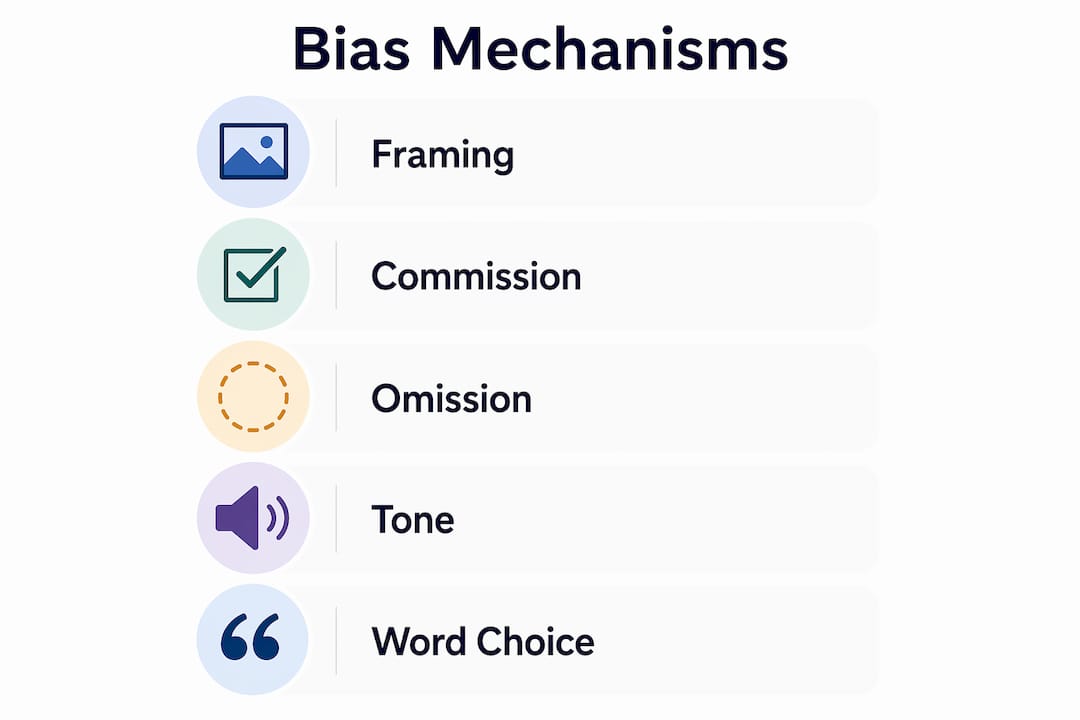
Understanding the news framing effect is central to recognising how these mechanisms work in practice. A single word choice, such as “migrant” versus “refugee,” carries entirely different emotional and political weight. Source selection compounds this further. Quoting only government officials in a story about government policy is a form of bias by omission, even if every quoted statement is accurate.
| Bias mechanism | How it operates | Example |
|---|---|---|
| Framing | Contextualises events to favour one interpretation | “Tax relief” vs “tax cuts for the wealthy” |
| Tone | Uses emotive language to colour factual reporting | “Claimed” vs “said” vs “confirmed” |
| Source selection | Chooses voices that reinforce a preferred narrative | Quoting only one side of a policy debate |
| Omission | Excludes facts that complicate the dominant angle | Ignoring contradictory data in a health story |
| Labelling | Applies loaded descriptors to people or groups | “Activist judge” vs “judge” |
These mechanisms do not require deliberate intent. Bias often emerges from the practical demands of condensing large information pools into coherent narratives. Editors and journalists make hundreds of micro-decisions per story, and each one carries the potential to tilt the final product.
Pro Tip: Read the same story across three outlets with different ownership structures. Note which sources each outlet quotes and which facts each one omits. The gaps between versions reveal more than any single article does.
What psychological factors amplify the effects of media bias?
Audience behaviour does not neutralise media bias. It frequently amplifies it. Readers self-select into ideologically consonant news environments, which means they encounter the same framing patterns repeatedly. Repeated exposure to partisan news intensifies political polarisation as consumers sort themselves into ideological niches, limiting trust across factions.
The persistence of these effects is striking. Even brief exposure to partisan media produces lasting attitude changes that endure beyond one week. That contradicts earlier assumptions about minimal media effects. The 2026 experimental evidence shows that persuasion accumulates with repeated exposure, meaning the daily habit of reading a single outlet compounds over months and years.
Correcting for known bias is harder than it sounds. Research by Jay C. Kao shows that audiences inadequately compensate for media bias even when they are aware of it. Knowing that an outlet leans in a particular direction does not reliably produce the mental adjustment needed to neutralise its influence. Slanted outlets amplify positive information about preferred factions and minimise unfavourable coverage, and readers absorb this filtered picture even when they are sceptical.
The psychological factors that make bias effects persistent include:
- Confirmation bias: Readers favour information that confirms existing beliefs, making ideologically aligned outlets feel more credible.
- Availability heuristic: Stories that receive heavy coverage feel more significant, regardless of their actual importance.
- Source credibility transfer: Trust in a familiar outlet transfers to the specific claims that outlet makes, bypassing critical evaluation.
- Partisan identity: News consumption becomes part of group identity, making it socially costly to switch to less ideologically aligned sources.
The role of partisan media in reinforcing these tendencies is well documented. The combination of audience self-selection and persistent persuasion effects creates a feedback loop that is difficult to break without deliberate effort.
How can readers recognise and reduce the impact of media bias?
Recognising bias requires specific habits, not just general scepticism. The following steps give readers a practical framework for evaluating news coverage critically.
- Check the source selection. Ask who is quoted and who is absent. A story about housing policy that quotes only landlords is incomplete by design.
- Examine the language. Words like “claimed,” “admitted,” or “insisted” carry implicit judgements. Neutral reporting uses “said.” Loaded language signals framing bias.
- Look for omissions. Search for the same story on outlets with different ownership. Facts that appear in one version and not another reveal editorial choices.
- Trace the financial relationships. Use public records to identify major advertisers and government contracts held by the outlet. Financial dependency shapes tone.
- Consult media watchdog organisations. Bodies that monitor journalistic standards provide independent assessments of outlet reliability and bias patterns.
- Diversify your sources deliberately. Reading outlets with different ownership structures and funding models reduces the cumulative effect of any single editorial perspective.
Avoiding common news consumption mistakes is as important as developing active reading skills. Passive consumption of a single outlet, even a high-quality one, creates blind spots. Media literacy is not a one-time achievement. It is a daily practice.
Key takeaways
Media bias develops through institutional structures, financial dependencies, and linguistic choices far more than through individual journalist ideology.
| Point | Details |
|---|---|
| Bias is structural, not just personal | Newsroom systems and editorial controls shape coverage more than individual political views. |
| Financial capture drives tone | Outlets receiving government advertising adopt favourable tones toward incumbents without explicit instruction. |
| 38 bias types exist at sentence level | Framing, tone, source selection, and omission all operate as distinct mechanisms within single sentences. |
| Partisan exposure has lasting effects | Even brief exposure to partisan media produces attitude changes lasting over one week. |
| Audiences cannot self-correct reliably | Knowing an outlet is biased does not reliably neutralise its influence on reader opinion. |
Why I think we are asking the wrong question about media bias
Most public debate about media bias focuses on which outlets lean left or right. That framing misses the point entirely. After following political journalism closely for years, I am convinced that the more important question is not “which way does this outlet lean?” but “what institutional pressures is this outlet responding to?”
The 2026 research on government advertising and editorial tone makes this concrete. An outlet does not need to be ideologically committed to a party to produce biased coverage. It simply needs to depend on that party’s advertising budget. The bias that results is just as real and just as persistent as any ideological commitment, but it is far harder to detect because it operates through tone and omission rather than overt argument.
The finding that editorial systems filter bias more effectively than individual virtue is, to me, the most practically useful insight in recent media research. It shifts the focus from blaming journalists to demanding better institutional structures. Strong editorial independence, transparent funding, and robust professional norms matter more than the political beliefs of any individual reporter.
The persistence of partisan media effects also troubles me. If a single week of exposure shifts political attitudes measurably, the cumulative effect of years of partisan consumption is enormous. Democratic discourse depends on citizens being able to update their views in response to evidence. A media environment that systematically filters evidence by faction undermines that capacity at scale. Structural safeguards and genuine media literacy education are not optional extras. They are prerequisites for informed democratic participation.
— John
Whitebunnywabbit’s resources on media literacy and political transparency
Understanding how bias shapes news coverage is the first step. Applying that understanding to real political reporting is where it becomes genuinely useful.
Whitebunnywabbit publishes analysis and commentary on political transparency, journalistic standards, and the principles that underpin free and fair reporting. The piece on journalistic education and standards examines why professional training and editorial accountability matter for news quality. The discussion of freedom of speech connects foundational democratic principles to the conditions that allow independent journalism to function. Both are worth reading alongside this article for a fuller picture of how media systems either protect or distort public understanding.
FAQ
What is media bias, exactly?
Media bias is the partial presentation of news through selective sourcing, framing, and tone rather than overt ideological declaration. A 2026 taxonomy identifies 38 distinct bias types operating at the sentence level across news platforms.
Does individual journalist ideology cause media bias?
Research shows only a weak correlation between individual journalist ideology and story framing. Newsroom systems and editorial controls shape coverage far more than personal political views.
How does government advertising create media bias?
Outlets receiving disproportionate government advertising adopt favourable tones toward incumbents to protect revenue. This adjustment happens without explicit editorial instruction, making it a systemic rather than deliberate form of bias.
Can readers correct for media bias once they know about it?
Awareness of bias does not reliably neutralise its effects. Research shows audiences inadequately compensate for known bias, leaving them vulnerable to the filtered narratives that slanted outlets produce.
How long do partisan media effects last?
Experimental evidence from 2026 shows that even brief exposure to partisan media produces attitude changes lasting over one week. Repeated exposure accumulates these effects and deepens political polarisation over time.
Leave a Reply