
Reporting presents verified facts in neutral language; commentary interprets those facts and argues from them. If you need to know what happened, look for sourcing, named witnesses, and a corrections policy. If you want someone’s take on what it means, look for labels like “Opinion,” “Commentary,” or “Op-Ed.” In the UK, bodies such as IPSO, Ofcom, and the BBC Editorial Guidelines set the standards that govern both, and knowing which applies tells you exactly what recourse you have when something looks wrong.
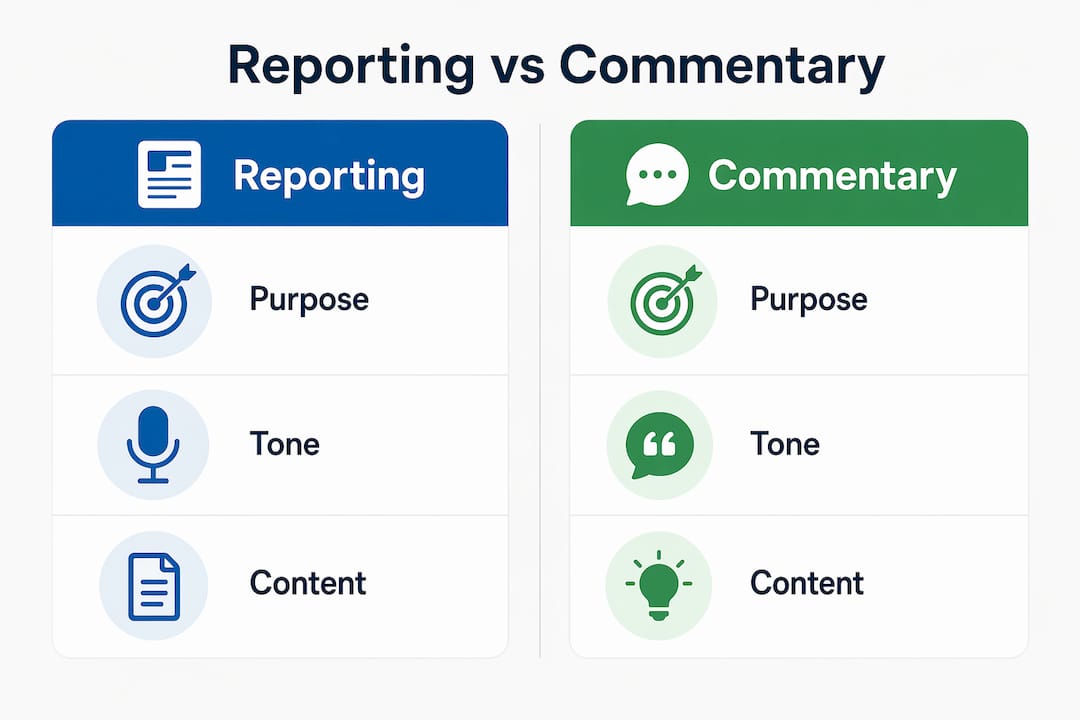
Table of Contents
- What is commentary vs reporting? Defining each clearly
- What commentary and opinion pieces are actually trying to do
- Analysis: the middle category you need to know about
- Reporting vs commentary: key differences at a glance
- How to spot reporting versus commentary in practice
- Why the distinction matters for trust and public life
- UK rules, labelling standards, and how to complain
- Key takeaways
- The view from Whitebunnywabbit
- Further reading and official sources
What is commentary vs reporting? Defining each clearly
News reporting has one job: tell you what happened, who was involved, when, and where, using verifiable facts and neutral language. Accuracy and objectivity are its governing principles, not persuasion. A straight news story attributes every claim to a named or clearly identified source, uses neutral verbs (“said,” “confirmed,” “denied”), and carries a timestamp. Wire stories, broadcast bulletins, and news items on a publication’s front page are the clearest examples.

The standards that govern reporting in the UK are concrete. IPSO’s Editors’ Code of Practice requires accuracy and a clear corrections policy. The BBC Editorial Guidelines demand impartiality and proper attribution. Ofcom’s Broadcasting Code applies to broadcast news, requiring due accuracy and due impartiality. These are not aspirational guidelines; they are enforceable rules with complaint mechanisms attached.
Concrete features that identify straight news reporting:
- Byline from a staff reporter or named news agency (Reuters, PA Media)
- Attribution verbs: “said,” “told reporters,” “confirmed in a statement”
- Named or clearly identified sources with their role stated
- Timestamp and dateline
- Corrections policy linked or referenced on the publication’s site
- Neutral, descriptive adjectives rather than evaluative ones
What commentary and opinion pieces are actually trying to do
Commentary’s purpose is to interpret, evaluate, and persuade. Where a news story tells you a bill passed Parliament, a column tells you why that matters, whether it is good policy, and what should happen next. Commentaries are designed to stimulate thinking and debate, placing an issue in context and offering insight or advocacy rather than neutral fact-telling.
Common formats include columns, op-eds, editorials, guest comment pieces, and pieces explicitly labelled “Commentary” or “Opinion.” The hallmarks are easy to spot once you know what to look for. Normative language is the giveaway: phrases like “I believe,” “we should,” “the government must,” or “this is wrong” signal that the writer is advancing a position, not reporting a fact. First-person voice and argumentative structure are standard. An editorial in a national newspaper arguing for a change in housing policy is a textbook example.
Hallmarks of commentary and opinion:
- Explicit labels: “Opinion,” “Commentary,” “Op-Ed,” “Editorial,” “Column”
- First-person voice or clearly attributed viewpoint
- Normative language: recommendations, judgments, calls to action
- Argumentative structure with a thesis and supporting reasoning
- Byline of a named columnist, editor, or guest contributor
One important caveat: the “safe harbour” principle does not give opinion writers a free pass on facts. Factual statements within a commentary remain subject to verification; a columnist who states a minister voted a particular way must get that fact right. Opinion allows rhetorical latitude on interpretation; it does not licence factual inaccuracy. For more on how opinion formats work in practice, Whitebunnywabbit’s guide on opinion journalism covers the conventions in detail.
Analysis: the middle category you need to know about
Analysis sits between reporting and commentary, and it is the category most often confused with both. Its purpose is to connect facts, explain mechanisms, and give context. Unlike commentary, it does not primarily aim to persuade. Unlike straight reporting, it goes beyond the who/what/when to explain why and how.
Analysis provides deeper context and interpretation grounded in evidence without necessarily advocating a position. A piece labelled “Analysis” might explain the economic forces behind a rise in energy prices, drawing on sourced data and expert comment, without telling you what the government should do about it. The verification standards sit closer to reporting than to opinion: claims still need sourcing, and the writer avoids direct advocacy language.
Look for the label “Analysis” or “Explainer” at the top of the piece. If the piece uses sourced evidence throughout but stops short of recommending a course of action, you are almost certainly reading analysis rather than commentary.
Reporting vs commentary: key differences at a glance
| Dimension | Reporting | Commentary |
|---|---|---|
| Purpose / goal | Inform; present verified facts | Interpret, evaluate, persuade |
| Typical language & tone | Neutral, descriptive, attribution verbs | Normative, argumentative, first-person |
| Evidence & sourcing | Named sources, documents, timestamps | Cited facts plus personal reasoning |
| Authorship & byline | Staff reporter or news agency | Named columnist, editor, or guest |
| Placement & labelling | Front page, news section, bulletin | Opinion section, “Op-Ed,” “Commentary” tab |
| Reader recourse | Request a correction for factual error | Submit a rebuttal or counter-opinion |
The single most reliable quick diagnostic is verifiability: reporting makes claims that a single objective fact can refute; commentary advances conclusions that depend on interpretation and cannot be disproven by one fact alone.
Quick checks to apply immediately:
- Is there an explicit label (“Opinion,” “Commentary,” “Analysis”)?
- Does the piece use “I believe” or “we should”? That is commentary.
- Are all factual claims attributed to a named source? That points to reporting.
- Is there a corrections link at the bottom? Publications apply corrections to reporting, not to opinion.
How to spot reporting versus commentary in practice
A practical checklist works better than abstract definitions when you are scanning a feed at speed.
- Check the label first. Look at the top of the page or the section tab. “Op-Ed,” “Opinion,” “Commentary,” and “Editorial” are explicit signals. If none appears, that does not automatically mean it is reporting.
- Read the byline. A staff reporter with a news-desk credit differs from a named columnist or a guest contributor identified by their organisation or affiliation.
- Scan for attribution. Reporting attributes every significant claim: “the Home Office said,” “according to court documents.” Commentary may cite facts but will also assert conclusions without attributing them to an external source.
- Look for normative language. Words like “should,” “must,” “failed,” “rightly,” and “wrongly” signal evaluation. A single evaluative adjective in a headline (“reckless budget”) is a strong indicator you are reading opinion or at least a piece with an editorial slant.
- Check for a corrections policy. Scroll to the footer or the publication’s “About” page. A visible corrections policy is a trust signal for reporting; its absence is worth noting.
- Ask the verifiability question. If no single fact could make the piece false, it is not straight news.
Worked examples. A headline reading “Chancellor’s budget will devastate working families” is commentary: “will devastate” is a prediction and a value judgment, not a reported fact. A headline reading “Chancellor announces £5bn cut to welfare spending” is reporting: the claim is verifiable against official documents. Trickier is the news story that ends with an opinionated paragraph from the reporter. That is a mixed piece; the factual paragraphs are subject to correction, but the final evaluative paragraph is closer to commentary and should ideally be labelled as such.
Reader recourse differs sharply. If a factual error appears in a news report, you can request a correction under the publication’s corrections policy or escalate to IPSO. If you disagree with a columnist’s argument, the appropriate response is a letter to the editor, a published rebuttal, or a counter-opinion piece. Demanding a “correction” to an opinion you simply disagree with will not succeed, because errors in reporting require corrections while disagreements with commentary require rebuttal.
Pro Tip: Watch the verbs. Reporting verbs attribute: “said,” “confirmed,” “denied.” Commentary verbs assert: “argues,” “believes,” “insists.” A piece built on attribution verbs is almost always reporting; a piece built on assertion verbs is almost always commentary.
Why the distinction matters for trust and public life
CP Scott, editor of the Manchester Guardian, put it plainly: “Comment is free, but facts are sacred.” That maxim, over a century old, remains the ethical spine of journalism. When the line blurs, the consequences are practical, not just philosophical.
Mislabelling commentary as reporting undermines public trust and weakens corrections culture. If readers cannot tell which content is subject to factual verification, they cannot know when to demand a correction and when to simply disagree. That confusion is exactly what misinformation tactics exploit: present an opinion as a reported fact, and it becomes much harder to challenge. The blending of opinion and reporting also reinforces echo chambers, because audiences who cannot separate the two tend to treat aligned opinion as confirmed fact.
Clear labelling, editorial separation between the news desk and the opinion desk, and a transparent corrections policy are the three structural remedies. Newsrooms are advised to label commentary clearly and separate opinion functions from the news desk to avoid confusing audiences. For readers, the practical implication is simple: check the label before you share.
UK rules, labelling standards, and how to complain
The UK has a layered regulatory framework that applies differently depending on the medium.
IPSO (Independent Press Standards Organisation) covers most national and regional newspapers and many online news publishers. Its Editors’ Code of Practice requires accuracy, clear corrections, and that opinion is distinguishable from fact. If a publication covered by IPSO publishes a factual inaccuracy in a news report, you can submit a formal complaint. IPSO’s complaint form is at ipso.co.uk.
Ofcom regulates broadcast news on television and radio. Its Broadcasting Code requires due accuracy and due impartiality. Complaints about broadcast news go to ofcom.org.uk. For context on how media watchdogs operate within this framework, Whitebunnywabbit’s guide on media watchdogs explains the landscape clearly.
BBC Editorial Guidelines govern all BBC output. The BBC has its own complaints process, and unresolved complaints can be escalated to the BBC Executive Complaints Unit and then to Ofcom. The guidelines explicitly require that opinion and analysis are clearly signalled and separated from factual reporting.
Labelling expectations under UK practice. Print publications place opinion on dedicated editorial pages. Online, look for section tabs (“Opinion,” “Comment,” “Analysis”), article-level labels at the top of the piece, and bylines that identify the writer as a columnist rather than a reporter. Practical labelling recommendations include displaying “Commentary” on broadcast and digital pieces and using bylines and section placement to signal opinion clearly.
Steps to take if you believe a factual error has been published:
- Note the publication date, URL, and the specific claim you believe is inaccurate
- Check whether the outlet is covered by IPSO, Ofcom, or the BBC complaints process
- Contact the publication’s corrections desk first; many errors are resolved at this stage
- If unresolved, submit a formal complaint to IPSO (for print/online) or Ofcom (for broadcast)
- Keep screenshots and records of all correspondence
For broadcast labelling and digital platform practices, resources such as Seeger Media offer useful context on how radio and digital outlets handle editorial separation.
Key takeaways
Reporting is verifiable and correctable; commentary is interpretive and contestable. Those two words are the whole distinction.
| Point | Details |
|---|---|
| Core definitional difference | Reporting presents verified facts; commentary interprets and argues from them. |
| Top quick check | Look for an explicit label (“Opinion,” “Commentary”) and normative language like “should” or “must.” |
| Verifiability test | Ask: could a single fact disprove this? If not, it is likely commentary, not reporting. |
| Reader recourse | Request a correction for factual errors in reporting; submit a rebuttal for disagreements with commentary. |
| UK complaint routes | IPSO covers most print and online news; Ofcom covers broadcast; the BBC has its own complaints process. |
The view from Whitebunnywabbit
The distinction between reporting and commentary is one I navigate every time a piece goes up on this site. Whitebunnywabbit publishes both news updates and opinion writing, and the discipline of keeping them separate is not just an editorial nicety. It is what makes either type of content worth reading.
The most useful habit I have developed is labelling before writing, not after. Deciding at the outset whether a piece is reporting a set of facts or arguing a position shapes every sentence that follows: the sources you seek, the verbs you choose, the conclusions you are entitled to draw. Readers deserve to know which mode they are in. When you land on an opinion page here, the label is there for a reason. If you want the underlying facts, follow the sourcing. If you want to push back on the argument, the comments and letters are the right place for that.
For anyone wanting to go deeper on the reporting side of this equation, Whitebunnywabbit’s piece on reporters and education is worth your time.
Further reading and official sources
Authoritative UK and international sources for anyone who wants to go further:
- IPSO — the UK’s independent press regulator; publishes the Editors’ Code of Practice and handles complaints against covered publications
- Ofcom — regulates broadcast news; Broadcasting Code sets accuracy and impartiality standards
- BBC Editorial Guidelines — detailed guidance on impartiality, accuracy, and the separation of opinion from reporting across all BBC output
- RTDNA guidance on labelling commentary — practical newsroom recommendations on how to label and separate commentary from news
- Poynter — US-based but internationally relevant journalism ethics resource covering reporting standards, fact-checking, and media literacy
- Whitebunnywabbit: how media bias develops — background on why labelling matters and how bias enters coverage
- Whitebunnywabbit: common news consumption mistakes — practical tips for readers on avoiding the conflation of opinion and reporting
For accessible guidance on reading digital news clearly, this piece on accessible reading materials is a useful companion resource on how clarity and labelling serve all readers.
This article is general information about journalism and media standards, not legal or regulatory advice. For your specific situation, consult the relevant regulator (IPSO or Ofcom) or a qualified media law professional.
Leave a Reply