
Ranked choice voting is a system where voters rank candidates in order of preference, so that counting can find a winner with broad support rather than just the most first-choice votes. In the UK, this idea appears in two main forms: the Alternative Vote (AV), used for single-winner contests, and the Single Transferable Vote (STV), used in multi-member constituencies. The Electoral Commission oversees elections where these systems apply, and the Electoral Reform Society has long campaigned for their wider adoption.
Where do these systems actually operate in the UK right now?
- AV is used in internal party elections and some organisational ballots, but not for any UK parliamentary or local government elections at present.
- STV elects local councillors across Scotland and members of the Northern Ireland Assembly.
- A national referendum on replacing First Past the Post (FPTP) with AV for Westminster elections was held in May 2011 and rejected by a large majority of voters.
Table of Contents
- How does ranked choice voting work in single-winner elections?
- How does STV work in multi-winner elections?
- Which ranked systems are used in the UK, and where?
- What are the main arguments for ranked choice voting?
- What are the main criticisms and limitations?
- How do you fill in a ranked ballot in the UK?
- How does ranked voting change party strategy and campaign behaviour?
- Key takeaways
- Why ranked voting deserves more honest debate than it usually gets
- Useful sources and further reading
How does ranked choice voting work in single-winner elections?
The single-winner version of ranked choice voting is known in the UK as the Alternative Vote (AV) and internationally as instant-runoff voting (IRV). The mechanics are straightforward once you walk through them step by step.
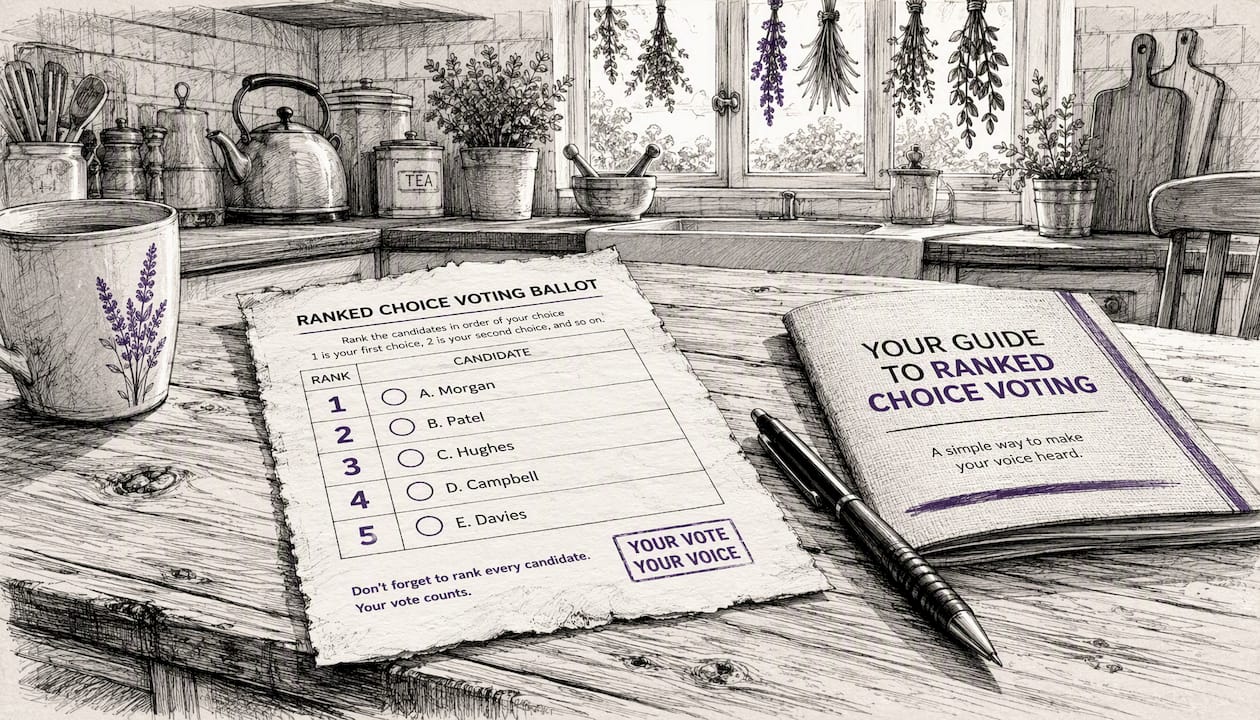
Marking the ballot
Voters write 1 next to their first choice, 2 next to their second, and so on. According to Electoral Reform Society guidance, you can rank as many or as few candidates as you like. Giving only a first preference is perfectly valid.
The counting process
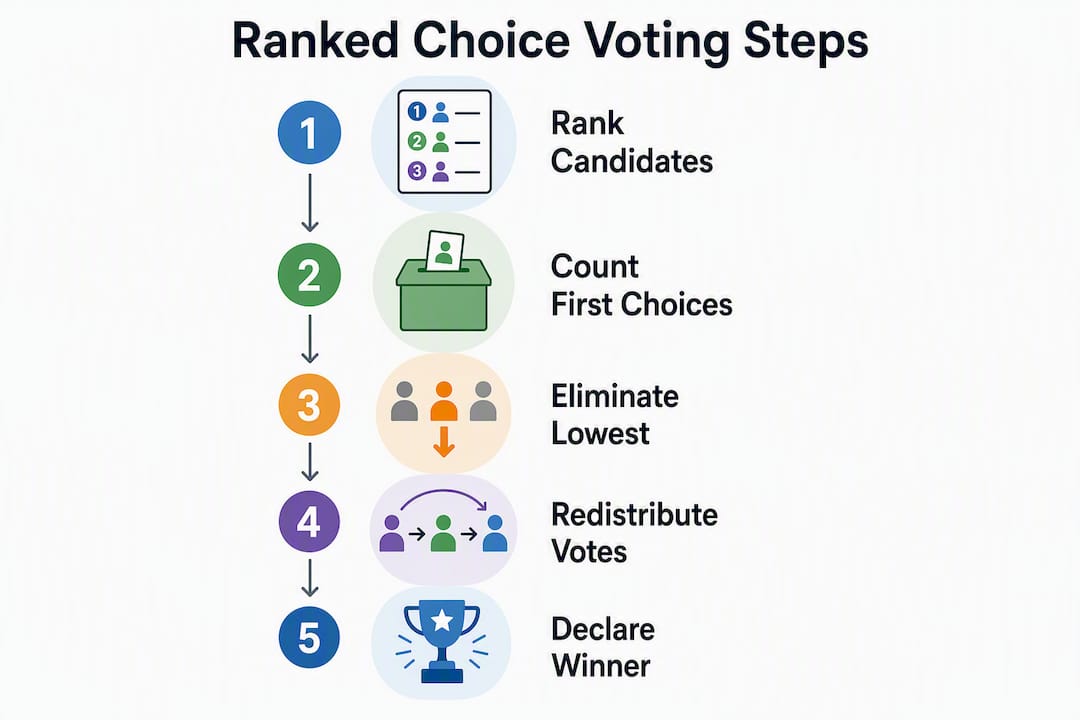
- All first preferences are counted.
- If any candidate holds more than 50% of first preferences, they win outright.
- If no one reaches that threshold, the candidate with the fewest votes is eliminated.
- Their ballots are redistributed to whichever remaining candidate each voter ranked next.
- Counting continues, round by round, until one candidate crosses the majority.
A worked example
Imagine a three-candidate contest with 100 votes cast:
| Round | Candidate A | Candidate B | Candidate C |
|---|---|---|---|
| Round 1 | — | — | 20 |
| After C eliminated | — + 12 = 57 | — + 8 = 43 | Eliminated |
Candidate C’s 20 votes split 12 to A and 8 to B. Candidate A reaches 57 and wins with a majority of the votes still in play.
Exhausted ballots
If a voter ranked only Candidate C and no one else, their ballot is set aside once C is eliminated. This is called an exhausted ballot. It reduces the total votes in play, which can lower the effective majority threshold in later rounds.
Pro Tip: If you do not want to give any preference to a candidate you strongly oppose, simply leave them off your ballot entirely. You will not spoil your vote by ranking fewer candidates than there are on the paper.
How does STV work in multi-winner elections?
Single Transferable Vote (STV) is the proportional cousin of AV. Where AV finds one majority winner, STV fills several seats in a way that reflects the overall spread of voter preferences. It is the system used to elect local councillors in Scotland and members of the Northern Ireland Assembly.
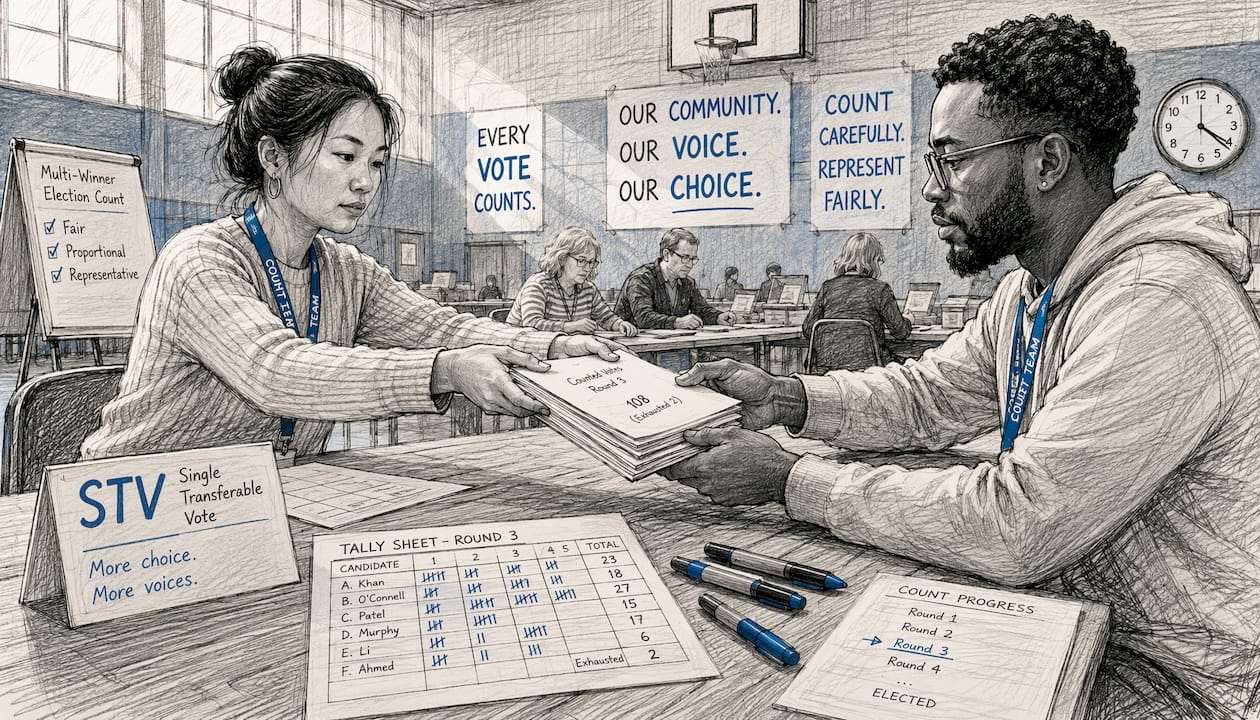
The Droop quota
The key calculation is the Droop quota:
With 100 valid ballots and 3 seats to fill, the quota is 25 (just over a quarter of votes cast). Any candidate who reaches 25 votes is elected immediately.
Surplus transfers
When a candidate exceeds the quota, their surplus votes are not wasted. They are redistributed to voters’ next preferences at a reduced value, so that no vote carries more weight than any other. If Candidate X wins with 40 votes against a quota of 25, the 15 surplus votes are transferred proportionally across the remaining candidates.
Elimination rounds
Once all surpluses are distributed, if seats remain unfilled, the candidate with the fewest votes is eliminated and their ballots transferred in full to next preferences. This alternation between surplus transfers and eliminations continues until all seats are filled.
| Stage | Action | Effect |
|---|---|---|
| Initial count | First preferences tallied | Candidates above quota elected |
| Surplus transfer | Excess votes redistributed at reduced value | Avoids wasting votes above quota |
| Elimination | Lowest candidate removed | Votes flow to next preferences |
| Repeat | Until all seats filled | Proportional outcome achieved |
The Electoral Reform Society notes that STV produces proportional results most reliably in constituencies returning four or more members. In smaller three-seat contests, larger parties can still gain a disproportionate advantage.
- STV is used for Northern Ireland Assembly elections and Scottish local government.
- Elsewhere, it elects parliaments in Ireland and Malta, and the Australian Senate.
- It cannot easily be run on the same day as X-mark elections, as Scotland discovered in 2007.
Which ranked systems are used in the UK, and where?
The UK uses several distinct ranked voting systems, each suited to a different electoral purpose. Understanding the differences matters because the system shapes the outcome.
Alternative Vote (AV) / Instant-runoff voting (IRV)
AV produces a single winner per constituency. It is identical to what the US calls instant-runoff voting and what Australia calls preferential voting. The UK Parliament’s own explainer describes the process as successive elimination until one candidate holds an absolute majority. AV is currently used for internal elections within several UK political parties and for some trade union and organisational ballots, but not for any public elections.
Single Transferable Vote (STV)
STV is the multi-winner system. The House of Commons Library briefing SN04458 draws a clear distinction: AV seeks a majority winner in a single seat; STV seeks proportional representation across multiple seats via quotas and transfers. STV has been used in Northern Ireland since the 1970s, introduced partly to address sectarian representation concerns, and in Scottish local government since 2007.
Supplementary Vote (SV)
SV is a simplified two-preference system, previously used for electing the Mayor of London and other directly elected mayors in England. Voters mark a first and second choice only. If no candidate wins a majority of first preferences, all but the top two are eliminated and second preferences from those ballots are redistributed. SV was replaced by FPTP for mayoral elections in England following the Elections Act 2022.
The 2011 AV referendum
The UK held a national referendum on 5 May 2011 on whether to replace FPTP with AV for Westminster elections. The proposal was rejected by approximately 68% of voters on a turnout of around 42%. The political debate around that vote illustrated how contested the case for change remained even among reformers.
What are the main arguments for ranked choice voting?
Supporters of ranked systems make several consistent arguments, most of which centre on legitimacy and incentives rather than raw efficiency.
- Majority support: Under AV, the winner must secure over 50% of votes still in play. The Electoral Reform Society argues this gives winners a stronger democratic mandate than a FPTP plurality.
- Fewer wasted votes: STV in particular reduces the number of votes that contribute nothing to the final result, because transfers mean most preferences eventually count towards someone’s election.
- Reduced spoiler effect: Voters can support a smaller party as their first preference without handing victory to their least preferred candidate. This weakens the “lesser evil” logic that drives tactical voting under FPTP.
- Broader campaign appeals: Candidates who need second and third preferences from rival supporters have an incentive to avoid the most divisive rhetoric. The Electoral Reform Society’s analysis of AV suggests this can soften campaign polarisation.
- Better representation under STV: In multi-member contests, STV tends to produce seat allocations that more closely reflect overall vote shares, giving smaller parties a fairer return.
One argument worth reading in full is the case made on Whitebunnywabbit’s own analysis of AV, which examines the constituency-level effects in some depth.
What are the main criticisms and limitations?
Ranked systems are not without genuine drawbacks, and the criticisms are worth taking seriously rather than dismissing as FPTP partisanship.
- Longer counts: Transferring votes across multiple rounds takes considerably more time than counting X-marks. Election administrators and the Institute for Government cite this as one of the main practical hurdles to wider adoption.
- Voter confusion and spoiled ballots: Some voters find numbered ranking less intuitive than a single X. Spoiled ballots tend to increase when a new system is introduced without adequate public education.
- Exhausted ballots reduce the majority: When many voters rank only one or two candidates, a large share of ballots drop out before the final round. The winner’s “majority” can then represent a smaller fraction of the original electorate than it appears.
- Tactical voting persists: The Institute for Government notes that ranked systems reduce but do not eliminate strategic behaviour. Parties may issue preference recommendations, form electoral pacts, or advise supporters to rank in a particular order to maximise seat gains.
- Complexity of STV counts: STV’s quota calculations and reduced-value surplus transfers require specialist software or trained counters. The first Scottish local elections under STV in 2007 produced some notably slow counts.
- Not always proportional: STV in small three-seat constituencies can still favour larger parties, as the LSE’s research on Scottish and Northern Irish elections has shown.
The trade-off, as Mark Pack’s evaluation of systems for the House of Commons argues, is that AV and STV produce different strategic outcomes and neither is a neutral technical fix.
How do you fill in a ranked ballot in the UK?
Marking a ranked ballot is simpler than the counting process behind it. Follow these steps and you are unlikely to go wrong.
- Read the ballot paper carefully. Check how many preferences the returning officer asks for. Some elections ask for up to five; others allow unlimited ranking.
- Write 1 next to your first choice. Use a pen or the pencil provided. Do not use ticks or crosses for ranked preferences.
- Write 2 next to your second choice, 3 next to your third, and so on, for as many candidates as you wish to rank.
- Do not give the same number to two candidates. If you write 2 next to two different names, both preferences may be disregarded from that point onwards.
- Leave candidates unranked if you prefer. You are not obliged to rank everyone. Stopping at your first preference is valid.
- Check your paper before submitting. A single clear number next to each ranked candidate is all that is required.
For postal ballots in STV elections (Northern Ireland Assembly, Scottish local council), the same rules apply. The returning officer’s instructions on the postal voting pack will specify the maximum number of preferences permitted.
Pro Tip: If you are voting in a Scottish council election or a Northern Ireland Assembly election, the Electoral Commission publishes a short voter guide specific to that election. Download it before polling day at electoralcommission.org.uk — it takes two minutes to read and removes any uncertainty about how many preferences to give.
How does ranked voting change party strategy and campaign behaviour?
Ranked systems do not just change how votes are counted. They change how parties campaign, how candidates present themselves, and how seats are ultimately distributed.
Under FPTP, a party’s core vote is usually enough to win a safe seat. Under AV or STV, winning second and third preferences from supporters of other parties can be the difference between victory and elimination. This creates a direct incentive to broaden appeal rather than simply energise a base.
- Softer rhetoric: Candidates who need transfers from rival voters have a reason to avoid attacking those voters’ first-choice parties too aggressively. This effect is more visible in STV contests, where multiple candidates from different parties compete in the same constituency.
- Electoral pacts and preference recommendations: Parties sometimes advise their supporters on how to rank other parties’ candidates. This is a form of strategic coordination that does not exist under FPTP and can effectively function as an informal coalition agreement before the votes are even cast.
- Multi-candidate party strategies under STV: In STV constituencies, a party must decide how many candidates to field. Running too few leaves votes on the table; running too many can split the party’s vote and cost it seats. This calculation shapes candidate selection in Northern Ireland and Scotland in ways that FPTP parties rarely face.
- Independent candidates benefit: Scottish local election data shows that independent councillors have survived and in some cases flourished under STV, because voters can support an independent first and a party second without feeling their vote is wasted.
The Institute for Government’s analysis is clear that strategic behaviour does not disappear under ranked systems; it adapts. Parties become more sophisticated about preference flows rather than less strategic overall. How rhetorical persuasion techniques shift under these incentives is a genuinely underexplored area of UK electoral research.
Key takeaways
Ranked choice voting gives voters more expressive power than a single X, but the system’s benefits depend heavily on which variant is used and how many seats are being contested.
| Point | Details |
|---|---|
| AV vs STV | AV finds a majority winner in one seat; STV fills multiple seats proportionally using a quota. |
| UK uses today | STV operates in Scottish local elections and Northern Ireland; AV is used in internal party ballots only. |
| 2011 referendum | The UK rejected replacing FPTP with AV by approximately 68% to 32% on a turnout of around 42% in May 2011. |
| Practical voting | Rank as many or as few candidates as you wish; never give the same number to two candidates. |
| Strategic effects | Ranked systems reduce but do not eliminate tactical voting; parties adapt through preference recommendations and pacts. |
For election-specific rules, consult the Electoral Commission or your local returning officer before polling day.
Why ranked voting deserves more honest debate than it usually gets
The conversation around ranked voting in the UK tends to collapse into two camps: reformers who treat AV or STV as an obvious improvement, and defenders of FPTP who treat any change as a threat to stable government. Neither position is particularly useful.
What the evidence actually shows is more nuanced. STV in Scotland and Northern Ireland has worked. Voters adapted faster than sceptics predicted, independent candidates have thrived, and the proportionality outcomes are genuinely better than FPTP would have produced. At the same time, the 2011 AV referendum was lost partly because the case for change was made poorly and partly because AV is a modest reform that satisfied neither committed proportionalists nor FPTP loyalists. Choosing a voting system is a political decision, not a technical one, and the choice between AV and STV reflects a prior choice about what elections are for: producing strong single-party governments or producing legislatures that reflect how people actually voted.
The administrative objections — slower counts, voter confusion — are real but solvable. Scotland solved them. Northern Ireland solved them. The harder question is whether the political will exists to have the argument honestly, rather than through the kind of referendum campaign that generated more heat than light in 2011. Readers who want to follow that debate closely will find Whitebunnywabbit’s ongoing political commentary a useful place to track how the arguments develop.
Useful sources and further reading
These are the most authoritative sources for anyone who wants to go deeper on ranked voting in the UK context.
- Electoral Reform Society: What is AV? — Clear mechanics of the Alternative Vote with arguments for and against; the best starting point for single-winner systems.
- Electoral Reform Society: What is STV? — Quota calculations, surplus transfers and UK use cases explained accessibly.
- House of Commons Library briefing SN04458 — Authoritative parliamentary briefing comparing AV and STV; useful for understanding the legal and constitutional context.
- UK Parliament: Voting systems in the UK — Official overview of all voting systems used across UK elections, including devolved contexts.
- Institute for Government: Electoral reform and the constitution — Rigorous analysis of strategic and constitutional implications; essential for understanding the limits of reform arguments.
- Mark Pack: Evaluating different electoral systems for the House of Commons — Detailed comparison of systems with honest assessment of trade-offs; particularly good on the political task of replacing FPTP.
- Electoral Commission — Official guidance on current elections, voter registration, and how to contact your local returning officer for election-specific rules.
This article provides general information about voting systems and is not legal or electoral advice. For rules that apply to a specific election, consult the Electoral Commission or your returning officer directly.
Leave a Reply