
Legislative gridlock is the persistent inability of a legislature to pass significant laws, typically measured as a falling ratio of enacted bills to the items on the government’s policy agenda. Put simply: Parliament keeps trying to legislate, and keeps failing. The House of Commons, the House of Lords, and the UK’s devolved legislatures can all contribute to or experience this condition, whether through bicameral conflict, coalition fragility, or sheer partisan deadlock.
Three quick UK illustrations:
- The 2010–2015 coalition government required constant negotiation between the Conservatives and Liberal Democrats before any major bill could advance.
- Between 2017 and 2019, the House of Commons defeated Theresa May’s Withdrawal Agreement three times, producing one of the most visible episodes of Brexit-era stalemate in modern British political history.
- The Northern Ireland Assembly has suspended operations on multiple occasions due to power-sharing breakdowns, leaving devolved governance in a prolonged state of legislative paralysis.
Gridlock matters because when a legislature cannot act, the status quo persists regardless of democratic mandates, public need, or electoral promises, and that gap between what voters expect and what government delivers corrodes trust over time.
Table of Contents
- What causes legislative gridlock?
- How do you spot and measure gridlock in practice?
- What are the real consequences of prolonged gridlock?
- How does gridlock look across different political systems?
- How can gridlock be reduced or resolved?
- UK case studies: gridlock in practice
- Gridlock versus deadlock, slow policymaking and government shutdown
- Key takeaways
- Why gridlock deserves more careful analysis than it usually gets
- Useful sources for further research
What causes legislative gridlock?
The causes split cleanly into two categories: structural features baked into the institutional design, and political dynamics that shift with each election or crisis.
Institutional causes
Bicameralism and veto points. The UK Parliament’s two-chamber structure means any bill must pass both the House of Commons and the House of Lords. The Lords can delay non-financial legislation for up to a year under the Parliament Acts 1911 and 1949, creating a formal veto point even when the Commons has a clear majority. Empirical analysis confirms that split chambers increase the likelihood of major legislative deadlock.
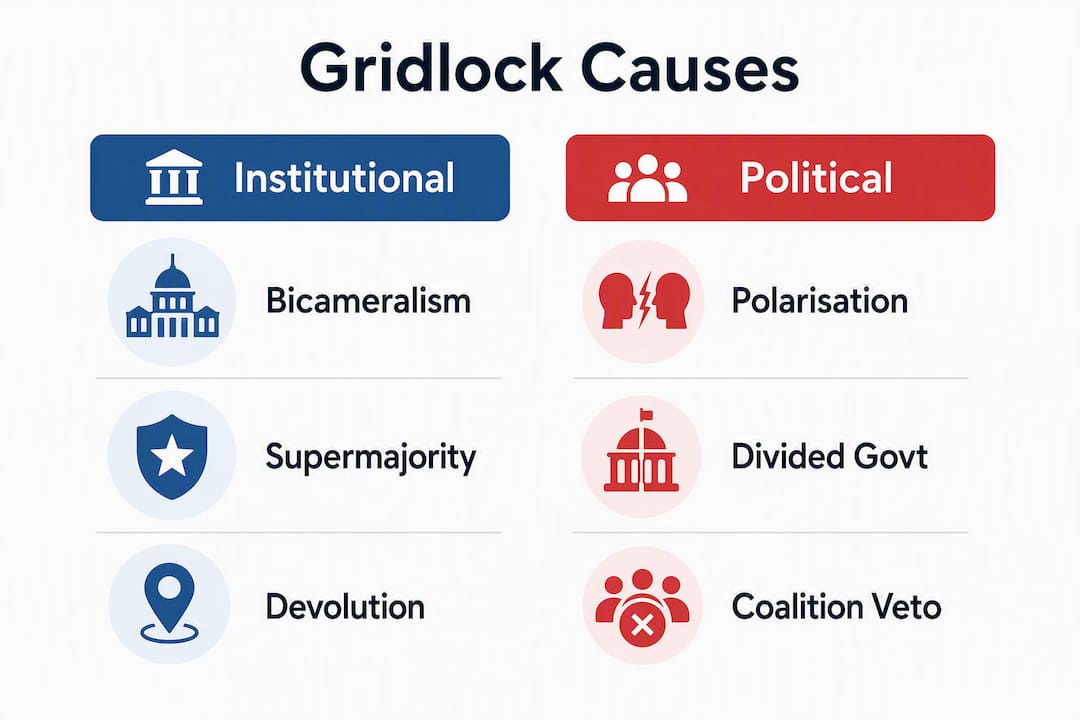
Supermajority and procedural rules. Some votes require more than a simple majority. In the US Senate, ending a filibuster historically requires a 60-vote supermajority. The UK equivalent is subtler: constitutional conventions, confidence motions, and programme orders can all slow or block legislation without a formal supermajority rule.
Devolved complexity. The Scottish Parliament, Senedd Cymru, and the Northern Ireland Assembly each hold devolved competences. When Westminster legislation touches those areas, the Sewel Convention requires a legislative consent motion, adding another potential veto point.
Political causes
Polarisation. When the ideological distance between parties widens, the range of policies that can attract majority support narrows. Theoretical models show that supermajority procedures combined with wide preference gaps make policy convergence difficult across many institutional settings, not just the US.
Divided or fragmented government. A hung parliament, where no single party commands a Commons majority, forces either a coalition or a confidence-and-supply arrangement. Both create multiple internal veto players. The 2010–2015 coalition is the clearest recent UK example.
Coalition fragmentation. The more parties in a governing arrangement, the more veto players exist. Each coalition partner can threaten to withdraw support, giving smaller parties disproportionate leverage over the legislative agenda.
Pro Tip: To diagnose which cause is dominant in a current impasse, check three things: the government’s legislative agenda (what bills were promised), the pivot points (which Lords amendments or backbench rebellions are blocking passage), and coalition cohesion measures (how often governing-party MPs vote against the whip). If agenda items are piling up unresolved, the cause is structural; if individual bills are being blocked by specific actors, it is a pivot-point problem.
How do you spot and measure gridlock in practice?
Observable signals come before any formal measurement. Watch for:
- A growing backlog of bills announced in the King’s Speech that have not received Royal Assent by the end of the session.
- Repeated government defeats in the Lords or Commons, especially on the same bill across multiple readings.
- Heavy reliance on statutory instruments and secondary legislation to implement policy that would normally require primary legislation.
- Long committee stages, repeated ping-pong between chambers, and bills carried over between parliamentary sessions.
For measurement, academic approaches that focus on salient agenda items rather than raw bill counts give a more accurate picture of deadlock. A government that passes 200 minor bills but fails on its ten flagship policies is more gridlocked than one that passes 80 bills, all of them substantive.
Practical indicator checklist
| Indicator | What to measure | Where to find the data |
|---|---|---|
| Agenda completion rate | Bills in King’s Speech vs. bills receiving Royal Assent | House of Commons Library, Parliament.uk bill tracker |
| Government defeats | Number of substantive defeats per session | Hansard, Institute for Government defeat tracker |
| Secondary legislation volume | Statutory instruments laid vs. primary bills passed | legislation.gov.uk, House of Commons Library |
| Ping-pong frequency | Number of times a bill passes between chambers | Hansard, Parliament.uk |
| Session carry-overs | Bills formally carried over to the next session | Parliament.uk bill tracker |
Hansard records every debate and vote verbatim. House of Commons Library briefings aggregate the data into readable summaries. The Institute for Government publishes regular analyses of government defeats and legislative productivity. Together, these three sources give any analyst or student a solid empirical foundation without needing specialist software.
What are the real consequences of prolonged gridlock?
Policy consequences
The most immediate effect is status quo persistence. When a legislature cannot pass new laws, existing policy remains in place regardless of whether it is working. Public services that need statutory reform, from social care funding to housing planning rules, simply stall. Governments under pressure often respond by reaching for statutory instruments and delegated powers, which allow ministers to change rules without full parliamentary scrutiny.
Institutional effects
Prolonged gridlock weakens the legislature’s agenda-setting authority. When the executive routinely bypasses primary legislation, Parliament’s role shifts from law-maker to occasional obstacle. That shift is gradual and rarely announced, but it accumulates. The greater the reliance on secondary legislation, the thinner the democratic record of debate and amendment that normally accompanies major policy change.
Democratic legitimacy
Scholarly analysis indicates that severe and lasting gridlock erodes public trust and the perceived responsiveness of government. When voters watch a parliament repeatedly fail to act on issues they consider urgent, the institution itself loses credibility, not just the governing party. How media narratives frame parliamentary impasses can amplify this effect, turning a temporary stalemate into a lasting story of institutional failure.
The feedback loop is worth noting: reduced trust makes voters more likely to support parties that campaign against the political establishment, which can increase polarisation, which in turn makes future gridlock more likely.
How does gridlock look across different political systems?
Presidential and semi-presidential systems
In presidential systems, the executive and legislature are elected separately and serve fixed terms. When they are controlled by opposing parties, gridlock is almost structurally guaranteed. There is no confidence mechanism to force an early election, no coalition negotiation to resolve the impasse. The US Congress is the most studied example, where checks and balances designed to prevent concentrated power can produce legislative standstill during periods of intense partisan disagreement.
Bicameral stalemate
Split chambers are a reliable gridlock engine. When the upper and lower houses are controlled by different parties or have fundamentally different compositions, every bill becomes a negotiation. The UK’s Lords is unelected and cannot be dissolved, which gives it a particular character: it can delay but not permanently block, yet that delay is enough to kill bills when parliamentary time is short.
Multiparty coalition deadlock
Fragmented parliaments with many parties produce coalition governments where each partner holds veto power. The Northern Ireland Assembly’s mandatory power-sharing model, which requires cross-community consent for major decisions, is the UK’s most structurally demanding example. When either the unionist or nationalist bloc withdraws, the Assembly cannot function.
Where the UK sits
The UK’s parliamentary system has built-in resolution mechanisms that presidential systems lack. A government that loses a confidence vote faces an election, which can break a deadlock by changing the composition of Parliament. The Fixed-term Parliaments Act 2011 temporarily complicated this by raising the threshold for early elections, and its repeal via the Dissolution and Calling of Parliament Act 2022 restored more flexibility. The UK also has the Parliament Acts as a backstop for Lords obstruction. These tools mean gridlock in the UK tends to resolve faster than in systems with fixed separation of powers, but the Brexit period showed they are not infallible.
| System type | Primary gridlock mechanism | UK equivalent | Resolution tool |
|---|---|---|---|
| Presidential | Executive–legislature split | N/A (parliamentary system) | Fixed-term elections only |
| Bicameral | Split chamber control | Lords vs. Commons conflict | Parliament Acts 1911/1949 |
| Coalition/multiparty | Internal veto players | 2010–15 coalition; NI Assembly | Coalition agreements; power-sharing rules |
| Devolved | Legislative consent disputes | Sewel Convention tensions | Intergovernmental negotiation |
How can gridlock be reduced or resolved?
Agenda control and timetable rules
Governments use programme motions to set strict timetables for each bill’s passage through the Commons. This limits the time available for obstruction and forces votes even when debate is unfinished. The trade-off is reduced scrutiny: bills passed under tight timetables sometimes contain errors that require later amendment.
Coalition-building and power-sharing bargains
The 2010 coalition agreement between the Conservatives and Liberal Democrats was a detailed written document that pre-negotiated the policy agenda, reducing the scope for internal vetoes on agreed items. The cost was a constrained agenda: both parties had to drop or dilute manifesto commitments.
Institutional reform
Changing the rules that create veto points can reduce gridlock structurally. Lords reform proposals have circulated for over a century. Reducing the Lords’ delaying power or changing its composition would alter the bicameral balance. The risk is that removing checks also removes the protection against hasty or poorly scrutinised legislation.
Secondary legislation and sunset clauses
Statutory instruments allow governments to act without primary legislation, but they receive minimal parliamentary scrutiny. Sunset clauses, which automatically expire a law after a set period unless Parliament actively renews it, are a partial safeguard: they force a review without requiring the government to introduce entirely new primary legislation.
Electoral change
Analyses consistently suggest that electorally driven shifts in the preferences of pivotal players are the primary mechanism that enables major policy change. Institutional tinkering rarely eliminates gridlock on its own; what breaks a genuine impasse is usually a change in who holds the pivotal votes. The 1997 and 2019 general elections both produced large Commons majorities that cleared legislative backlogs quickly.
A note of caution on bundling. Omnibus bills that package multiple policies together can seem like a way to build coalitions, but research shows they sometimes increase gridlock by giving legislators leverage incentives: a party may block an otherwise passable bill to use it as a bargaining chip in a larger package.
Practical checklist for political actors:
- Identify the specific veto point blocking progress before choosing a remedy.
- Use timetable motions for bills with broad support but procedural obstruction.
- Reserve secondary legislation for genuinely technical matters, not contested policy.
- Build coalition agreements in writing before a parliament sits, not during a crisis.
- Treat electoral strategy as the long-term solution when institutional fixes have been exhausted.
UK case studies: gridlock in practice
The 2010–2015 coalition government
After the 2010 general election produced a hung parliament, the Conservatives and Liberal Democrats formed the UK’s first peacetime coalition since the Second World War. The coalition agreement set out a shared programme, but the arrangement created constant internal negotiation. The Liberal Democrats blocked Conservative proposals on boundary reform and Lords reform; the Conservatives blocked Liberal Democrat proposals on electoral reform after the 2011 AV referendum failed. Legislative output was not catastrophically low, but the agenda was visibly constrained by the need to maintain two-party consent on every significant bill.
Brexit-era stalemate, 2017–2019
The 2017 general election left Theresa May’s government dependent on a confidence-and-supply arrangement with the Democratic Unionist Party. The House of Commons defeated her Withdrawal Agreement on 15 January 2019 by 432 votes to 202, the largest defeat for a sitting government in modern parliamentary history. It was defeated again on 12 March 2019 and a third time on 29 March 2019. Parliament simultaneously refused to agree on any alternative, producing a textbook case of legislative stalemate: the Commons could neither pass the government’s preferred policy nor coalesce around an alternative. Hansard records every vote in full; the House of Commons Library published detailed briefings on each defeat.
Northern Ireland Assembly power-sharing breakdowns
The Northern Ireland Assembly operates under mandatory cross-community power-sharing, requiring both unionist and nationalist representatives to participate for the executive to function. The Assembly has been suspended or non-functioning for significant periods: from 2002 to 2007, from January 2017 to January 2020 following the resignation of Sinn Féin ministers over the Renewable Heating Incentive scandal, and again from February 2022 to February 2024 when the Democratic Unionist Party withdrew over the Northern Ireland Protocol. During these periods, devolved legislation could not be passed and civil servants operated under caretaker arrangements. The Institute for Government has documented the governance consequences in detail.
Gridlock versus deadlock, slow policymaking and government shutdown
These terms are often used interchangeably, but they describe different conditions:
- Legislative gridlock is a persistent pattern in which a legislature repeatedly fails to pass significant laws across multiple issues and over time. The government continues to function; it simply cannot legislate effectively.
- Legislative deadlock is typically used for a specific impasse on a single bill or issue, rather than a systemic pattern. A parliament can be deadlocked on one bill while passing others freely.
- Slow policymaking is not gridlock. All legislatures take time; committee scrutiny, Lords amendments, and consultation are features, not failures. Gridlock is diagnosed by comparing output against the stated agenda, not by measuring how long a bill takes.
- Government shutdown is a distinct phenomenon, most associated with the United States, where Congress’s failure to pass appropriations legislation causes federal agencies to cease non-essential operations. The UK has no direct equivalent: the government can continue to spend under existing statutory authority even without a new budget, and a failure to pass legislation does not halt public services in the same way.
The key distinction to hold onto: gridlock preserves the status quo rather than causing institutional collapse. A gridlocked parliament is still sitting, still debating, still scrutinising. What it is not doing is changing the law.
Key takeaways
Legislative gridlock is a structural and political condition in which a legislature persistently fails to convert its agenda into law, with consequences for policy delivery, institutional authority, and public trust.
| Point | Details |
|---|---|
| Core definition | Gridlock is a falling ratio of enacted bills to the legislative agenda, not simply slow lawmaking. |
| Primary causes | Bicameralism, veto points, polarisation, and coalition fragmentation each create barriers to majority agreement. |
| UK measurement tools | Hansard, House of Commons Library briefings, and the Institute for Government provide the primary data for tracking defeats and agenda completion. |
| Realistic remedies | Electoral shifts that change pivotal actors tend to break gridlock more reliably than procedural reforms alone. |
| UK specifics | Parliamentary conventions, the Parliament Acts, and confidence mechanisms give the UK faster resolution tools than presidential systems, but they have limits. |
Why gridlock deserves more careful analysis than it usually gets
The standard media treatment of legislative gridlock frames it as pure dysfunction, a parliament failing to do its job. That framing is understandable but incomplete. Constitutional designs that prioritise checks and balances deliberately create the conditions under which gridlock can occur, because the alternative, a legislature that passes whatever the executive wants without friction, is its own kind of democratic failure.
The Brexit period is instructive here. The House of Commons between 2017 and 2019 was, by any measure, gridlocked. It was also, arguably, doing exactly what a legislature should do: refusing to endorse a policy that lacked genuine majority support, even under enormous executive pressure. Whether that was a feature or a bug depends entirely on your view of what Parliament is for.
What matters for students and engaged readers is developing the habit of distinguishing between gridlock as a symptom of polarisation, where the political system has genuinely broken down, and gridlock as a safeguard, where the legislature is correctly resisting a policy that lacks sufficient consensus. The role of partisan media in shaping opinion makes this distinction harder to draw in real time, because coverage tends to frame every impasse as crisis. The analytical tools in this guide, agenda completion rates, pivot-point analysis, defeat tracking, exist precisely to cut through that noise.
Useful sources for further research
For anyone going deeper on legislative gridlock, these are the sources worth bookmarking.
| Source | Best for |
|---|---|
| Hansard | Full verbatim records of every Commons and Lords debate and vote |
| House of Commons Library | Briefing papers, bill tracking, and aggregated defeat data |
| Institute for Government | Analysis of legislative productivity, government defeats, and constitutional change |
| Sarah Binder, “Stalemate” (JSTOR) | Academic framework for measuring deadlock using salient agenda items |
| Brookings: “Going Nowhere” | Comparative analysis of gridlock as a structural byproduct of checks and balances |
| Josh Chafetz, “The Phenomenology of Gridlock” | Legal and constitutional theory of gridlock; useful for advanced students |
| Annenberg Classroom: Gridlock | Accessible introductory definition; good starting point for students |
For data on bill counts and secondary legislation volumes, the House of Commons Library and legislation.gov.uk are the most reliable primary sources. For interpretation and contextual analysis, the Institute for Government and academic work by scholars such as Sarah Binder provide the strongest frameworks. Whitebunnywabbit’s own political coverage offers ongoing commentary on UK governance and parliamentary affairs for readers who want analysis alongside the raw data.
Leave a Reply