
False equivalence is defined as an informal logical fallacy that treats two unequal arguments or situations as equivalent based on superficial similarities, while ignoring critical differences in scale, context, or evidence. You encounter it in political debates, news coverage, and everyday arguments. Recognising it is one of the most practical skills in critical thinking. This guide explains the false equivalence fallacy, walks through clear examples, and gives you concrete tools to spot it wherever it appears.
What is false equivalence and how does it work?
False equivalence is an informal fallacy where the logical flaw centres on focusing only on one shared trait to assert that two things are equal, while ignoring every important difference between them. The result is a comparison that looks reasonable on the surface but collapses under scrutiny.
The mechanism is straightforward. Two subjects share one visible characteristic. A speaker uses that single similarity to claim they are equivalent. Everything else, including scale, context, intent, and consequence, gets quietly discarded. The audience is left with a distorted picture.

This matters because false equivalence does not just mislead in the moment. It flattens complex realities into inaccurate sameness, stripping away the context that rational decision-making depends on. When that context disappears, so does the quality of the argument.
The fallacy is also known by the related term “false balance,” particularly in media contexts. Both terms describe the same core problem, though they operate in slightly different settings. The distinction is worth understanding, and it is covered in detail below.
Common examples of false equivalence in media and everyday life
The clearest way to understand this fallacy is through examples. False equivalence examples explained properly reveal just how wide the gap between the two compared things actually is.
The oil spill comparison
Comparing the Deepwater Horizon oil spill with a neighbour accidentally spilling a pint of oil on their driveway is a textbook case. Both involve oil. Both involve spillage. That is where the similarity ends. One caused an environmental catastrophe affecting hundreds of miles of coastline. The other is a minor household incident. Treating them as equivalent because they share a surface trait is precisely how the fallacy operates.
Political false equivalence examples
Political discourse produces this fallacy constantly. A common pattern is comparing a politician who misspoke once in an interview with another who has a documented record of deliberate deception, and then presenting both as “equally dishonest.” The comparison ignores frequency, intent, and consequence. Readers who accept it uncritically walk away with a distorted sense of both figures.
Another pattern appears when a minor policy disagreement within one party is compared to a major constitutional crisis within another. The framing suggests both parties are “equally divided,” which obscures the actual difference in severity.
True equivalence vs false equivalence
The table below shows the difference between a genuine comparison and a false one.
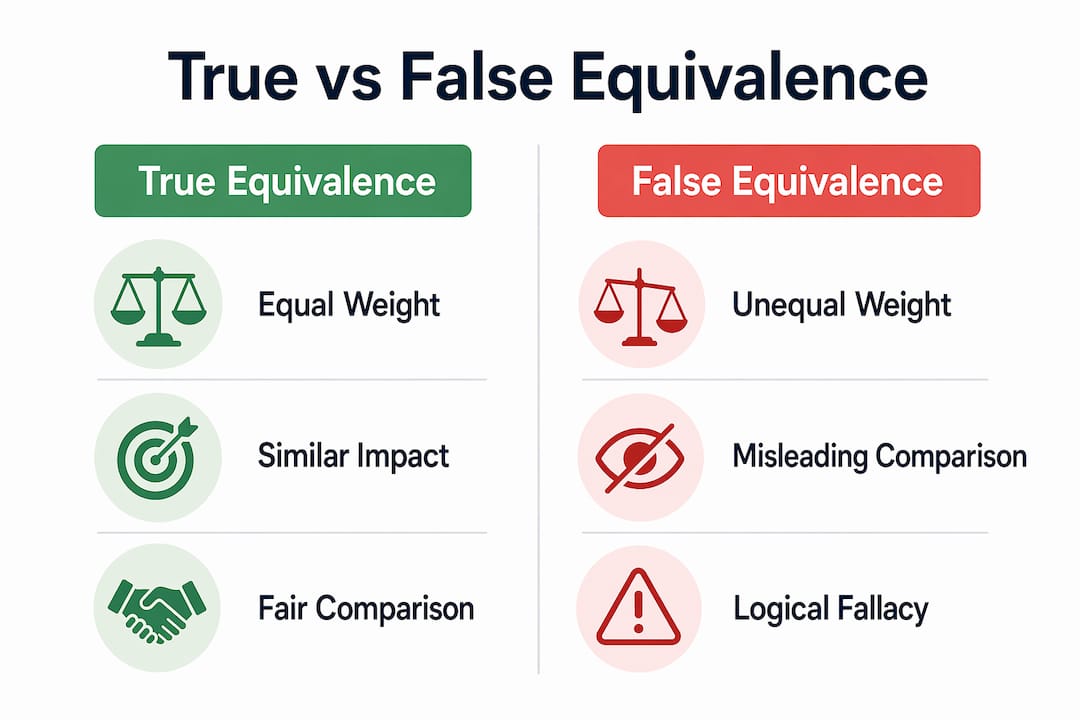
| Comparison type | Example | Why it holds or fails |
|---|---|---|
| True equivalence | Two drivers both caught speeding at the same speed | Same act, same context, same consequence |
| False equivalence | Jaywalking vs. armed robbery, both called “breaking the law” | Shared category, vastly different severity |
| True equivalence | Two countries both imposing trade tariffs of the same rate | Comparable action, comparable scale |
| False equivalence | A student missing one class vs. a student failing every exam, both called “struggling” | One shared label, entirely different situations |
The pattern is consistent. False equivalence borrows a shared label or category and uses it to imply equal weight, even when the underlying facts are incomparable.
Pro Tip: When you hear “both sides do it,” ask immediately: at what scale, with what frequency, and with what consequences? Those three questions cut through most false equivalence arguments in seconds.
How does false equivalence differ from false balance and factual relativism?
These three concepts are related but distinct. Conflating them leads to sloppy analysis, so the differences are worth pinning down precisely.
False balance in media means giving equal weight to viewpoints despite vastly disproportionate evidence. A broadcaster invites one climate scientist and one climate sceptic to debate, presenting both as equally credible. The audience infers a 50/50 scientific split that does not exist. False balance is essentially false equivalence applied to editorial decisions about airtime and representation.
Factual relativism asserts that all ideas have equal validity regardless of evidence. This goes further than false equivalence. It is not just one bad comparison. It is a worldview that rejects the idea that evidence can distinguish better from worse claims. Factual relativism is often used to normalise extremist views by placing them on the same footing as well-evidenced positions.
| Concept | Core claim | Typical setting | Example |
|---|---|---|---|
| False equivalence | Two unequal things are equivalent | Debate, argument, rhetoric | Comparing a minor scandal to a criminal conviction |
| False balance | Both sides deserve equal coverage | Journalism, broadcasting | Equal airtime for fringe science and consensus science |
| Factual relativism | All claims are equally valid | Philosophy, political rhetoric | “Your facts are just your opinion” |
Pro Tip: False balance is the editorial version of false equivalence. When you read a news article, check whether the sources quoted actually represent comparable levels of expertise and evidence, not just opposing viewpoints.
Why is false equivalence dangerous in politics and public discourse?
The real-world consequences of this fallacy are serious. False equivalence in media distorts audience perception and polarises opinion by implying equal merit for unequal views. That distortion does not stay contained to one article or one broadcast. It accumulates.
Giving equal platform to extremist and fact-supported views normalises false legitimacy and harms public understanding. When a fringe position receives the same editorial treatment as a well-evidenced one, audiences reasonably conclude the two are comparable. They are not, but the framing says otherwise.
“False equivalence obscures power dynamics in geopolitical contexts, misleading both policy and public discourse. When a powerful state and a far weaker one are presented as equally responsible for a conflict, the structural imbalance disappears from the conversation entirely. Policy built on that framing produces solutions that do not fit the actual problem.”
The specific harms include:
- Misinformation spread. Audiences who accept false equivalence arguments are more likely to share misleading political comparisons without questioning the underlying logic.
- Obscured power dynamics. When a large institution and an individual are framed as equally culpable, accountability disappears.
- Normalised extremism. Repeated false equivalence between mainstream and extremist positions gradually shifts what audiences consider acceptable.
- Polarisation. “Both sides are equally bad” framing discourages nuanced analysis and pushes audiences toward tribal thinking.
Frequent use of false equivalence by speakers often signals deliberate rhetorical manipulation. When you notice a pattern of these comparisons from the same source, that pattern itself is informative about the source’s credibility.
How to identify false equivalence in arguments and media
Spotting this fallacy requires a specific set of questions applied consistently. The following steps work in debates, news articles, and social media posts alike.
-
Identify the shared trait. What is the one thing the speaker says both subjects have in common? Name it explicitly. This is the hook the fallacy hangs on.
-
List the differences. Ask what the two subjects do not share. Consider scale, context, intent, frequency, and consequence. If the differences outweigh the similarity, you are likely looking at false equivalence.
-
Check the evidence on both sides. Ask whether both positions have comparable supporting evidence. A claim backed by peer-reviewed research is not equivalent to a claim backed by anecdote, even if both are presented as “one perspective.”
-
Assess the framing. Look at how the comparison is introduced. Phrases like “both sides,” “just as bad,” and “no different from” are common signals. They do not prove false equivalence, but they warrant closer inspection.
-
Use media literacy resources. Tools like the media narrative framework help you identify how stories are constructed and where false balance enters editorial decisions.
-
Ask who benefits. False equivalence rarely appears by accident in political or media contexts. Asking who gains from the comparison often reveals the rhetorical purpose behind it.
Pro Tip: Apply the “scale test” to any comparison you encounter. If you cannot describe both subjects using the same units of measurement, the comparison is almost certainly misleading. “Both are crimes” fails the scale test. “Both resulted in a £500 fine” passes it.
Key takeaways
False equivalence is an informal fallacy that distorts rational discourse by treating unequal arguments as equivalent, and recognising it requires examining scale, context, and evidence rather than accepting surface-level comparisons.
| Point | Details |
|---|---|
| Core definition | False equivalence treats unequal things as equal by focusing on one shared trait while ignoring critical differences. |
| False balance in media | Giving equal airtime to unequal positions misleads audiences about the actual weight of evidence on each side. |
| Factual relativism | Treating all claims as equally valid regardless of evidence is a more extreme form of the same fallacy. |
| Real-world danger | The fallacy obscures power dynamics, normalises extremism, and contributes to polarisation in public discourse. |
| Identification method | Apply the scale test: check evidence, context, and who benefits from the comparison before accepting it. |
Why I think false equivalence is the most underrated threat to clear thinking
I have spent years reading political coverage and watching debates, and the false equivalence fallacy appears more reliably than almost any other rhetorical trick. What makes it particularly insidious is that it feels fair. “Hearing both sides” sounds like good journalism. “Treating everyone equally” sounds like good ethics. The fallacy hides inside virtues.
The cases that stay with me are the geopolitical ones. When two parties in a conflict are presented as equally responsible, and one is a state with a military and the other is a civilian population, the framing does not just mislead. It actively prevents the audience from understanding what is happening. Policy built on false equivalence produces solutions that do not fit the actual problem.
What I find most useful is treating the fallacy as a signal rather than just an error. When a speaker or outlet consistently reaches for false equivalence, that pattern tells you something about their intent. It is rarely accidental. Recognising it as a rhetorical strategy, rather than a one-off mistake, changes how you engage with the source going forward.
My advice is simple: slow down when something feels artificially balanced. Real complexity rarely resolves into two equal sides. When it appears to, that is exactly the moment to ask harder questions.
— John
Thinking more clearly about media and politics
Whitebunnywabbit covers the kind of political and media analysis that puts these critical thinking tools to work on real stories. If the false equivalence fallacy has made you think harder about how news is framed and how arguments are constructed, the resources here go deeper.
The piece on reporters and education examines why journalists need a stronger grounding in logical reasoning to avoid perpetuating fallacies in their coverage. For readers who want to understand how misinformation spreads through exactly these kinds of distorted comparisons, that article is a direct next step. Whitebunnywabbit publishes commentary and analysis aimed at readers who want to think more clearly about the news they consume.
FAQ
What is the false equivalence fallacy in simple terms?
False equivalence is a logical fallacy where two unequal things are presented as equivalent because they share one superficial trait, while ignoring significant differences in scale, context, or evidence.
What is a clear example of false equivalence?
Comparing the Deepwater Horizon oil spill to a neighbour spilling a pint of oil is a classic example. Both involve oil spillage, but the scale and consequence are incomparable.
How does false equivalence differ from false balance?
False equivalence is a reasoning error in any argument. False balance is its editorial form, where media outlets give equal airtime to positions with vastly unequal evidential support.
Why is false equivalence common in political debate?
False equivalence is a useful rhetorical tool because it sounds fair. Presenting two unequal positions as equivalent deflects criticism and muddies accountability, which benefits speakers who want to avoid scrutiny.
How do I spot false equivalence in news articles?
Look for “both sides” framing, then check whether the two sides actually have comparable evidence, scale, and context. If one side’s position is supported by substantially more evidence, the comparison is likely false equivalence.
Leave a Reply