
Public intellectuals are mediators between specialised knowledge and the democratic public sphere. Their primary function is not to make policy or wield authority, but to mobilise information and arguments for public disputes without bypassing democratic deliberation. They give voice to unformed public impulses, helping citizens understand their encoded desires and see them represented in public life. What separates a genuine public intellectual from a pundit or partisan commentator comes down to a few things:
- They translate complex ideas without sacrificing rigour
- They foster critical and empathetic thinking rather than confirming existing biases
- They respect democratic equality, avoiding claims to personal authority
- They engage indirectly through media, lectures, and writing rather than direct policymaking
How public intellectuals shape democratic discourse
The clearest measure of their influence is not reach but quality of thought they introduce into public life. A public intellectual who elevates critical thinking shifts how citizens frame problems, not just which side they take. That distinction matters in practice: think of how a well-argued essay in a serious publication can reframe a policy debate that tabloid coverage had flattened into a binary.
Their methods include:
- Writing for general-audience publications, not just academic journals
- Appearing on radio, television, and podcasts to reach non-specialist audiences
- Hosting or participating in public lectures and panel discussions
- Using digital platforms to sustain longer, more nuanced arguments than social media typically allows
The risk is always partisanship. As Harvard essayist George Scialabba observed, public intellectuals are often partisan, sometimes rancidly so. The goal, though, is honest disagreement staged in public, not the elimination of conflict. Anastasia Berg of the University of California, Irvine, frames it well: the task is to show audiences how to disagree in ways that are “antagonistic and exciting and incisive” without condescension.
Pro Tip: When writing or speaking for a general audience, test your argument against the strongest opposing view first. If you can only articulate the weakest version of the other side, you are not yet ready to publish.
Key intellectual frameworks explaining their function
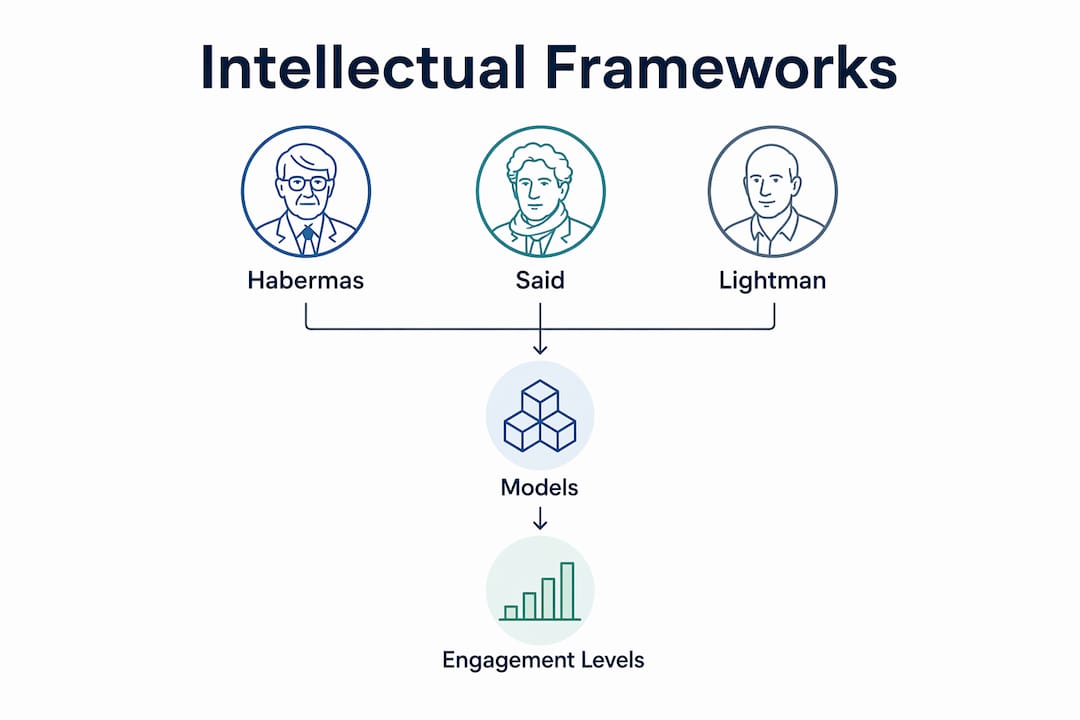
Three theoretical positions dominate serious discussion of what public intellectuals are actually for.
Jürgen Habermas: the indirect model
Habermas argues that the philosopher acting as a public intellectual is one citizen among many, with no special claim to authority. His model insists on renouncing authority and narcissism in public interventions. The philosopher who intervenes directly in politics, Hannah Arendt noted, stops being a philosopher and becomes a politician. Habermas’s mediated approach preserves scholarly objectivity while still allowing genuine influence.
Edward Said: the outsider within
Said’s framework positions the intellectual as someone who stands outside power structures to challenge the status quo while remaining embedded in society for relevance. The tension is deliberate. Too far outside and you lose the audience; too embedded and you lose the independence that makes your critique worth hearing.
Alan Lightman’s hierarchy
MIT’s Alan Lightman proposed three levels of public intellectual engagement. Level I involves explaining your discipline clearly to a general audience. Level II connects your discipline to broader social and cultural questions. Level III, by invitation only, sees the intellectual become a symbol representing an entire field or movement, carrying the greatest responsibility and the greatest risk of speaking beyond their expertise.
| Framework | Core task | Key constraint |
|---|---|---|
| Habermas (indirect model) | Mobilise arguments for public disputes | No direct policymaking; renounce authority |
| Said (outsider within) | Challenge power while remaining socially relevant | Balance independence with embeddedness |
| Lightman (Level I) | Explain discipline to general audiences | Accuracy and clarity over simplification |
| Lightman (Level II) | Connect discipline to social and cultural context | Avoid overreach beyond expertise |
| Lightman (Level III) | Represent entire fields or movements | Greatest responsibility; must acknowledge limits |
How UK public intellectuals have evolved
Britain has a long tradition of thinkers who crossed the line between academic life and public debate. John Stuart Mill wrote for popular newspapers while developing his political philosophy. George Orwell made the essay a weapon of democratic argument. Bertrand Russell moved from mathematical logic to nuclear disarmament campaigns, embodying Lightman’s Level III transition. More recently, figures such as Mary Beard brought classical scholarship into mainstream television and social media, and Amartya Sen connected economic theory to questions of justice and famine in ways that reached far beyond academic economics.
The institutional structures that supported this tradition have weakened. Small literary magazines, the kind that once sustained writers like Orwell between books, can no longer financially support independent voices. Urban gathering spaces where ideas were tested in public have thinned out. Many intellectuals have been absorbed into universities, where promotion depends on peer-reviewed output rather than public engagement. The result, as Scialabba put it, is “a narrowing horizon.”
How public intellectuals relate to media
Media is not just a distribution channel for public intellectuals. It shapes what they can say and how they say it. The column format, for instance, imposes a particular rhythm of argument: a provocation, a development, a resolution, all within roughly 800 words. Television demands a different compression. Each format produces a different kind of intellectual.
The relationship cuts both ways. Partisan media can amplify an intellectual’s reach while narrowing their independence, rewarding those who confirm the audience’s existing views. Media watchdogs play a role here, holding both journalists and the intellectuals who appear alongside them to standards of accuracy and fairness. The healthiest arrangement is one where the intellectual retains editorial independence from the outlet carrying their work, a condition that has become harder to maintain as advertising revenue has collapsed and outlets have grown more ideologically defined.
Methods for engaging diverse audiences
Reaching beyond a specialist readership requires deliberate choices about form and register. Code-switching is the term researchers now use for the practice of adjusting language, tone, and format to suit different platforms and audiences without losing the substance of the argument. A scholar who can write a peer-reviewed article, a long-form essay, a short podcast script, and a thread on a social platform is not dumbing down. They are translating.
Practical methods include:
- Writing op-eds that lead with the concrete stakes before the theoretical framework
- Using podcasts for longer arguments that social media cannot sustain
- Engaging directly with community organisations rather than waiting for audiences to find academic work
- Making research open-access so that paywalls do not restrict the conversation to elites
The social media commentary environment adds pressure to perform rather than argue. The intellectuals who navigate this best tend to treat each platform as a different room in the same conversation rather than a separate identity.
Key Takeaways
Public intellectuals serve democracy best when they prioritise rigour and honest disagreement over follower counts and partisan alignment.
| Point | Details |
|---|---|
| Indirect engagement | Habermas’s model keeps intellectuals influential without bypassing democratic deliberation. |
| Honest disagreement | The core task is safeguarding meaningful public disagreement, not amplifying popular opinion. |
| Code-switching | Translating complex ideas across formats is a skill, not a compromise of intellectual integrity. |
| Eroding structures | The loss of independent magazines and public spaces concentrates intellectual life in academia. |
| Whitebunnywabbit | Covers media literacy, political commentary, and democratic discourse for readers who want depth beyond the headlines. |
Why the digital age gets this wrong
The conventional wisdom holds that social media has democratised public intellectual life by giving anyone a platform. That is partly true and mostly misleading. Digital platforms pressure intellectuals to simplify complex ideas and compete on visibility metrics rather than argument quality. The result is that traditional credentials no longer guarantee influence, but neither does genuine intellectual rigour. What the algorithm rewards is emotional resonance and tribal confirmation.
The deeper problem is structural. The erosion of traditional support structures, small magazines, independent publishers, physical gathering spaces, has pushed intellectual life into academia and onto platforms that were not designed for sustained argument. What looks like a proliferation of public intellectuals is often a proliferation of commentators. The distinction is not snobbery. A commentator tells you what happened and what to think about it. A public intellectual gives you the tools to think for yourself.
The ethical responsibility that follows from this is clear: avoid building a personal brand at the expense of intellectual honesty. The impact of public intellectuals lies in the clarity and rigour they bring to public thought, not in their follower counts. That is a harder standard to meet than it sounds, especially when the incentive structures of every major platform point in the opposite direction.
Whitebunnywabbit covers the debates that matter
If you want to follow the arguments that public intellectuals are actually having, rather than the simplified versions that reach mainstream news, Whitebunnywabbit publishes commentary and analysis on the political and media questions that shape democratic life. The site covers media literacy and education, the mechanics of how opinion forms, and the relationship between journalism, commentary, and public argument.
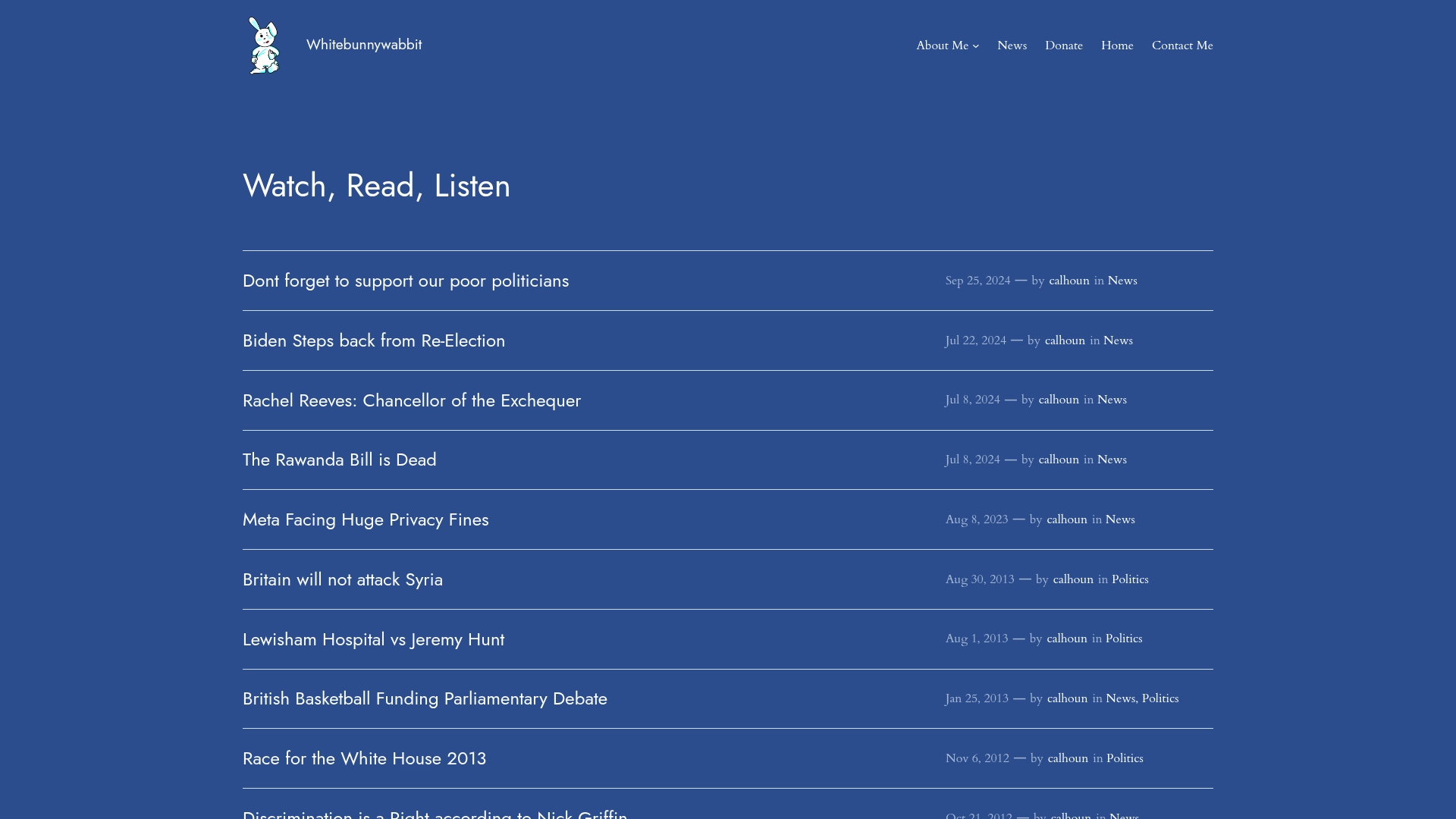
From pieces on how editorial debate works online to analysis of partisan media and echo chambers, Whitebunnywabbit offers the kind of sustained engagement with ideas that the social media feed rarely provides. For readers who take democratic discourse seriously, it is worth bookmarking.
Leave a Reply